I'm having issues with a BX1500, bought new in July: farting out on lower notes, sounds generally, "strangled". This has been through a plethora of speakers, and it even took a trip back to Carvin about a month & a half ago. They couldn't find anything wrong, and said they had tested it with a speaker on the bench. I'm hoping they can make me happy, somehow--this is the first new bass amp I'd bought in over 20 years.

Enjoy the benefits of a premium membership!
Upgrade Account
-
TalkBass has been independent since 1998. Add your voice.
Create a free account to reply to discussions, view embedded media, and browse with fewer display ads.
Join free Log in
Want zero display ads or expanded classifieds tools? Compare plans.
You are using an out of date browser. It may not display this or other websites correctly.
You should upgrade or use an alternative browser.
You should upgrade or use an alternative browser.
Carvin's BX1500 and B2000
- Thread starter vinxbass
- Start date
More options
Who Replied?
- Jan 17, 2002
- 1,249
- 23
- Disclosures
- I paid for all my gear myself. Well, me and MasterCard.
When you're doing the "deep tissue massage" routine with the ribbon connectors, remember that the input jack (lower left in that guts shot) connects to the preamp board via yet another ribbon cable. This is similar to the BX500 I've had issues with. That cable should also be hit with a dose of your favorite contact cleaner. You'll probably need to remove the preamp PC board from the front panel to get to every connector. Fortunately this doesn't take long if you have a couple of nutdrivers of the right size.
Carvin's latest amps sound great and are tremendous values, which makes these little issues with the ribbon cables all the more frustrating.
Carvin's latest amps sound great and are tremendous values, which makes these little issues with the ribbon cables all the more frustrating.

jnewmark the ribbon cables that I cleaned are the twisted black cables at the front of the amp near my legs in this pix. You simply pull them off the preamp and spray male and female with Deoxit. I did all three cables at the front of the unit (I'm assuming its called the preamp/equalizer board):
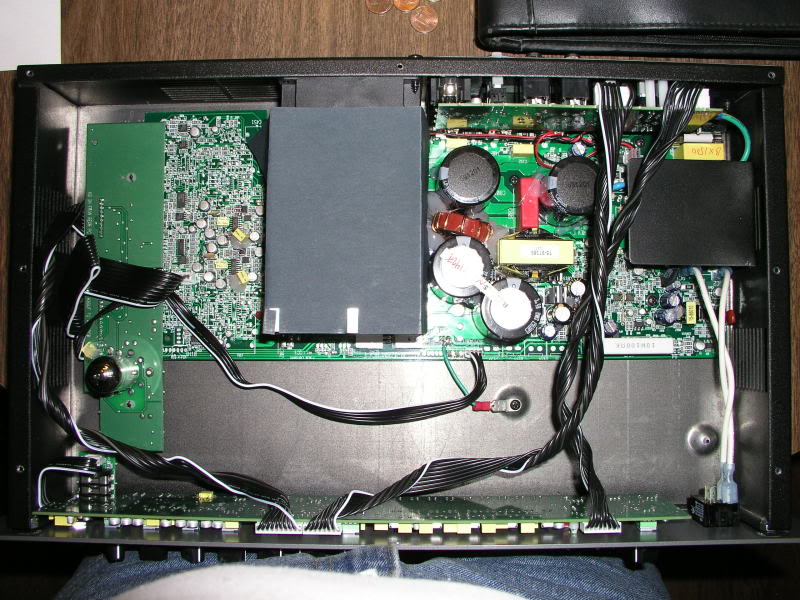
rtz...one month is a little soon to do this. I am surprised. My redline R600 needed this treatment after 8 years.
So, you are basically unpluging them from the front of the amp, and spraying the end where it connects ? I don't get the " male/female " thing. What do they look like ?
- Jan 17, 2002
- 1,249
- 23
- Disclosures
- I paid for all my gear myself. Well, me and MasterCard.
The "male" end is a row of pins sticking up from the printed circuit board. The female is what's attached to the ribbon cable proper.

So after cleaning the connectors with Deoxit my BX1500 seems to have, well, extra gain. Maybe the connectors over time were oxidizing slowly and I was losing gain something like shock absobers in a car wearing so slowly you dont notice it.
Last rehersal my drummer was asking me to please turn down he cant hear his kick drum. I had the amp on the same settings I always did but, he was right, the thing is just clean and loud now. Is anyone else discovering the same thing? Just curious.
Last rehersal my drummer was asking me to please turn down he cant hear his kick drum. I had the amp on the same settings I always did but, he was right, the thing is just clean and loud now. Is anyone else discovering the same thing? Just curious.

I still want to experiment with bypassing the preamp of my bx1500 and try driving the power amp section with a Tech 21 ParaDriver.
Since I want to bridge the amp, I assume the best way to do it is to use a "Y" cable so...
..............................Insert 1
Paradriver (pre) -<
..............................Insert 2
Correct?
Since I want to bridge the amp, I assume the best way to do it is to use a "Y" cable so...
..............................Insert 1
Paradriver (pre) -<
..............................Insert 2
Correct?

@Bassist
According to the manual, the inserts are designed to accept TRS (tip,ring,sleeve) type jacks. Since the "ring" is the return signal, you might have to modify a standard (Tip-Sleeve) instrument cable.
According to the manual, the inserts are designed to accept TRS (tip,ring,sleeve) type jacks. Since the "ring" is the return signal, you might have to modify a standard (Tip-Sleeve) instrument cable.
As I recall I tried that and didnt get much volume... it was awhile back though so I'll give her another try.
@Bassist
Using the effects RETURN should send the input signal to both amps.
From the manual: The RETURN jack is designed to receive signals from the output of an external effects processor.
When a signal is plugged into the RETURN, it breaks the connection between the preamp and the internal power amp. The RETURN signal goes through the GRAPHIC EQ (if active) and MASTER
controls to the power amp(s)."
Regarding BRIDGE mode: The BRIDGE switch on the back has to be engaged and you have to use the middle speaker out.
From the manual: "The AMP BRIDGE switch enables the full power of both amps in the BX1500 to be sent to the single
BRIDGE ONLY jack. The LED will illuminate to indicate BRIDGE mode.
Total minimum impedance is 4 ohms. DO NOT connect speakers to the SPK 1 or SPK 2 when in AMP BRIDGE mode. NOTE: In the AMP BRIDGE mode, the MASTER and POWER AMP1 controls adjust the output volume."
Hope this helps.
Using the effects RETURN should send the input signal to both amps.
From the manual: The RETURN jack is designed to receive signals from the output of an external effects processor.
When a signal is plugged into the RETURN, it breaks the connection between the preamp and the internal power amp. The RETURN signal goes through the GRAPHIC EQ (if active) and MASTER
controls to the power amp(s)."
Regarding BRIDGE mode: The BRIDGE switch on the back has to be engaged and you have to use the middle speaker out.
From the manual: "The AMP BRIDGE switch enables the full power of both amps in the BX1500 to be sent to the single
BRIDGE ONLY jack. The LED will illuminate to indicate BRIDGE mode.
Total minimum impedance is 4 ohms. DO NOT connect speakers to the SPK 1 or SPK 2 when in AMP BRIDGE mode. NOTE: In the AMP BRIDGE mode, the MASTER and POWER AMP1 controls adjust the output volume."
Hope this helps.
@Bassist
If you still want to use the inserts 1 and 2, you will have to switch the tip and the ring on the insert jacks (1 and 2) of your "Y" splitter but leave the TIP disconnected.
The reason for this is the Sansamp is sending the signal through the TIP while the BX1500 will be receiving the input signal from the RING.
PARA--TRS (no change)
---------------insert 1 (wire from TIP to RING, wire from RING taped)
---------------insert 2 (wire from TIP to RING, wire from RING taped)
If I'm wrong anyone please correct me on this.
Personally, I wouldn't go this route, the effect return loop is a whole lot easier.
If you still want to use the inserts 1 and 2, you will have to switch the tip and the ring on the insert jacks (1 and 2) of your "Y" splitter but leave the TIP disconnected.
The reason for this is the Sansamp is sending the signal through the TIP while the BX1500 will be receiving the input signal from the RING.
PARA--TRS (no change)
---------------insert 1 (wire from TIP to RING, wire from RING taped)
---------------insert 2 (wire from TIP to RING, wire from RING taped)
If I'm wrong anyone please correct me on this.
Personally, I wouldn't go this route, the effect return loop is a whole lot easier.
Thanks Darius!
As long as the effect Return loop method gives me the same amount of power as going directly into the poweramps, it seems to be the way to go.
As long as the effect Return loop method gives me the same amount of power as going directly into the poweramps, it seems to be the way to go.

I may be missing something, but it seems like you can just use 1 insert jack. The section of the BX1500 manual that talks about the inserts says, "When the X-OVER is OFF, both outputs receive the same full range signal." If this is true when not bridged, wouldn't it also apply when it is in bridge mode, thus eliminating the need to use both inserts?
I sometimes use an Ampeg SVP-Pro with my BX1500 using a Hosa YPP-117 stereo breakout cable into an insert jack using just the ring side. I found that I got some unwanted distortion through the effects return, which is why I started using the insert.
Edit: I see my error. I was equating "both outputs" with "both sides of the power amp."
I sometimes use an Ampeg SVP-Pro with my BX1500 using a Hosa YPP-117 stereo breakout cable into an insert jack using just the ring side. I found that I got some unwanted distortion through the effects return, which is why I started using the insert.
Edit: I see my error. I was equating "both outputs" with "both sides of the power amp."
I sometimes use an Ampeg SVP-Pro with my BX1500 using a Hosa YPP-117 stereo breakout cable into an insert jack using just the ring side. I found that I got some unwanted distortion through the effects return, which is why I started using the insert.
The HOSA YPP-117 has a stereo(TRS) male to two mono(TS) females, this should work just using the RING side.
PARA-->standard inst cable-->MONO(TS, RING side)female---stereo(TRS)male--->Carvin insert1 or 2.
Try it.
@Bassist
From the manual: The RETURN jack is designed to receive signals from the output of an external effects processor.
When a signal is plugged into the RETURN, it breaks the connection between the preamp and the internal power amp. The RETURN signal goes through the GRAPHIC EQ (if active) and MASTER
controls to the power amp(s).
Does anyone know if the compressor is also in play when the Return jack is used ? The manual states that the compressor is internally wired to the power amp.
- Jan 17, 2002
- 1,249
- 23
- Disclosures
- I paid for all my gear myself. Well, me and MasterCard.
There's an easy way to find out: Try it. Send an external signal (f'rinstance an MP3 player) through the Return jack, dial up some compression and see if the light comes on.


@BassmanPaul has both models! I have the BX1600. There are many BXers and B'ers lurking along on TB, keeping quiet, and waiting until one day we will all unite, strike a low B, and take out the power grid. We all have generators and a years supply of canned soup; we will be where we belong, at the top of the food chain!