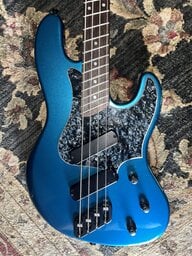
I bought a Rotosound RS66LE (heavy gauge) to get closer to Steve's tone and to get used to heavy gauge. it is similar to the SH77 (the G string was missing, so I had to put an Ernie Ball single G string( middle gauge))Most folks here know what “clank” tone is. I was working on getting a similar Steve Harris tone 20 years ago, and I’m sure there are other folks on TalkBass who have been working to achieve that same tone for even longer than that.
It’s possible your setup isn’t the most ideal for achieving the tone you’re looking for, which is why in previous threads folks were recommending you learn how to do a setup yourself. If you hold down your first fret and last fret to the fretboard, how much space is between the bottom of the string and the top of the 8th-10th frets? Do the strings touch the frets? They shouldn’t. Can you just barely squeeze a business card in there? That’s pretty decent. Can you fit a credit card or something thicker in there? Your setup probably isn’t ideal.
In addition, I remember you wanting to use higher gauge strings. While string gauge isn’t synonymous for string tension, a heavy gauge typically means higher string tension which can hinder your ability to achieve “clank” tone. Steve Harris uses thick, high tension flatwound strings. They work for him, but they did not work for me. I personally use light gauge round wounds, and I have no problem getting clank when I want to.
Your playing technique can play a huge role in the sound you’re getting. Playing through the string and towards the pickup will help. You might have to hit the strings harder than you normally would if the setup isn’t ideal.
How new and fresh the strings are also plays a role. I know you got new strings put on recently so that shouldn’t be an issue, but if you’re playing 5+ hours a day and aren’t playing with clean hands and wiping down the strings once you’re done playing then they will dull out a lot quicker. Keep in mind, Steve Harris puts new strings on before every show he plays, and I believe I once read he does the same for each track he records in the studio. He strings are very new and fresh, and that helps him get his tone. Unfortunately, most people don’t have that kind of money to spend.
Lastly, it’s possible you just need to practice more. It took me probably 3-4 years before I personally thought I was having consistent, good tone. It takes times to figure these things out, so don’t get discouraged.

Enjoy the benefits of a premium membership!
Upgrade Account
-
TalkBass has been independent since 1998. Add your voice.
Create a free account to reply to discussions, view embedded media, and browse with fewer display ads.
Join free Log in
Want zero display ads or expanded classifieds tools? Compare plans.
You are using an out of date browser. It may not display this or other websites correctly.
You should upgrade or use an alternative browser.
You should upgrade or use an alternative browser.
Clank effect
- Thread starter icarus88
- Start date
More options
Who Replied?A credit card fits easily into the first fret, as I said there is no way I can measure itMost folks here know what “clank” tone is. I was working on getting a similar Steve Harris tone 20 years ago, and I’m sure there are other folks on TalkBass who have been working to achieve that same tone for even longer than that.
It’s possible your setup isn’t the most ideal for achieving the tone you’re looking for, which is why in previous threads folks were recommending you learn how to do a setup yourself. If you hold down your first fret and last fret to the fretboard, how much space is between the bottom of the string and the top of the 8th-10th frets? Do the strings touch the frets? They shouldn’t. Can you just barely squeeze a business card in there? That’s pretty decent. Can you fit a credit card or something thicker in there? Your setup probably isn’t ideal.
In addition, I remember you wanting to use higher gauge strings. While string gauge isn’t synonymous for string tension, a heavy gauge typically means higher string tension which can hinder your ability to achieve “clank” tone. Steve Harris uses thick, high tension flatwound strings. They work for him, but they did not work for me. I personally use light gauge round wounds, and I have no problem getting clank when I want to.
Your playing technique can play a huge role in the sound you’re getting. Playing through the string and towards the pickup will help. You might have to hit the strings harder than you normally would if the setup isn’t ideal.
How new and fresh the strings are also plays a role. I know you got new strings put on recently so that shouldn’t be an issue, but if you’re playing 5+ hours a day and aren’t playing with clean hands and wiping down the strings once you’re done playing then they will dull out a lot quicker. Keep in mind, Steve Harris puts new strings on before every show he plays, and I believe I once read he does the same for each track he records in the studio. He strings are very new and fresh, and that helps him get his tone. Unfortunately, most people don’t have that kind of money to spend.
Lastly, it’s possible you just need to practice more. It took me probably 3-4 years before I personally thought I was having consistent, good tone. It takes times to figure these things out, so don’t get discouraged.


So here’s what you want to try:A credit card fits easily into the first fret, as I said there is no way I can measure it
Hold the E string down to the first fret as if your were fretting it normally with your left hand.
Using your right elbow, hold the E string down to the last fret as if you were fretting it with your elbow.
Now see if the credit card fits between the E string and the 8th-10th frets, while still fretting the 1st fret and having your elbow hold down the string at the last fret.
This isn’t an exact measurement, but it can help you get a sense of where you’re at. If the credit card easily fits between the E string and the 8th-10th frets while fretting the 1st and last fret then you likely want to tighten the truss rod. If the E string is already touching the 8th-10th frets before applying the credit card then your truss rod needs to be loosened. If the credit card barely fits between the string and the frets then your setup is likely pretty good and the truss rod doesn’t need further tweaking.
Hope this all makes sense. It’s a lot easier to show than to explain.
Bas gitarımın bazı resimleri
Attachments
-
 IMG-20240825-WA0000.jpg757.8 KB · Views: 8
 -
 IMG-20240825-WA0007.jpg695.3 KB · Views: 7
 -
 IMG-20240825-WA0006.jpg718.1 KB · Views: 8
 -
 IMG-20240825-WA0005.jpg692.2 KB · Views: 8
 -
 IMG-20240825-WA0004.jpg618.7 KB · Views: 6
 -
 IMG-20240825-WA0003.jpg361.8 KB · Views: 8
 -
 IMG-20240825-WA0002.jpg713.3 KB · Views: 7

You merely adopted The Clank. We have TB'ers on here who were there when The Clank was born, who literally wrote BOOKS on The Clank. How dare you accuse us of unfamiliarity with The Clank? You who cannot even find The Clank when it's literally at your fingertips?No one here knows what a clank tone is. I took it to a guitar shop, the guy lowered the action and adjusted the truss rod, but no, I still couldn't get that clank tone.

It’s hard to tell from photos, but to my eye it looks decent with maybe a slight forward bow to the neck (meaning the truss rod could be tightened a hair). I tend to run my basses with perfectly straight necks.Bas gitarımın bazı resimleri
The real question is how does it feel to you? Putting tone aside for a minute, is it easy to play the bass? Does your hand get tired after playing for awhile or can you play for as long as you want without getting tired?
I did what you said, the credit card goes in frets very easily, but the card stays on the fret (does not fall to the ground) and when I pull my elbow it fallsSo here’s what you want to try:
Hold the E string down to the first fret as if your were fretting it normally with your left hand.
Using your right elbow, hold the E string down to the last fret as if you were fretting it with your elbow.
Now see if the credit card fits between the E string and the 8th-10th frets, while still fretting the 1st fret and having your elbow hold down the string at the last fret.
This isn’t an exact measurement, but it can help you get a sense of where you’re at. If the credit card easily fits between the E string and the 8th-10th frets while fretting the 1st and last fret then you likely want to tighten the truss rod. If the E string is already touching the 8th-10th frets before applying the credit card then your truss rod needs to be loosened. If the credit card barely fits between the string and the frets then your setup is likely pretty good and the truss rod doesn’t need further tweaking.
Hope this all makes sense. It’s a lot easier to show than to explain.
I also noticed the bow on the neck, I ordered an Allen tool and will try lowering the action again, thank you all very muchIt’s hard to tell from photos, but to my eye it looks decent with maybe a slight forward bow to the neck (meaning the truss rod could be tightened a hair). I tend to run my basses with perfectly straight necks.
The real question is how does it feel to you? Putting tone aside for a minute, is it easy to play the bass? Does your hand get tired after playing for awhile or can you play for as long as you want without getting tired?
I play more comfortably, the strings gave my right hand fingers more feeling (it's hard to explain, it's like the fingers fit better on the strings)I gained more speed, I have more difficulty playing the thin strings fast with the right handIt’s hard to tell from photos, but to my eye it looks decent with maybe a slight forward bow to the neck (meaning the truss rod could be tightened a hair). I tend to run my basses with perfectly straight necks.
The real question is how does it feel to you? Putting tone aside for a minute, is it easy to play the bass? Does your hand get tired after playing for awhile or can you play for as long as you want without getting tired?
Here means where i live!!!You merely adopted The Clank. We have TB'ers on here who were there when The Clank was born, who literally wrote BOOKS on The Clank. How dare you accuse us of unfamiliarity with The Clank? You who cannot even find The Clank when it's literally at your fingertips?

I lowered the action of the Squier PJ, if I lower it even more I get fret buzzing, but the strings still don't hit the frets and the action still seems high, is the problem with the design?
Just geometry

I have my bass set up for clank and clean playing. So here are a few things that I found that get me there and the things to watch out for.
String tension is an important factor. Medium gauge is the heaviest you want to go for strings but not ultra light or the strings will buzz on the frets but not in a good way.
As everyone else mentioned low action and not too much relief. I have never used any sort of measuring device to set this, I just fret at the 1st and the 17th on the string and eyeball it. It gets me roughly where I need it and then I just make small adjustments to what feels good to me. If the frets near the nut buzz with the string height low near the neck pocket, you don’t have enough relief.
Check fret leveling near the 12th fret and higher, if frets are not proper level there you won’t be able to lower the action enough to get the clank and not have nasty buzzing.
Last as others have pointed out technique is an important factor, figuring out how to play with a lighter touch when wanting to play clean and how to strike the strings just right when wanting to clank.
I going to make an assumption and say you might need to have some fret leveling done to your neck. Sometimes the Squier necks come out of the factory with good fret leveling and other times they need a little work.
I just replaced the neck on my modified Squier Jaguar PJ because I had a pretty bad hump around the 13th to 14th frets and there wasn’t really enough fret wire left to have it leveled properly.
Good Luck.
Edit: I understand what it’s like trying to have a local guitar shop trying to set up a bass by a guitar player. Some of them only dabble playing bass and they just don’t get that playing techniques between bass and guitar are very different. They usually set up the action way to high to compensate playing with a pick, even when you tell them ahead of time that you primarily use a 2 finger pluck technique with a lighter touch.
String tension is an important factor. Medium gauge is the heaviest you want to go for strings but not ultra light or the strings will buzz on the frets but not in a good way.
As everyone else mentioned low action and not too much relief. I have never used any sort of measuring device to set this, I just fret at the 1st and the 17th on the string and eyeball it. It gets me roughly where I need it and then I just make small adjustments to what feels good to me. If the frets near the nut buzz with the string height low near the neck pocket, you don’t have enough relief.
Check fret leveling near the 12th fret and higher, if frets are not proper level there you won’t be able to lower the action enough to get the clank and not have nasty buzzing.
Last as others have pointed out technique is an important factor, figuring out how to play with a lighter touch when wanting to play clean and how to strike the strings just right when wanting to clank.
I going to make an assumption and say you might need to have some fret leveling done to your neck. Sometimes the Squier necks come out of the factory with good fret leveling and other times they need a little work.
I just replaced the neck on my modified Squier Jaguar PJ because I had a pretty bad hump around the 13th to 14th frets and there wasn’t really enough fret wire left to have it leveled properly.
Good Luck.
Edit: I understand what it’s like trying to have a local guitar shop trying to set up a bass by a guitar player. Some of them only dabble playing bass and they just don’t get that playing techniques between bass and guitar are very different. They usually set up the action way to high to compensate playing with a pick, even when you tell them ahead of time that you primarily use a 2 finger pluck technique with a lighter touch.
Last edited:
I think the design of the guitar is also important here (they don't use Fender P bass for nothing, right?) I plucked harder (I already play towards the pickup, I can show you my right hand technique if you want) No, there is still no string hitting the fret. I examined it carefully.I have my bass set up for clank and clean playing. So here are a few things that I found that get me there and the things to watch out for.
String tension is an important factor. Medium gauge is the heaviest you want to go for strings but not ultra light or the strings will buzz on the frets but not in a good way.
As everyone else mentioned low action and not too much relief. I have never used any sort of measuring device to set this, I just fret at the 1st and the 17th on the string and eyeball it. It gets me roughly where I need it and then I just make small adjustments to what feels good to me. If the frets near the nut buzz with the string height low near the neck pocket, you don’t have enough relief.
Check fret leveling near the 12th fret and higher, if frets are not proper level there you won’t be able to lower the action enough to get the clank and not have nasty buzzing.
Last as others have pointed out technique is an important factor, figuring out how to play with a lighter touch when wanting to play clean and how to strike the strings just right when wanting to clank.
I going to make an assumption and say you might need to have some fret leveling done to your neck. Sometimes the Squier necks come out of the factory with good fret leveling and other times they need a little work.
I just replaced the neck on my modified Squier Jaguar PJ because I had a pretty bad hump around the 13th to 14th frets and there wasn’t really enough fret wire left to have it leveled properly.
Good Luck.
I pluck/hammer whatever you want to call it between the p and j pickups. It seems to allow me to get more aggressive but reduce the amount of flopping around the strings do. If I pluck over the P or above it I have to really pluck much less aggressively or the low action on my strings start to buzz.

Here means where i live!!!
#1. Steve Harris uses flat wound strings, not rounds. That makes a big difference. https://www.sweetwater.com/store/de...ature-monel-flatwound-long-scale-bass-strings
#2. Bring a recording of the sound you're looking for to your local tech. There are plenty of examples of Steve playing alone throughout the Maiden catalog.
Some of us were playing Iron Maiden when Clive Burr was still in the band, playing stuff like "Running Free".

It’s technique. The string will hit the fret when you make it hit the fret & won’t hit the fret until you make it, regardless of the setup. The setup makes it easier or harder for the player to make it happen, but it’s the player that has to make it happen either way.I think the design of the guitar is also important here (they don't use Fender P bass for nothing, right?) I plucked harder (I already play towards the pickup, I can show you my right hand technique if you want) No, there is still no string hitting the fret. I examined it carefully.

Learn how to setup your bass. Plenty of Youtube videos. Capo for holding strings on the 1st fret. Allen wrenches for the truss rod and bridge. You can do itI lowered the action of the Squier PJ, if I lower it even more I get fret buzzing, but the strings still don't hit the frets and the action still seems high, is the problem with the design?

maybe some super slinky strings, play with aggression, turn up treble. Are you using pick or fingers...? I would learn the basics of setup and intonation.
I like low action i usually straighten the neck out flat, tune up to key EADG, then check it at the 12th fret..They gotta be the same pitch at that fret. If sharp or flat, then you adjust bridge saddles and keep checking till open strings EADG and 12th fret on each string match..it sounds confusing to some but after a few times you be doing it without a prob...Get a cheap guitar setup kit while your at it...good luck!
I like low action i usually straighten the neck out flat, tune up to key EADG, then check it at the 12th fret..They gotta be the same pitch at that fret. If sharp or flat, then you adjust bridge saddles and keep checking till open strings EADG and 12th fret on each string match..it sounds confusing to some but after a few times you be doing it without a prob...Get a cheap guitar setup kit while your at it...good luck!
Last edited: