What amp does not have an input gain control?To have an input pad is nice when you get the occasional super hot bass. I got a G&L L2000 that has got to be the hotest bass on the planet. It will overdrive an amp that doesn't have a pad.

TalkBass has been independent since 1998. Add your voice.
Create a free account to reply to discussions, view embedded media, and browse with fewer display ads.
Join free Log in
Want zero display ads or expanded classifieds tools? Compare plans.
What amp does not have an input gain control?To have an input pad is nice when you get the occasional super hot bass. I got a G&L L2000 that has got to be the hotest bass on the planet. It will overdrive an amp that doesn't have a pad.
Well, I believe you then. Just not sure why one L-2000 is so much hotter than the other. Maybe you can lower the pickups?I'm am sure. I own two L2000 basses one is not an issue one is absolutely unusable with any of my amps that dont have a pad.
..and he certainly has a volume control as well on that bass.What amp does not have an input gain control?

I own an SM-400S and to me the SWR heads in that era offered a different voicing in a similar kind of way that GK was SS different from the Ampeg and Fender tube heads. I keep my old SWR less as a daily driver and more of a nostalgia piece that can still hold its own tone-wise against more heads.Great thread lots of cool amps mentioned. After so many mentioned the SWR stuff I found a deal locally for a vintage SM400 that looks real clean. Guy says it has some scratchy spots. Hopefully I can square those away myself. Planning on running it Bridged into an 8 ohm GK CX-210.

I make no representation or promise that this documentation is 100% correct, but someone like agedhorse could tell you if it is authentic and accurate. He has direct experience with SWR from his Fender days (perhaps earleir) and serviced my SM-400S a few years back.100 bucks is a steal for that. Congrats
This always merits mentioning:
From the SWR SM-400 manual in the section on chassis heat:
"The only condition you should be aware of is if one or more of the power amplifiers in your unit becomes "over biased." This condition can be recognized by turning your amplifier on and letting it sit without speakers plugged in and without playing it. If, under these conditions, your unit becomes quite warm, it may be over biased. This situation should be attended to and can be easily remedied in about 15 minutes by a service tech. A power amp can become over biased through continuous vibration or by any large jolt received in shipping, etc. "

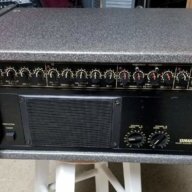
So I picked this up this morning. Its in excellent condition, needs a little cleaning.
I paid 100 Bucks with the rack. Rack appears to be a fairly nice custom build 4 space with what looks like a grey duratex type finish.


Why is Class AB a requirement? As for simple, that concerns the pre-amp section not the class of the power amp. AB amps require more cooling than Class D so typically a bigger, noisier cooling fan.
Why is Class AB a requirement? As for simple, that concerns the pre-amp section not the class of the power amp. AB amps require more cooling than Class D so typically a bigger, noisier cooling fan.
While it's fun to dream and perhaps even a healthy thing to do now and then, correctly assessing market viability, being abel to build quality at a target price point, getting a new design through testing and certifications, etc. is not as much fun as one might imagine.I've thought about hiring someone to build me an amp design of my choosing. I take care of all the costs and they create my design. Even wondered if such an amp would be a viable piece in the market though it sure is crowded. It seems there's more builders than players these days. Not sure in the coming days there will be as many looks like we fixin to have a depression.
Probably true in many cases, but the higher heat loads inherent in less efficient class AB designs might require moving more air as part of the thermal management aproach - a bigger fan(s) moving more air could be noisier. As always though there are a lot of variables. With enough heat sink area and perhaps clever venting to create enough convective airflow, a totally passive thermal management approach (like many older Peavey procucts for example) is certainly possible.not really a fan is a fan.
It's great to have the skills, time, and tools/equipment to build your own custom tailored head, but for many of us that's just not in the cards...we're stuck "buying off the rack"!Basically what im doing building a amp nobody builds.
Meaning eliminating pretty much every " fancy" unneeded feature