• TalkBass has been independent since 1998. Add your voice.
    Create a free account to reply to discussions, view embedded media, and browse with fewer display ads.
    Join freeLog in
    Want zero display ads or expanded classifieds tools? Compare plans.

Classical drop-D extension focused build

Glad I could help. Gorgeous work as always.

That looks realy awesome all complete. Another successful build!

That looks great - I like the way your designs are consistent throughout - headstock, body shape, pickups etc. Nice job.

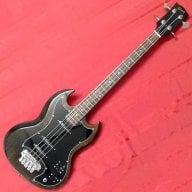
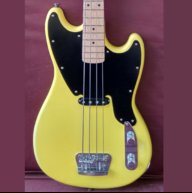
:) Thanks guys! They are consistent in a few ways but they all sound different, which is pu placement and the inherent difference between a big single, a single HB'r, and 2 (hot) singles as the electronics are identical. (except for the switching on the newest one) The black one (8lbs/1oz) has a reconfigured '65 Teisco Del Rey mahogany body and the other two are my basswood clones. (white/black one - 7lbs/11oz and the newest at 7lbs/4oz) All are 1-1/4" thick.
 
  • Like
Reactions: ICM
I love the more aggressive upper horn bevel. I also love the rest of it, but that much should be obvious by now.

:) Thanks! Yah, each body so far came out slightly different and I did go farther with all the bevels including the rear one on the newest. I have more ideas for the next one, nothing completely different but just a bit more sculpting.
 
I think I worded my comment incorrectly, I meant to say that each of your basses are true to a style, not that ALL of your basses are the same.

No, I understood that Jisch - variations on a theme :) I was further extrapolating on the sound differences. :bassist:
 
  • Like
Reactions: Beej and Jisch
Also looks like the pickup type and placement approaches Ric style, but the "bridge" PU is more like a P location. Can't wait to hear a demo!

It's funny because as it's 32" scale it is ballpark relative compared to a 34" scale bass, but adding the central pu was the right direction. The bass really woke up with the 'bridge' pu, which is a bit hotter. I guess I could reverse them as is more typical of a 2 pu bass, but I personally favor the bridge pu in general so I like it that way. The neck-hugger rounds it out nicely. I feel it was why so many 70's Fender Tele basses (with the neck-hugger HB) were modded to have a second mid-to-lower position bridge pu. Big phat boom-boom-boom only goes so far... November is looking more open so my aim will be to attempt demo's of all the Del Rey inspired basses. They are all similar but different in character and it'll be fun to record and hear the differences.
 
  • Like
Reactions: BassHappy
Here's how Phil Kubicki did it - (my fretless Factorbird currently has BEAD strings)

capo on
fullsizeoutput_d7f.jpeg

capo off - recesses into fb and is fretted over the capo
fullsizeoutput_d80.jpeg

lever, spring, bolt, plate
fullsizeoutput_d81.jpeg

cast metal
fullsizeoutput_d82.jpeg

recess into ebony hs
fullsizeoutput_d83.jpeg

plate
fullsizeoutput_d84.jpeg

spring in lever
fullsizeoutput_d85.jpeg
 
This is my only 100% Kubicki remnant I still own (bass of the capo detail pics) - I ordered the lined fretless neck from Phil in '94 and the tuner-bridge was from the black FCS Factor that was missing pu's & pre. (which I turned into a hybrid bass w/a Jazz neck, sold many years ago) It has G&L L-2000 pu's and pre and the body is Koa. Both this one and the "J-Factor" are included on the "The Kubicki Factor" Facebook page.

fullsizeoutput_d86.jpeg
 
Last edited:
This is my only 100% Kubicki remnant I still own (bass of the capo detail pics) - I ordered the lined fretless neck from Phil in '94 and the tuner-bridge was from the black FCS Factor that was missing pu's & pre. (which I turned into a hybrid bass w/a Jazz neck, sold many years ago) It has G&L L-2000 pu's and pre and the body is Koa. Both this one and the "J-Factor" are included on the "The Kubicki Factor" Facebook page.

View attachment 2789531
Exceptional!
 
  • Like
Reactions: JIO
Here's how Phil Kubicki did it - (my fretless Factorbird currently has BEAD strings)

capo on
View attachment 2788754
capo off - recesses into fb and is fretted over the capo
View attachment 2788755
lever, spring, bolt, plate
View attachment 2788756
cast metal
View attachment 2788758
recess into ebony hs
View attachment 2788759
plate
View attachment 2788760
spring in lever
View attachment 2788763
Thanks for the detail pics. i've always wondered exactly how Kubicki worked it out.

It raises a question: as far as the small dog of the lever, that projects towards the body, and the recess in the circular plate that it fits into -- this would prevent excessive upward (counter-clockwise) movement of the arm. Do you have a feel for why this was necessary? I would have thought that the spring force would increase enough with raising the lever that people would just not over crank it. Is it just a belt-and-suspenders thing, or am I missing something?
 
Thanks for the detail pics. i've always wondered exactly how Kubicki worked it out.

It raises a question: as far as the small dog of the lever, that projects towards the body, and the recess in the circular plate that it fits into -- this would prevent excessive upward (counter-clockwise) movement of the arm. Do you have a feel for why this was necessary? I would have thought that the spring force would increase enough with raising the lever that people would just not over crank it. Is it just a belt-and-suspenders thing, or am I missing something?

It's merely a stop. It stops the lever raised at 1/2" above the string/fb. Somewhat overkill, but w/o it someone might pull it higher and distort the spring so it wouldn't have enough downward force to capo the string. The sign of a well thought-out design.
 
Here's how Phil Kubicki did it - (my fretless Factorbird currently has BEAD strings)

capo on
View attachment 2788754
capo off - recesses into fb and is fretted over the capo
View attachment 2788755
lever, spring, bolt, plate
View attachment 2788756
cast metal
View attachment 2788758
recess into ebony hs
View attachment 2788759
plate
View attachment 2788760
spring in lever
View attachment 2788763

The more I learn about Philip Kubicki, the more I realise how the rest of us are just paddling around in the shallow end! What a legend. :)
 
Hi. I'm Warren from New Zealand and I've just joined this group. I found this thread because I am looking for Kubicki style D extension capo ideas. I will be interested in how this build ends up resolving the issue.

Way back in 1985 I built a bass that borrowed the D extension idea from the Kubicki bass. At the other end, the arrangement of the tuning machines was borrowed from the Fleishman basic 4. I originally had a little plastic covered brass 'capo' the swung around to lock off the string at the E, but it broke off quite a few years ago. You can see it in the second old photo. The photo of the bass in the case was taken today. Since the little capo lever broke I have just been using a Shubb capo to do the job and it works OK. One advantage of it for me is the ability to have an open Eb option. The bass has served me well for over 30 years. I'm mostly a church musician, but also record some of my own music. I have wanted to purchase a genuine Kubicki bass for a long time and regularly watch what comes up on eBay, but they are all too expensive for my budget at the moment especially once exchange rate, shipping etc. are factored in (no pun intended). I have also thought it would be a good idea to have a 'spare'. Once or twice over the years my faithful yellow bass has needed emergency repairs to electronics. Also people occasionally ask to borrow it, and it is irreplaceable if it got damaged or stolen, so I was also looking for something less precious.

What I have ended up with at this stage is the Washburn Status S1000 in the pictures. Because it's is a long scale bass and my old bass isn't, I have blocked of the A, D and G strings at the second fret with a clip screwed into the phenolic fingerboard. I can use the shubb capo on it, but I'd quite like to do something sleeker. I'm wondering about using a commercial partial capo, or making something along the lines of the Woodies G-band clip on capo. I had thought doing something closer to the proper Kubicki one might be an idea, but I hadn't appreciated until I saw the detail pictures JIO posted just how big the cutaway behind the zero fret was. I know it isn't a proper Status bass, but I'd rather leave it in a state that could be returned more or less to original condition.

Just fishing for ideas really (and keen to see how JIO resolves the issue).

fretted body.jpg
fretted dextn.jpg
IMG_2629.JPG
IMG_2633.JPG
IMG_2635.JPG
IMG_2636.JPG
 
Hi. I'm Warren from New Zealand and I've just joined this group. I found this thread because I am looking for Kubicki style D extension capo ideas. I will be interested in how this build ends up resolving the issue.

Way back in 1985 I built a bass that borrowed the D extension idea from the Kubicki bass. At the other end, the arrangement of the tuning machines was borrowed from the Fleishman basic 4. I originally had a little plastic covered brass 'capo' the swung around to lock off the string at the E, but it broke off quite a few years ago. You can see it in the second old photo. The photo of the bass in the case was taken today. Since the little capo lever broke I have just been using a Shubb capo to do the job and it works OK. One advantage of it for me is the ability to have an open Eb option. The bass has served me well for over 30 years. I'm mostly a church musician, but also record some of my own music. I have wanted to purchase a genuine Kubicki bass for a long time and regularly watch what comes up on eBay, but they are all too expensive for my budget at the moment especially once exchange rate, shipping etc. are factored in (no pun intended). I have also thought it would be a good idea to have a 'spare'. Once or twice over the years my faithful yellow bass has needed emergency repairs to electronics. Also people occasionally ask to borrow it, and it is irreplaceable if it got damaged or stolen, so I was also looking for something less precious.

What I have ended up with at this stage is the Washburn Status S1000 in the pictures. Because it's is a long scale bass and my old bass isn't, I have blocked of the A, D and G strings at the second fret with a clip screwed into the phenolic fingerboard. I can use the shubb capo on it, but I'd quite like to do something sleeker. I'm wondering about using a commercial partial capo, or making something along the lines of the Woodies G-band clip on capo. I had thought doing something closer to the proper Kubicki one might be an idea, but I hadn't appreciated until I saw the detail pictures JIO posted just how big the cutaway behind the zero fret was. I know it isn't a proper Status bass, but I'd rather leave it in a state that could be returned more or less to original condition.

Just fishing for ideas really (and keen to see how JIO resolves the issue).

View attachment 2961992 View attachment 2961993 View attachment 2961995 View attachment 2961997 View attachment 2961998 View attachment 2961999

Very cool bass Warren and welcome to tb! As life has a way of muscling in front of projects, my capo-machine got pushed to the back burner so thank you for reminding me to move it back to the front! I think a bass can be capo'd in a few ways but my design goal is to make it small and automatic. Phil Kubicki's design is very good and not difficult to engage/disengage - I want to take it one step further. That and make it something that could be used on a variety of neck types.

Another great design that's already out there is the Hipshot drop-D machine. If you want to see it in action by a master check out Michael Manring - he's developed a very sophisticated style of de-tuning on the fly using the Hipshot machine on all 4 tuners that is mechanically seamless and allows for his beautiful polly-tonal expression on a 4 string bass. He lives in the Bay Area and I've met him and seen a number of his solo performances. Never fails to wow me.

Do you have any pics of your capo (from the back as well) when it was still intact?

 
  • Like
Reactions: mapleglo
Very cool bass Warren and welcome to tb! As life has a way of muscling in front of projects, my capo-machine got pushed to the back burner so thank you for reminding me to move it back to the front! I think a bass can be capo'd in a few ways but my design goal is to make it small and automatic. Phil Kubicki's design is very good and not difficult to engage/disengage - I want to take it one step further. That and make it something that could be used on a variety of neck types.

Another great design that's already out there is the Hipshot drop-D machine. If you want to see it in action by a master check out Michael Manring - he's developed a very sophisticated style of de-tuning on the fly using the Hipshot machine on all 4 tuners that is mechanically seamless and allows for his beautiful polly-tonal expression on a 4 string bass. He lives in the Bay Area and I've met him and seen a number of his solo performances. Never fails to wow me.

Do you have any pics of your capo (from the back as well) when it was still intact?


WOW. Really incredible playing and use of the drop-D's. Also looks like he's got some sort of de-tuning device on the bridge as well.

Edit

Just watched a video where He's explaining the features of the bass; there are indeed tuning devices on the bridge, as well as a host of other coolness in the electronics etc. A mad scientist's dream :woot:
 
Last edited: