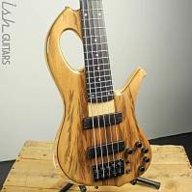
Interesting. What fingerboard wood do you have and was it the same for both of your LG4s?
This is going to sound a little far-fetched but you can check it with Jimmy...
The old LG4 had an Indian rosewood board. My spalted LG4 has wood from Jimmy's old workbench, which was identified by a wood specialist at NAMM 2010 as being a Polynesian/Dalbergia cross. Yes, it sounds wacky, but apparently trees can cross pollenate in bizarre ways, and that's what this is. Again, check with Jimmy if you like ('cuz I know there's a few of you wanting to call B.S. here). It exhibits pretty much the same sonic characteristics of Dalberigia, and more importantly to me feels the same.
Other differences, the old bass had stainless steel frets, and a Poly finish. The old LG4 had a really "big" sound to it, and was pretty aggressive with the Indian board and SS frets.
The new bass has normal fret wire, and nitro. It also has a very distinct low-mid "sock". In point of fact it is a pretty versatile instrument and I'm not sure exactly what to attribute that too, but considering that it's a nitro/alder/rosewood instrument, it seems to have a little more bounce to it than it should. The spalted body seems to be as good a reason for this as any, but of course some "expert" who has never spent any significant time playing a spalted bass will be along shortly to claim definitively why this can't be so.
I quiver with anticipation.
In the meantime, I suggest you try to find a spalted AC sometime and try it for yourself - really the only way to know for sure. I sure do like mine.