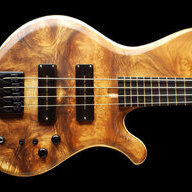
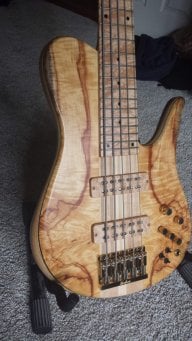
I'll try at some point, although I keep the backs of mine fairly simple. I'd love to have the nice back wood, but I'm a tad cheap and I'd hate to have a pretty wood that nobody gets to see.
No bother mate, that's usually how I roll too

Eude

TalkBass has been independent since 1998. Add your voice.
Create a free account to reply to discussions, view embedded media, and browse with fewer display ads.
Join free Log in
Want zero display ads or expanded classifieds tools? Compare plans.
I'll try at some point, although I keep the backs of mine fairly simple. I'd love to have the nice back wood, but I'm a tad cheap and I'd hate to have a pretty wood that nobody gets to see.

He he, well if you're ever over this way man, give me a shout.
I used to live up in Scotland, but I've been down in London now for almost a year. It's not a bad place bar the recent rioting which you probably saw on the TV...
If it'll help swing it, a Youngs Brewery Pub just opened about 5 mins walk from my front door
Really pleased the 32" has worked out so well.
Like I keep saying, one of these days, I'll be noising Cliff up for a 32" 6 string for sure!
Eude


I don't know if there's a right or wrong answer, just preferences and a little trial and error.
That being said, I might recommend a zero fret to allow you to play around with different string gauges and not have to worry about how well the strings fit in the nut.

Don't quite have time to get perfect pics, but these will do for now.
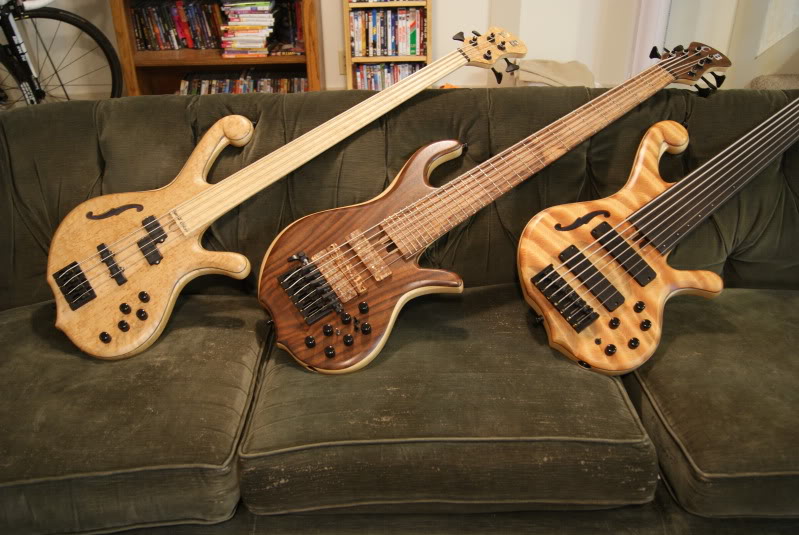
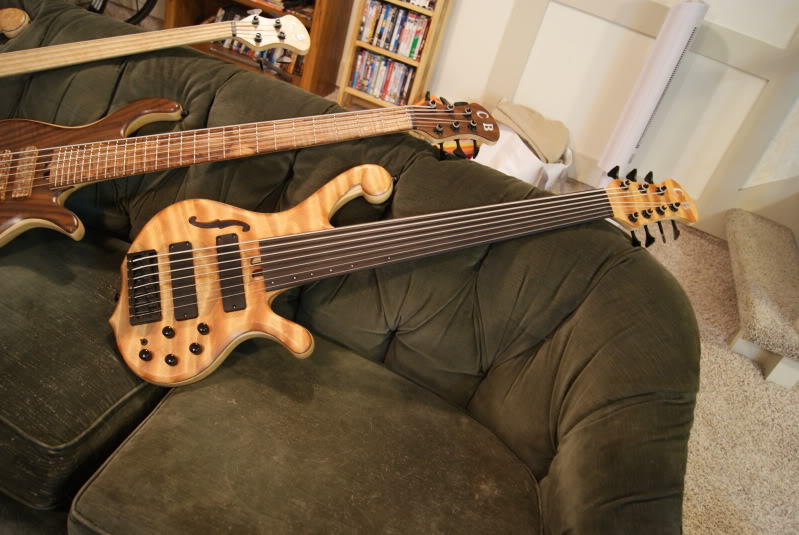
For size comparison.
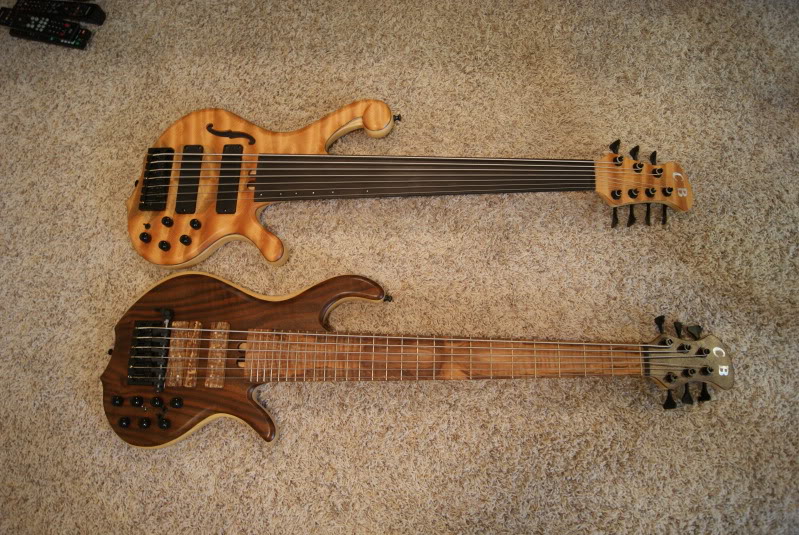
I've have pondered the zero fret option; I can see why you would suggest it. One of these days, someone is going to invent a nut that is adjustable for each string.

Beautiful bass! Truly a work of art. The top is one of my favorites, from what i understand Douglas fir that figured is rare .Can anyone confirm this?

Wow! That model is the bass in the middle?
Both Alembic and Warwick have something of this nature.
: Lots of work for something a zero fret does in such a simple nature.
Any Bordwell owners out there with a zero fret? Cliff...any thoughts on this matter?
This might be a little closer to the mark


You're probably right.
WTH is that??
My Rami 6 has it. Not sure if Cliff has done this on more of his basses. Regardless, I like it so far and plan on doing this on fretted basses whenever possible.

Link Removed
Thanks. I didn't even notice this in the pictures you posted! Now I see it. It really does seem like it would be great for changing strings.
If the zero fret ever has to be repaired, it seems that a nut might be easier to replace. What did Cliff think about installing a zero fret on this bass?
Cliff seemed to really like the idea of installing it. Not that changing strings would be the only benefit, but having your open string sound like a fretted string is kinda nice from a consistency perspective. Theoretically, perhaps the action can be a tad lower because of the zero fret. I don't quite have the funds/space to A/B it to anything similar without the zero fret, but I'm very happy with it and plan on getting it on fretted basses whenever possible.
A nut would be much easier to replace than a zero fret. That's one disadvantage, but not sure how big of a deal this would be on a bass. With guitar, there would be bending to a lesser degree on the fret as well as zero fret, so more potential to wearing it out.

That's cool that Cliff seems to like it. The tonal consistency between open and fretted strings is certainly an advantage. Low action is also a good thing in my book, and I would think this could only help in matters of improved intonation when fretting.
I am wanting to go with stainless steel frets as it is...perhaps this would be an advantage for the longevity of a zero fret?
Hmm...come to think of it, did you ever consider the possibility of having a metal nut rather than the zero fret?
One more thing that I keep wondering about this approach:
Since there is no groove for the string to sit in on the zero fret to make it stationary, like there would be in a nut, when playing an open string, do you notice any kind of movement of the string over the zero fret?

I don't think that's the real issue. I'd think the issue would be differing widths of the slot. Not string height at the first fret.Both Alembic and Warwick have something of this nature. Lots of work for something a zero fret does in such a simple nature.
Nope. He's talking about differing widths of the slot. Not string height at the first fret.
Generally speaking string height at the first fret should be the same no matter what gauge strings you use.
The problem with changing gauges with a nut is you have to file the nut out for larger strings (wider slot, but leave the bottom alone), but then if you go (back) to smaller gauge, you get nut buzz from the string vibrating in a slot "too wide". You do have a little slop to play with as long as there's enough down-force on the string and the slot bottom is rounded, but it is still possible to get noise if you dig in on a string and the gap is big enough.
Alembic, Warwick, and possibly others simply have adjustable heights. That wouldn't solve this problem.
FYI, I reworded my post... don't wanna' speak for someone else, but I do still think the real issue wasn't being dealt with anyway.Gotcha.