Doesn't he only work one day a year?
Something tells me with the amount of basses you put out you might have a slightly different work ethic.
Why don't we have a "Like" button?


TalkBass has been independent since 1998. Add your voice.
Create a free account to reply to discussions, view embedded media, and browse with fewer display ads.
Join free Log in
Want zero display ads or expanded classifieds tools? Compare plans.
Doesn't he only work one day a year?
Something tells me with the amount of basses you put out you might have a slightly different work ethic.
wow being compared with Santa .............. Pretty cool!



It's a good thing, Tom - you know...bringing joy to all the good boys & girls


And hopefully some of the naughty ones as well!


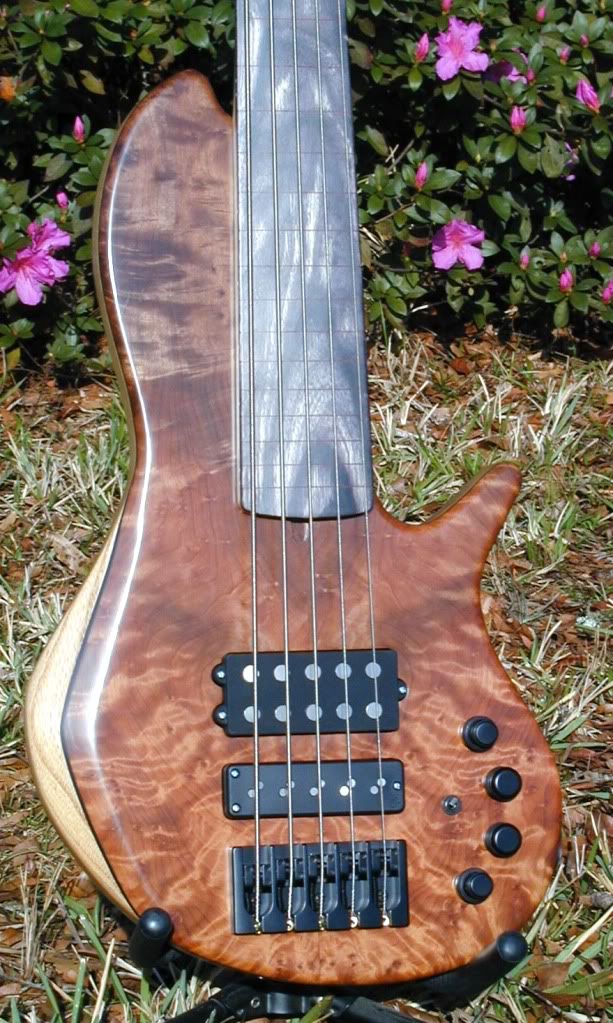
...And, that gorgeous Myrtlewood top
You NASTY girl you!
Off to test drive 4 Woo Hoo!

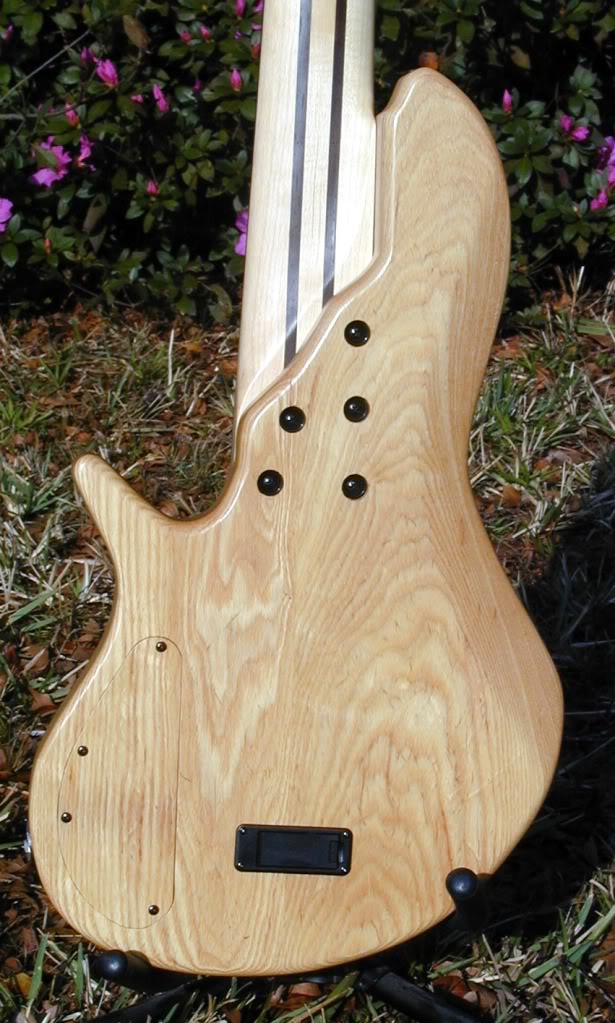
Tom got everything lined out and it is shipping tomorrow amongst a few others finished ones (I think). Tom has been busy this week indeed. I am just as impressed with the ash body rear as I am the redwood front.
I'll try to answerThe Hipshot system seems very interesting, but I do have some concerns about it as I have no experience with any headless hardware. For those with experience with the Hipshot system, maybe you can clear some things up for me:
I have a 6-string headless and the double-neck headless, so I have a total of three of these systems. I have earlier played a Warwick Nobby Meidl and I have another old Riverhead headless bass. I'm not that experienced with headless, compared to headed basses, but I have some experience.The first time, yes. But when you read the instructions, it seems like a bigger task than it really is. The biggest problem is actually getting the old strings out of the bridge pieces. But there is a small and convenient tool in the box that helps you measure the string before you cut it, insert the ball-end in the bridge/holder, and bend the string end and inset it into the head piece. It's pretty straight-forward once you've done it a couple times.1) Do you find string installation to be more of a task when compared to standard tuning machines?
It's just different. It's not hard to intonate the bridge system at all. It just seems a little more intimidating since it's busier at the bridge end. But it's not a problem.2) How does string tuning/saddle intonation compare with the standard Hipshot tuning machines and bridges? Is it easier, more difficult, or just different?
Absolutely not.3) When playing the headless, is there ever any noise/rattling coming form the bridge pieces?
i haven't heard any noise at all from these systems.No, I don't really expect this to be of bad quality or prone to breaking. they are busier than a normal bridge, and maybe the system will take less abuse than a traditional setup, but it all depends on how much abuse you are going to expose it to.4) Do you have any concerns about the tuning knobs or headpiece clamp screws wearing out and not functioning properly?
 No question, Tom takes customer service to a new level!
I'll try to answer
The biggest problem is actually getting the old strings out of the bridge pieces.
But there is a small and convenient tool in the box that helps you measure the string before you cut it, insert the ball-end in the bridge/holder, and bend the string end and inset it into the head piece. It's pretty straight-forward once you've done it a couple times.
It's just different. It's not hard to intonate the bridge system at all. It just seems a little more intimidating since it's busier at the bridge end. But it's not a problem.
)Absolutely not.
No, I don't really expect this to be of bad quality or prone to breaking. they are busier than a normal bridge, and maybe the system will take less abuse than a traditional setup, but it all depends on how much abuse you are going to expose it to.
I like mine.
The Hipshot system seems very interesting, but I do have some concerns about it as I have no experience with any headless hardware. For those with experience with the Hipshot system, maybe you can clear some things up for me:
1) Do you find string installation to be more of a task when compared to standard tuning machines?
2) How does string tuning/saddle intonation compare with the standard Hipshot tuning machines and bridges? Is it easier, more difficult, or just different?
3) When playing the headless, is there ever any noise/rattling coming form the bridge pieces?
4) Do you have any concerns about the tuning knobs or headpiece clamp screws wearing out and not functioning properly?
Thanks for considering my questions.
I haven't changed my strings yet, but I can tell you that I love the feel and response when tuning. Very precise, and easy to dial in. And I think you answered all your own questions when you write the word "Hipshot". For a long time I have found their products to be of outstanding quality, durable and functional. I would never expect an errant rattle from a Hipshot bridge, or a Clement bass.
I also really like the balance of mine. I think the missing headstock is a big factor.
Yes, this is correct. You need the "speaking" length, and the string anchor is not var from the "ordinary" location on a standard string. The string is then cut approximately 10mm longer than the top of the headpiece. You use the accompanying tool to measure it. So on a 34" bass, you need 35-36" string length, maximum. You need a shorter string than you would need if you are stringing a "normal" bass.So, as long as you can get the string anchored at the bridge end of things, it sounds like you can use any length of string you want...providing the speaking length of the string will reach past the nut and the rest of the string will be long enough to fit into the head piece. In other words, a long scale string could be used on a medium scale bass with the headless system without any problem. Is this correct?
No, it is not really a problem at all. I have 2 5-string and 1 6-string system, and the only thing is to get used to the tighter space between the string knobs. But as mentioned above, the responsiveness is great, it takes very little adjustment to get it in tune.Very nice to hear this. Do you find it a bit awkward to tune the string with your right hand rather than your left? (...assuming that you tune this way
I know that Steinberger owners are a little worried about their systems, as the string jaw seems to break over time. The Hipshot system seems to be much more solid than the Steinberger system was. I haven't owned one of those, but I had a friend who owned one and we struggled really hard to get hold of a new string jaw (MusicYo had them in stock... but refused to ship to Norway... I mean... it's a tiny part and it would be in an envelope...I think my greatest concern is that the threads might become stripped and the gear loosen over time if one makes frequent string changes. I would definitely try my best to take good care of the hardware.
 customer non-service).
Well your input is very important to me and really helps me out. I really respect your opinion. Thank you.