
Enjoy the benefits of a premium membership!
Upgrade Account
-
TalkBass has been independent since 1998. Add your voice.
Create a free account to reply to discussions, view embedded media, and browse with fewer display ads.
Join free Log in
Want zero display ads or expanded classifieds tools? Compare plans.
You are using an out of date browser. It may not display this or other websites correctly.
You should upgrade or use an alternative browser.
You should upgrade or use an alternative browser.
More options
Who Replied?
very definitely.Do they play Sadowsky in Nashville? I know they do in New York....

- Apr 3, 2003
- 35,516
- 19,947
- Disclosures
- Editor-in-Chief, Bass Gear Magazine
WRT Nashville and the current "country pop"...
1.) Nashville just happens to be where a lot of the budding artists come from these days in country/country-pop, so it makes 100% sense to me that people go down there to start (hopefully) successful careers down there by being seen by the "next big thing".
2.) Don't blame Nashville for what's popular. Maybe it's not the most rewarding thing from an artist's perspective, but if you're talking about budding careers in the music industry serving the popular opinion to be successful and have a decent lifestyle, well, the popular opinion is what it is, and for the last several decades in music, maybe even forever, that's NOT been about the most interesting/challenging music authored. It's always been about the easiest thing the general populous can relate to and enjoy listening to, which is at a MUCH lower level musically than most true musicians. Take it from an old Jazz buff (me)... the "good stuff" is just DAMN hard to sell and succeed with (monetarily, at least). Period.
FWIW, .02...
I will add that the approach of the "country bass line" has really changed over the past couple of decades. As you all know, there are some monster players in Nashville, and while I don't listen to a lot of country, I do fill in work with a modern country band every now and then, so I've learned a bunch of tunes, and I have to say, modern country bass lines are really fun to play! There's a lot more going on than you might think.

100% agreed. Our band covers some of what I like to call "crossover country" and there's some seriously cool stuff going on.I will add that the approach of the "country bass line" has really changed over the past couple of decades. As you all know, there are some monster players in Nashville, and while I don't listen to a lot of country, I do fill in work with a modern country band every now and then, so I've learned a bunch of tunes, and I have to say, modern country bass lines are really fun to play! There's a lot more going on than you might think.

And now I'm reminded of that old (and inaccurate) joke...
Q: How many Nashville bass players does it take to screw in a light bulb?
A: 1. 5. 1. 5.
Don't forget to try the veal, ladies and germs!

Q: How many Nashville bass players does it take to screw in a light bulb?
A: 1. 5. 1. 5.
Don't forget to try the veal, ladies and germs!

A: 1. 5. 1. 5.
I remember an interview... pretty sure it was with Michael Rhodes... who said the top Nashville bassists call that the "eat s#1t" line, and they try not to play it!

I will add that the approach of the "country bass line" has really changed over the past couple of decades. As you all know, there are some monster players in Nashville, and while I don't listen to a lot of country, I do fill in work with a modern country band every now and then, so I've learned a bunch of tunes, and I have to say, modern country bass lines are really fun to play! There's a lot more going on than you might think.
This is a very good point. There is a lot more going on in some of the modern country than you would expect. My main gig these days is in this field, and coming from a jazz background, I've found it pretty cool how melodic the bass tends to be in a lot of the new stuff. Its not so much I V... By the way, the Sadowsky sound absolutely SLAYS for modern country



re: Somewhere else vs Nashville...
Probably have to wait for whatever happens post COVID for anything remotely in that realm. But, what I’m seeing suggests that remotely distributed tech is going to splinter a lot of local scenes. Also, a somewhat recent visit to Austin seemed to indicate a pretty serious dissolution of that scene. So, I wouldn’t hold my breath for some successor to Nashville any time soon. Not to be a negative Nancy. I just think the remote tech is upending a lot of pro scenes.
Re: Country...
Seriously, there has long been more than the stereotyped 1-5 line. Just for starters, Ray Charles wrote quite a bit in that genre, stating that one of Country’s great characteristics was story telling. Even some of the oldie / moldie’s, such as “Crazy” are fairly well crafted tunes. And, certainly the volume of what now comes under the umbrella of “Modern Country” contains a vast wealth of broad spectrum song writing. With great bass lines.
At some point, most players get past the grail of developing their own unique persona, focusing instead on being competent players. And, that involves playing in multiple genres. “Country” is a prolific space with a multitude of excellent material. There are other genres as well. We are fortunate to have them all.
Probably have to wait for whatever happens post COVID for anything remotely in that realm. But, what I’m seeing suggests that remotely distributed tech is going to splinter a lot of local scenes. Also, a somewhat recent visit to Austin seemed to indicate a pretty serious dissolution of that scene. So, I wouldn’t hold my breath for some successor to Nashville any time soon. Not to be a negative Nancy. I just think the remote tech is upending a lot of pro scenes.
Re: Country...
Seriously, there has long been more than the stereotyped 1-5 line. Just for starters, Ray Charles wrote quite a bit in that genre, stating that one of Country’s great characteristics was story telling. Even some of the oldie / moldie’s, such as “Crazy” are fairly well crafted tunes. And, certainly the volume of what now comes under the umbrella of “Modern Country” contains a vast wealth of broad spectrum song writing. With great bass lines.
At some point, most players get past the grail of developing their own unique persona, focusing instead on being competent players. And, that involves playing in multiple genres. “Country” is a prolific space with a multitude of excellent material. There are other genres as well. We are fortunate to have them all.
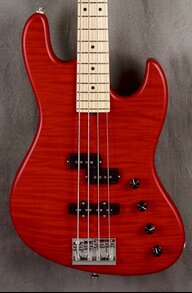
Here's a question for the group: Anyone else out there that has both a NYC with Soap Bars and a MIJ MetroExpress RV4 with Hum Cancelling JJs, and if so, have you noticed a difference in output between the two basses?
After acquiring a 2020 MIJ Metro last month, I noticed that it seems to have significantly hotter output than my 2019 NYC 5-24 with Soaps in 60s J positions. @deepestend confirms that both have essentially the same preamp.
To try and quantify this, I did a semi-scientific test. Both instruments are set to recommended pickup/string measurements with new Blue Label Nickel 40s. Fresh batteries test at 9.36V on the NYC, and 9.33V on the Metro with the Batt-O-Meter. All controls set flat.
Running direct into a Focusrite Scarlett interface and Logic Pro and optimizing gain, I recorded a series of open E string whole notes on each bass, playing as consistently as possible. The MIJ Metro reads consistently 6-7 dB hotter than the NYC 5-24. I realize that Logic Pro metering isn't calibrated, but still saw a difference that confirmed what I was hearing.
Also, the Metro seems a bit 'punchier', but I credit that to the different characteristics of the pickup types, woods, etc.
Don't get me wrong, both sound wonderful, but I'm just curious if this is the expected output of these two fantastic instruments. Your expert opinions?
After acquiring a 2020 MIJ Metro last month, I noticed that it seems to have significantly hotter output than my 2019 NYC 5-24 with Soaps in 60s J positions. @deepestend confirms that both have essentially the same preamp.
To try and quantify this, I did a semi-scientific test. Both instruments are set to recommended pickup/string measurements with new Blue Label Nickel 40s. Fresh batteries test at 9.36V on the NYC, and 9.33V on the Metro with the Batt-O-Meter. All controls set flat.
Running direct into a Focusrite Scarlett interface and Logic Pro and optimizing gain, I recorded a series of open E string whole notes on each bass, playing as consistently as possible. The MIJ Metro reads consistently 6-7 dB hotter than the NYC 5-24. I realize that Logic Pro metering isn't calibrated, but still saw a difference that confirmed what I was hearing.
Also, the Metro seems a bit 'punchier', but I credit that to the different characteristics of the pickup types, woods, etc.
Don't get me wrong, both sound wonderful, but I'm just curious if this is the expected output of these two fantastic instruments. Your expert opinions?

You know those little black furry things Roger supplies to fit on guitar stands to stop rubber etc. affecting the nitro on the back of the necks?
I sprayed a Squier P/J recently in Aztec Gold nitrocellulose lacquer and noticed a 2" patch of gray dusty stuff on the back of the top 'horn'.
I rubbed it off but a week later noticed the nitro had disintegrated down to the primer.
Figured it was a poor paint job by myself from rattle cans so I resprayed the patch yesterday.
I then picked up my '77 Stingray (nitro) and played for 30 minutes - and afterwards noticed there was a similar grey patch in the same area as the Squier.
I rubbed it right off and there's just a dullness there now but no real damage.
Couldn't work out what it was until I held a bass and saw it rubbed against my tee shirt in that exact place (right under '1902' in the image).
The grey printed matter in the image on the front of the tee shirt apparently eats nitro.
Should I have known this? Playing for 50 years and I've never heard of it apart from Roger's furry things.

I sprayed a Squier P/J recently in Aztec Gold nitrocellulose lacquer and noticed a 2" patch of gray dusty stuff on the back of the top 'horn'.
I rubbed it off but a week later noticed the nitro had disintegrated down to the primer.
Figured it was a poor paint job by myself from rattle cans so I resprayed the patch yesterday.
I then picked up my '77 Stingray (nitro) and played for 30 minutes - and afterwards noticed there was a similar grey patch in the same area as the Squier.
I rubbed it right off and there's just a dullness there now but no real damage.
Couldn't work out what it was until I held a bass and saw it rubbed against my tee shirt in that exact place (right under '1902' in the image).
The grey printed matter in the image on the front of the tee shirt apparently eats nitro.
Should I have known this? Playing for 50 years and I've never heard of it apart from Roger's furry things.

I have 2 NYC and a Metro. 1 nyc has soapbars, that’s the one with the lowest output. The Metro has the highest output of the 3 basses, by far.Here's a question for the group: Anyone else out there that has both a NYC with Soap Bars and a MIJ MetroExpress RV4 with Hum Cancelling JJs, and if so, have you noticed a difference in output between the two basses?
After acquiring a 2020 MIJ Metro last month, I noticed that it seems to have significantly hotter output than my 2019 NYC 5-24 with Soaps in 60s J positions. @deepestend confirms that both have essentially the same preamp.
To try and quantify this, I did a semi-scientific test. Both instruments are set to recommended pickup/string measurements with new Blue Label Nickel 40s. Fresh batteries test at 9.36V on the NYC, and 9.33V on the Metro with the Batt-O-Meter. All controls set flat.
Running direct into a Focusrite Scarlett interface and Logic Pro and optimizing gain, I recorded a series of open E string whole notes on each bass, playing as consistently as possible. The MIJ Metro reads consistently 6-7 dB hotter than the NYC 5-24. I realize that Logic Pro metering isn't calibrated, but still saw a difference that confirmed what I was hearing.
Also, the Metro seems a bit 'punchier', but I credit that to the different characteristics of the pickup types, woods, etc.
Don't get me wrong, both sound wonderful, but I'm just curious if this is the expected output of these two fantastic instruments. Your expert opinions?
But that doesn’t matter to me...
They all sound great.

Wow that’s crazy, I guess there’s some rubbery material in that lettering on the shirt but I’m surprised that would do it. Those damn Canaries.You know those little black furry things Roger supplies to fit on guitar stands to stop rubber etc. affecting the nitro on the back of the necks?
I sprayed a Squier P/J recently in Aztec Gold nitrocellulose lacquer and noticed a 2" patch of gray dusty stuff on the back of the top 'horn'.
I rubbed it off but a week later noticed the nitro had disintegrated down to the primer.
Figured it was a poor paint job by myself from rattle cans so I resprayed the patch yesterday.
I then picked up my '77 Stingray (nitro) and played for 30 minutes - and afterwards noticed there was a similar grey patch in the same area as the Squier.
I rubbed it right off and there's just a dullness there now but no real damage.
Couldn't work out what it was until I held a bass and saw it rubbed against my tee shirt in that exact place (right under '1902' in the image).
The grey printed matter in the image on the front of the tee shirt apparently eats nitro.
Should I have known this? Playing for 50 years and I've never heard of it apart from Roger's furry things.
View attachment 4057374

Doug Parent
Supporting Member
Also, the Metro seems a bit 'punchier', but I credit that to the different characteristics of the pickup types, woods, etc.
I made the same observation when comparing several different brands of soapbar pickups to a single coil or stacked J pickup. The latter having a more focused tone while the soapbar had a wider warmer slightly softer tone. The only "soapbar" that sounded more like a single coil was the Nordstrand big single, or the Big Blade. Each great in their own way.

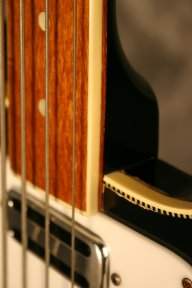

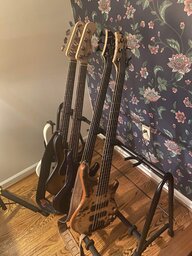
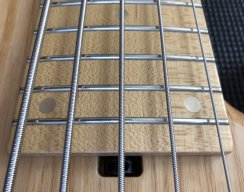
View attachment 4058238 View attachment 4058239 View attachment 4058240 Look what fedex dropped off today:
Sweeeeet!!

So what do you think? I’ve been tossing around the idea of picking up a PJ5...
View attachment 4058238 View attachment 4058239 View attachment 4058240 Look what fedex dropped off today:
View attachment 4058238 View attachment 4058239 View attachment 4058240 Look what fedex dropped off today:
Sweet bass, and that fingerboard is just gorgeous. Ebony or rosewood?