
Enjoy the benefits of a premium membership!
Upgrade Account
-
TalkBass has been independent since 1998. Add your voice.
Create a free account to reply to discussions, view embedded media, and browse with fewer display ads.
Join free Log in
Want zero display ads or expanded classifieds tools? Compare plans.
You are using an out of date browser. It may not display this or other websites correctly.
You should upgrade or use an alternative browser.
You should upgrade or use an alternative browser.
More options
Who Replied?

One of my favorite looking Sadowsky basses - I'd love to get a PJ5 in that color green with QM top...
. . . Now who live close and has a NYC PJ5? . . .
I have a backwards one!!!
I played the NYC JJ in worship yesterday. I do love the sound, but I have to say that, in that setting at least, the PJ is better for me. It has more power and the tight low end punch is there for me when I need it.
It's funny that you mention that the single coils improved the B string on your bass. The B on my JJ is fine, but there is an obvious difference between the two on my basses. I think the PJ is better.
I haven't A/B tested them enough to fully articulate the differences between the two, but as of today, I would have to say that I prefer the performance of the PJ.

- Apr 3, 2003
- 35,516
- 19,947
- Disclosures
- Editor-in-Chief, Bass Gear Magazine

So, if I have this correct (please fix as needed), both your basses predate the graphite rods, as I recall. I think you posted previously the PJ5 predates them, and I think your JJ is a 2003 which predates the crossover, unless maybe if it was made very very late that year.I played the NYC JJ in worship yesterday. I do love the sound, but I have to say that, in that setting at least, the PJ is better for me. It has more power and the tight low end punch is there for me when I need it.
It's funny that you mention that the single coils improved the B string on your bass. The B on my JJ is fine, but there is an obvious difference between the two on my basses. I think the PJ is better.
I haven't A/B tested them enough to fully articulate the differences between the two, but as of today, I would have to say that I prefer the performance of the PJ.
The JJ is ash/maple with a maple top, and I think the PJ is too (tho I'm not sure about the body). So the only question left as to what could be particularly notably different about the basses is if there's a significant difference in the weight (doubtful), or if one was chambered and the other was not (I don't know how to check this).
The other interesting question is, at least for a "baseline" for comparison, is the same true for the bridge pickup solo'd? I realize that'd be an SD HC vs an SD SC, but still interesting.
If all else is equal, what I think you're hearing is that series mode P pickup, especially in the reverse position, adding a bit of extra meat to that B string. I would predict that would even out between the basses as you pan towards the bridge... even with the HC vs SC... maybe start to give the JJ an advantage at some point in the sweep.
I actually just played my Metro PJ5 in the progressive/contemporary church yesterday (ash/maple, of course no rods, no chambers, and no top, and with the newer Nordstrand p'ups) and it totally rocked the house. I personally don't generally prefer it over the JJ, but that bass is in NO danger of being flipped. NONE. Between my two Metros, while that MV5-24 is a truly great bass, the PJ5 has something extra going on in the instrument itself. Woods... go figure.

So, if I have this correct (please fix as needed), both your basses predate the graphite rods, as I recall. I think you posted previously the PJ5 predates them, and I think your JJ is a 2003 which predates the crossover, unless maybe if it was made very very late that year.
The JJ is ash/maple with a maple top, and I think the PJ is too (tho I'm not sure about the body). So the only question left as to what could be particularly notably different about the basses is if there's a significant difference in the weight (doubtful), or if one was chambered and the other was not (I don't know how to check this).
The other interesting question is, at least for a "baseline" for comparison, is the same true for the bridge pickup solo'd? I realize that'd be an SD HC vs an SD SC, but still interesting.
If all else is equal, what I think you're hearing is that series mode P pickup, especially in the reverse position, adding a bit of extra meat to that B string. I would predict that would even out between the basses as you pan towards the bridge... even with the HC vs SC... maybe start to give the JJ an advantage at some point in the sweep. . .
You are spot on.
The built date of the two basses is less than a year apart. The PJ is an 2002 and the JJ an 2003. Both bodies are ash w/ a maple top, and each has a maple FB. Neither has graphite rods. I am almost certain that neither is chambered. Each has a reported weight of 8 1/2 lbs or so. It's close enough that I can't hold one in each hand state which is heavier. It couldn't be more than a couple of ounces either way.
So, I guess I have about as tight of a control environment as you could hope for. The only variable that still exists outside the PU configuration is the strings. That will be taken care of this week. I picked up a couple of sets of Lo-Riders for them, but I haven't re-strung them as of yet. But they are both currently strung with fresh SS strings. I can't imagine strings being that big of a factor.
The difference really is pretty significant to my ear. There were a couple of pieces we did Sunday where I used the B string quite a bit. I was wanting for the PJ after the first service.
My Nordstrand PJ set is supposed to be here today. I am excited about what they will do for the bass. If they can add even a touch of the JJ's "dimension" to the PJ, I can see the PJ becoming player 1A and daring any bass, anywhere to try to knock it off the hill.
Although, the overall tone of the JJ bass is outstanding. I am eager to try it in some other settings. I also play with a "James Taylor -ish" S/S who has a really clean, open sound. I think the JJ is really going to dazzle for that work. I am also looking forward to getting it on some tracks.
Maybe it just doesn't work as well as the PJ for that overly-thick, three guitar, piano plus aux perc thing that the worship band has going.
...AND the pickup type!!So, I guess I have about as tight of a control environment as you could hope for. The only variable that still exists outside the PU configuration is the strings...
Tho in a comparison between the HC (PJ) and SC (JJ), I'd typically expect the SC to win, which is why I was asking what happened as you pan'd each one back towards the bridge... if maybe the JJ's focus started to get better and the PJ's lost a bit of ground... at least compared to the JJ.
Both Blues?they are both currently strung with fresh SS strings.
Actually, they can definitely be, but not in this case if they're both the same type.I can't imagine strings being that big of a factor.
Back from vacation, so here's my photo ID for the club:
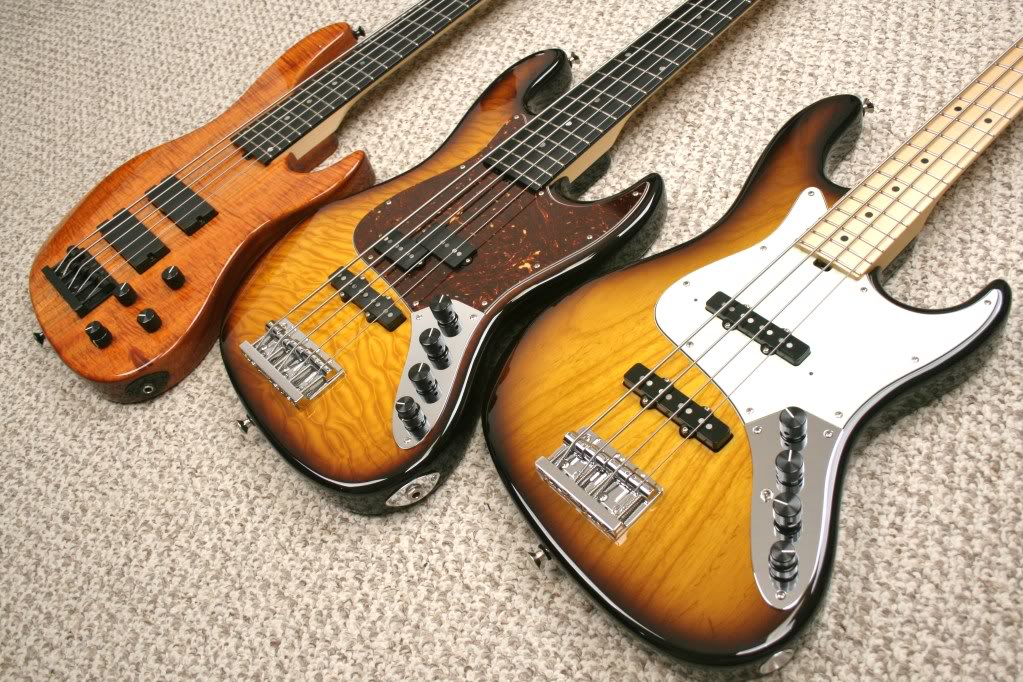
Tom, welcome back from vacation. There are new rules now beside the photo confirmation. They will need your blood type, mother's maiden name and one of your Sadowskys has to be sent to the first Sadowsky Club member who has the initials "JJ".


Nope, not yet. I have yet to place the order 'cause the strings currently on it still have lots of life left.Did you ever get that set of flats that you were thinking of trying on theP/J ?
I own several Sadowsky's and just love them, however, I want a PJ 5 NY and have a 97' Standard Jazz 5 NY, once owned by Marcus Miller, I would like to trade if anyone is interested. Thanks
My Nordstrand PJ5 set came today. I have been talking to a couple buddies and googling a bit. I decided to attempt to solder them. It worked out great. They are in neat as pin.
But, it's too late. The family is sleeping!!! I can't try them.
Who says kids need sleep to do well in school?
But, it's too late. The family is sleeping!!! I can't try them.
Who says kids need sleep to do well in school?
hey guys posted a question similar to it before.
Is the P of the PJ pickup HC? As in, is it as "noiseless" as the J? or will it emit some noise like a regular SC?
and I couldn't understand why would the B string of a PJ be more Solid sounding when the placement of the pickups (B,E,A strings) are almost similar in spacing as compared to the JJ? I will be only logical if the (D,G strings) are brighter because in a PJ,the pickup placing for this 2 strings are closer to the bridge. isn't it? oh I'm referring to Normal PJ. NOT the reverse.
Is the P of the PJ pickup HC? As in, is it as "noiseless" as the J? or will it emit some noise like a regular SC?
and I couldn't understand why would the B string of a PJ be more Solid sounding when the placement of the pickups (B,E,A strings) are almost similar in spacing as compared to the JJ? I will be only logical if the (D,G strings) are brighter because in a PJ,the pickup placing for this 2 strings are closer to the bridge. isn't it? oh I'm referring to Normal PJ. NOT the reverse.
hey guys posted a question similar to it before.
Is the P of the PJ pickup HC? As in, is it as "noiseless" as the J? or will it emit some noise like a regular SC?
and I couldn't understand why would the B string of a PJ be more Solid sounding when the placement of the pickups (B,E,A strings) are almost similar in spacing as compared to the JJ? I will be only logical if the (D,G strings) are brighter because in a PJ,the pickup placing for this 2 strings are closer to the bridge. isn't it? oh I'm referring to Normal PJ. NOT the reverse.
Hi,
P pickup is HC by nature as it is actually kind of split pickup, only the coils are not in-line.
It would sound different from a J pickup because it's a different design. It's wider and has more wire around the poles (I think), maybe even uses a different kind of wire. I also think the poles location is different

hey guys posted a question similar to it before.
Is the P of the PJ pickup HC? As in, is it as "noiseless" as the J? or will it emit some noise like a regular SC?
and I couldn't understand why would the B string of a PJ be more Solid sounding when the placement of the pickups (B,E,A strings) are almost similar in spacing as compared to the JJ? I will be only logical if the (D,G strings) are brighter because in a PJ,the pickup placing for this 2 strings are closer to the bridge. isn't it? oh I'm referring to Normal PJ. NOT the reverse.
Yes, a modern P pickup is a 'split coil' and hence HC. Actually, one of the negatives of the PJ pickup configuration is that the J pickup really needs to be an HC pickup also, since it won't hum cancel with the P pickup.
While the neck J pickup solo'd or favored sounds quite a bit like a P Bass on a standard JJ configuration, it isn't quite as fat in the low mids. This is probably what some hear regarding the B string... more upper harmonic content with the P pickup (i.e., midrange) versus a J pickup in the neck position, making the B sound a bit fatter, especially through rigs with a somewhat attenuated true low end.
Yep. Ever since the major design update in '57, the P has had this "staggered" split coil hum canceling pickup. Further, they're wired in series, which is where a lot of the "meat" comes from in that P sound.Yes, a modern P pickup is a 'split coil' and hence HC.
. . .Further, they're wired in series, which is where a lot of the "meat" comes from in that P sound.
I would have to agree with this. I have a significant amount of experience with basses that offer series switching options. I have owned a G&L L2500, Roscoe Beck V and a couple of others with a series/parallel switch. I have also made that mod on a couple of conventional single coil jazzes.
There's no doubt that series wiring adds a thickness to the tone.
It would an interesting experiment to do with the Sadowsky. I have never seen a jazz bass series/parallel switch wiring diagram with a vol/pan setup. I have only done it with the traditional V/V/T design. But, I am sure I could figure it out easily enough. I wouldn't attempt it unless it was a fully reversible and fairly non-invasive.
- Apr 3, 2003
- 35,516
- 19,947
- Disclosures
- Editor-in-Chief, Bass Gear Magazine
I would have to agree with this. I have a significant amount of experience with basses that offer series switching options. I have owned a G&L L2500, Roscoe Beck V and a couple of others with a series/parallel switch. I have also made that mod on a couple of conventional single coil jazzes.
There's no doubt that series wiring adds a thickness to the tone.
It would an interesting experiment to do with the Sadowsky. I have never seen a jazz bass series/parallel switch wiring diagram with a vol/pan setup. I have only done it with the traditional V/V/T design. But, I am sure I could figure it out easily enough. I wouldn't attempt it unless it was a fully reversible and fairly non-invasive.
I have some basses (vol/vol, of course!
 ) that have dual-coil pickups in roughly J-bass positions, and each pickup has a switch for series/single coil/parallel. This is a pretty cool feature, and yes, it does let you get a decent P-bass sound if you run the neck pickup only with the coils in series. These pickups have all been "soapbar-size" (or slightly smaller), but I don't see why you couldn't do it with a split-coil or a stacked dual-coil.
Tom.
Yeah, all you need to do is drill a hole for the series/parallel switch, and then have it be the path to the volume in series mode, as opposed to the pan being the path in parallel mode. Clearly, there is no "pan" in series, since both pickups literally act as one in series mode (which is why one of the volume controls does nothing in series mode on a J bass... whether it's aftermarket or the S1 switch Fender had for a while).It would an interesting experiment to do with the Sadowsky. I have never seen a jazz bass series/parallel switch wiring diagram with a vol/pan setup. I have only done it with the traditional V/V/T design. But, I am sure I could figure it out easily enough. I wouldn't attempt it unless it was a fully reversible and fairly non-invasive.
Latest posts
-
 Post a funnier picture than the one above - Parallel Universe Edition
- Latest: BassFishingInAmerica
-

-
-

-
