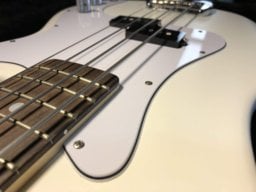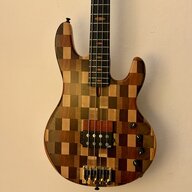
Thank you for this. I have enjoyed your videos quite a lot. I didn’t know you had one about the Sandberg bridge (which I am really appreciating for removing/reinstalling flatwounds!). I will check that out.Although in my videos I never give my opinion but leave it to the listeners, this time I will write what I think about these two basses and what are their pros and cons (but strictly as my subjective opinion):
Just a reminder...it'sa comparison of Sandberg California TT5 Superlight and Fender American Deluxe Jazz Bass V.
PROS for Fender (Cons for Sandberg):
1. Fender sound has slightly better articulated bass for my taste (but a very small difference that can be easily set with any EQ on Sandberg).
2. Adjusting the intonation on a Fender bridge is much easier and precise by simply adjusting the saddle screws without loosening the strings (kudos to Leo Fender for that design). Adjusting the intonation on Sandberg is a lot more complicated due to the mandatory loosening of the allen key on the saddle as well as the strings, and manually moving the saddle by hand which requires several attempts. (Manual for Sandberg bridge is in a video on my YT channel).
3. Fender does not have a neck dive (due to super light body, Sandberg has it but ONLY in sitting position).
4. Fender body is lacquered and the finish seems quite resistant, typical for Fenders. Sandberg's body is made of Paulownia wood, it is not varnished and seems very fragile and sensitive.
5. The fender has ''strings through body'' option (if that's an advantage to anyone).
6. Fender preamp is a 3 band EQ with Middle pot, opposite to Sandberg which is 2 band.
PROS for Sandberg (Cons for Fender):
1. Sandberg weighs (or light) an incredible 2,7 kg - 5,95 lbs.
2. Sandberg has one more fret.
3. Sandberg body geometry allows easyer access to the last frets then Fender.
4. Sandberg neck shape is thinner and more pleasant to play (subjective feeling again).
5. Sandberg has a "zero fret", so an "empty" string sounds more uniform with a pressed one (especialy with an older strings).
6. Changing the strings on Sandberg is simpler because they don't go through any holes. Changing strings on a Fender is more complicated due to threading them through the body or bridge (especially with already used strings).
7. Sandberg potentiometers seem to be of better quality. They are metal and do not move by themselves. Fender potentiometers are plastic and often inadvertently move to an unwanted position.
8. On Sandberg preamp it is easier to notice whether the bass is in passive or active mode due to the push/pull pot, which is very accessible.
Other parts and accessories on the basses I found to be pretty much the same.
Quick question about the zero fret… My TM4 a slight indentation under the E string… is that a problem?