• TalkBass has been independent since 1998. Add your voice.
    Create a free account to reply to discussions, view embedded media, and browse with fewer display ads.
    Join freeLog in
    Want zero display ads or expanded classifieds tools? Compare plans.

Complex bass and too many tones!

To me, a good bass is one that sounds good with everything flat. But I have some with preamps for fun. Mostly I'm the guy who plays the pbass with sunburst, flats, tort, fabric cable...I like that sound, and find that there's tremendous variety available from it. It's not a simple sound, it's complex, and that single humbucker covers a huge frequency range. With a good outboard eq and an understanding, you can get anything.

The pbass thing has been back in style for a while now, but it looks like fancier basses are on the increase again. Cyclical fashion.
 
  • Like
Reactions: chris_b
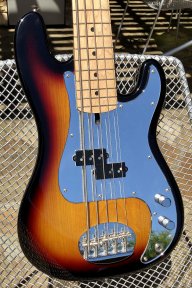
While I agree with the original poster's idea of "set it and forget it," I also came to the conclusion that having a lot of functionality that I didn't like too much or use too often was probably not having. As an example, for several year, I played a Canadian Dingwall AB-2 5 string. It had multiple pickups, multiple ways to configure them, an onboard preamp, several other tonal controls, and a passive mode. To be clear, this was an excellent bass with a wide range of unique tones. If I were playing alone or recording, these features would be a great asset. However, in terms of playing in a band, I found an effective "set it and forget it" tone. I still had to dial in my sound to the space we were playing, but I tended to do that more on an EQ basis much further down the signal chain. I also made minimal changes to my tone from song to song (at most, clicking an effect on or off). This was fine for quite a while, but because the Dingwall was expensive and unique looking, I became uncomfortable always playing out with it. In the end, I chose to move to a Lakland Skyline 5 string P - much less expensive, mostly ordinary looking and inherently already possessing a bass tone that fits well into a mix (the sound that people expect to hear). As an added benefit, dialing in a sound to the space you're playing in is even faster and easier. I'm also an older school bassist, so I also have a pretty minimal signal chain/pedal setup. I have nothing against people who prefer to have lots of onboard tonal options and huge pedal boards. I just found it easier to work with a simpler set up.
 
Discussions of this sort get muddied by the fact that we all play a variety of different genres of music. Bearing in mind also that we all fall somewhere on a spectrum from hobbyist to seasoned pro. I myself never got much further than the local club circuit here in Los Angeles - never had a roadie or a bass tech. Keeping things simple was essential for me. No part of the Hail Mary Play of a 2 minute line-check was EVER gonna involve my dependency on a 9-volt battery.
 
  • Like
Reactions: scuzzy
The most surprising thing to me in this thread is the number of posts that basically say, it’s my tone, I like it, I wanna use it all the time.

It shouldn't come as a surprise. "One tone to own them all" describes many top professional bass players, Carol Kaye, James Jamerson, Chris Squire, Chuck Rainy, Duck Dunn. . . . the list is endless and covers many genres and styles of music.

With my number 1 bass, there are at least 6 pickup selection / coil tap options that produce musical, useable sounds. That’s before I touch the EQ. I can’t imagine sounding exactly the same on every tune; I’d be bored to death in one set.

Your EQ is your choice. That's fine, but if you are in a band and playing for an audience the goal must surely be a well played and received song. The tone of the bass is only a small cog in that wheel. The one most important thing a bass player has to do, to be a successful musician, is to groove/swing/rock (whatever you want to call it), and that doesn't require any tone at all.

James Jamerson used the same tone for 15 years on many thousands of hit songs. Boring is the last way I'd imagine anyone could describe his playing.
 
The 'too many controls' on your bass are not about the instrument but about sounding good through different backlines in sometimes rooms that have horrible acoustics. Get put up with an overly trebbly old SWR stack that has no mids? You will be happy with the mid freq, treble and passive tone pot on your active bass, man! Wooden stage that's hollow and the cabinet sits in a corner being overly boomy as a result? Cut some lows with your active pre! Bliss! Drowning in the mix because there's no mids coming out the stack? mid freq pot with a sweep will save you.

Also, pickup coil mode switching can make you punch through a mix like a charm in some cases where you'd otherwise get swamped.

Just saying there is always a time and place where you will be happy with those otherwise seemingly unuseful controls.

The only thing an onboard pre can not fix is those old honky Peavey combo's that everyone and their mom had as a "professional backline" in the eighties... Nothing can make those boxy pieces of s**t sound good. :smug:
 
  • Like
Reactions: MisterUbu
I have not see that (yet) but will check it out. Still... sooo many tonal options from those fantastic electronics.

I haven't seen that either, however, I do know that his signature bongo that they just released last week or so does not have the 4 band eq and instead has a preconfigured eq that you cannot change. So I'm not sure if it's that he didn't use the 4 band eq, but rather, he set it and then never changed it and I'm assuming the new signature model has this preference of his built in.
 
Everybody is different. Some like it really simple and some like variety. Some are somewhere in between. In the end, none of those guarantee much of anything. You go with what works for you and what you need or want to accomplish. I have met people that can make just about anything happen with one pickup guitar with just a volume knob through a few pedals into an amp with just a volume knob. No joke. ...and I have met people with guitars and amps and pedalboards with more knobs and blinking lights than NASA and accomplish great things. I can say in both cases I have seen people not be able to make either work. Me? I love simplicity. Not that it is better, it just puts me in the frame of mind I work best in. Maybe not EXTREME simplicity but I just am not after an infinite number of options.
 
  • Like
Reactions: KaraQ and bogwart
Elisabeth here started off as a Sterling by Musicman SUB bass. I had the Delano humbucker and split coil added along with the Glockenklang stacked pre-amp (yes, Sandberg was my inspiration) so I can have a classic Stingray sound and a Fender P. Do I use both pickups? Absolutely. Do I use active & passive for recording and live shows? 100%. I notice the differences but does average Joe watching our band on stage? Probably not, but she's my #1 and I love her. It's all a matter of preference.
IMG_20151102_200821.jpg
 
I don't have a hard time finding many different tones with just 2 volumes, 2 pups on my SB2 but I will admit that once I find "that days" combo, I keep it there (even for different songs). My jazz bass seems to just fade back and forth between pickups depending on songs, I generally don't touch the EQ but once, if active. Back when I played out a lot I would EQ my bass(s) to the room, and if there was any tweaking at all it was done on the amp/DI during sets. Rarely did I mess with my bass preamp, not even volume (when I had volume pedal and mute to take care of that). I do remember a couple times now, but the house mixer was doubled over drunk so I had to take control...
 
I haven't seen that either, however, I do know that his signature bongo that they just released last week or so does not have the 4 band eq and instead has a preconfigured eq that you cannot change. So I'm not sure if it's that he didn't use the 4 band eq, but rather, he set it and then never changed it and I'm assuming the new signature model has this preference of his built in.
The reading I've done on this was that he had the eq set and the knobs essentially locked, so that they cannot be turned. He has permanently set and forgot his onboard eq, but he is using it. Just like the other EBMM sig basses where are the controls are not connected, they are making it as accurate as possible, although it's not usable for everyone or everything.