I hate to derail the thread a bit but I was wondering if you guys could give me any string suggestions? I have fender flats on my bass now and while they sound good I think they make my bass sound too up-righty. I'm not looking for strings that are trying to be rounds. Just a little more defintion and perhaps and bit more in the mids

Enjoy the benefits of a premium membership!
Upgrade Account
-
TalkBass has been independent since 1998. Add your voice.
Create a free account to reply to discussions, view embedded media, and browse with fewer display ads.
Join free Log in
Want zero display ads or expanded classifieds tools? Compare plans.
You are using an out of date browser. It may not display this or other websites correctly.
You should upgrade or use an alternative browser.
You should upgrade or use an alternative browser.
Confessions of a Flatwound convert...
- Thread starter Sundogue
- Start date
- Status
- Not open for further replies.
More options
Who Replied?I hate to derail the thread a bit but I was wondering if you guys could give me any string suggestions? I have fender flats on my bass now and while they sound good I think they make my bass sound too up-righty. I'm not looking for strings that are trying to be rounds. Just a little more defintion and perhaps and bit more in the mids
the big C's.
chromes.

If there's a style I don't see them working at all, however, it's heavier metal music. I'm not sure how Steve Harris does it (his tone still seems pretty bright) but every time I listen to Soundgarden, I want to rip those flats off of Ben's bass because he's too indistinct in the mix for my tastes and could've made the entire band sound better easily if he used rounds.
I listen to Soundgarden a lot so I find this interesting. I assume you're talking about the album Superunknown (and a few tracks from Down on the Upside), because that's where the bass had a sound more associated with flats, where it tended to less distinct. I actually like that dark, low, tone, because the bass is there doing its job. It sits in the background, making for a whole new layer to the music; a hidden beauty that relatively few will ever perceive.
Ben doesn't stand out at all in the verses of Spoonman, and a lot of intricate playing is unclear in the mix of Head Down and Fresh Tendrils. But do you know the bass is there? Definitely. Being so low makes the bass cut through in its own way, which I enjoy. For example, in Let Me Drown and 4th Of July, when the bass first comes in, it's like a kick in the chest (In the latter though, did he even use flats? In the intro, the loud string squeaking and artificial harmonic make me wonder...).
I highly recommend you listen through many of the songs after transposing them up an octave. Due to the mountain of fundamental, the bass becomes infinitely more present. It's like hearing it for the first time and is undoubtedly a necessity when you're trying to learn those songs. You'll find that Ben really liked power chords, they're all over this album. (4th of July uses a repeated open C powerchord. As in, if you tuned to CGCF, you would strike the two lowest strings open. Yeah.)
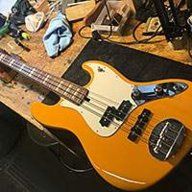
IMO, Chromes actually sound great on a Jazz, more than a P, P's need big clanky rawk Rotos, if you're going flat, or Fender/Labella etc. if you're makin' with tha thump.
Yep! Love Chromes on a J.

I listen to Soundgarden a lot so I find this interesting. I assume you're talking about the album Superunknown (and a few tracks from Down on the Upside), because that's where the bass had a sound more associated with flats, where it tended to less distinct. I actually like that dark, low, tone, because the bass is there doing its job. It sits in the background, making for a whole new layer to the music; a hidden beauty that relatively few will ever perceive.
Ben doesn't stand out at all in the verses of Spoonman, and a lot of intricate playing is unclear in the mix of Head Down and Fresh Tendrils. But do you know the bass is there? Definitely. Being so low makes the bass cut through in its own way, which I enjoy. For example, in Let Me Drown and 4th Of July, when the bass first comes in, it's like a kick in the chest (In the latter though, did he even use flats? In the intro, the loud string squeaking and artificial harmonic make me wonder...).
I highly recommend you listen through many of the songs after transposing them up an octave. Due to the mountain of fundamental, the bass becomes infinitely more present. It's like hearing it for the first time and is undoubtedly a necessity when you're trying to learn those songs. You'll find that Ben really liked power chords, they're all over this album. (4th of July uses a repeated open C powerchord. As in, if you tuned to CGCF, you would strike the two lowest strings open. Yeah.)
While I don't listen to Soundgarden, I agree with your assessment in so far as the bass' desired effect in the music. I feel that too often bass players are interested in "cutting through" rather than sitting in that bass pocket within the rhythm section and providing the underlying support for the rest of the instruments.
I think it gets right to the heart of the matter regarding flatwounds and the application for them. Some bass players desire to "cut through" while others prefer to be that bottom support. Both are valid concerns.
Flatwounds aren't going to be the be all and end all, for every type of music, but what they do provide is that thick underlying support to the music in a way rounds don't completely convey, just like flats do not in the way rounds do.
I've heard it mentioned many times over my career and many times in this thread. In some cases bass players have problems being heard using flats. The problem is not as much one that is caused by the strings themselves, but rather the player's expectations of what the bass should sound like.
If one is expecting the brightness and that "cutting through the mix" one gets with rounds in let's say, more of a soloists idea of what bass should be, then no; Flats are not going to give you that and therefore no matter what you do or how you EQ you are going to feel like something is missing in your sound.
On the other hand if the player's expectations are that the bass is going to stand out in it's own designed, unique voice of being the bass instrument that it is, and you desire to give the music that underlying strength and support, then your perception of the bass' sound is going to match your expectations and you will not struggle with being heard and will not feel anything is missing because you know that what is missing from your sound, is being provided by the other instruments.
It's all about giving each instrument space in the music. Many round players want to dominate the music in that they expect the bass to not only provide the bottom to the rhythm, they also expect to be the dominating sound in the mid range where the guitars and other instruments shine as well. If one's expectation is for the bass to be that, then flats are not for you and one should use roundwounds and play the "cut through the mix" and "volume" game with the rest of the band.
I believe there is a psychological phenomenon at play here as well. I think many of today's players equate being in a supportive role in the background with being unimportant. As if the lead guitarists and singers get all the props, while the rhythm section is this "silent partner" that receives no recognition. I do believe many players overcompensate by overplaying parts in an attempt to prove how worthy their contribution is too. The "look at me!" syndrome, as if to say..."If only I could get my bass to sound as bright and stand out like the lead guitars do, and if I play some flashy runs then people will notice what a worthy musician I am too."
And there is nothing wrong with feeling that way depending on the style of music played and what is important overall. Some music is inherently more "bass" forward. Most is not. The Stanley Clarkes, Vic Wootens, Chris Squires and Geddy Lees of the world do not want to be in a supportive role, nor should they be. But most music is better served by fulfilling the role that each instrument needs to fill, much in the way an orchestra successfully creates a lush texture of sound by each musician being subservient to the music. Not everyone can be the famed violin soloist that gets all the props. However, that soloist will sound empty without the other parts. Some players don't want to be that support. Some relish it.
The main reason I switched to flatwounds is that my perception of my role and what I feel needs to be heard has changed. Since diving into my "role" as a supporting player in the rhythm section and using flatwounds to give my bass a stronger "bass" sound, I no longer fight to be heard. I hear myself better than I ever have, not because I'm using flats now, but because my perception of my sound is clearer in my mind. I'm playing at lower volumes than ever before and yet because I have no desire to cut through, I hear every note I play better and more defined (even in a very loud, rich rock music environment) because what I'm listening to is the bass. I have no expectations that any guitar-like tones emanating from roundwound strings better be just as loud and present as the guitars' sound. I'm fortunate in that I love to hear my talented guitarists' riffs singing on top of my supporting rhythm. The single biggest change to my sound is not my flatwound strings, but my perception and expectations as to what my bass should be delivering.


Soundgarden???
These doesn't sound like flats to me. Looks like he played with an old EB0 with the mud knob cranked to 11
edit: Completing... I don't know how this guy thinks he will cut through with this tone...
These doesn't sound like flats to me. Looks like he played with an old EB0 with the mud knob cranked to 11
edit: Completing... I don't know how this guy thinks he will cut through with this tone...
Cutting through is highly overrated. 
The whole idea of "cutting through the mix" is based on the the need to hear one's instrument above, or at least on par, with those very frequencies one is trying to "cut through".
In almost any given musical situation mid-range frequencies are simply going to be over saturated to begin with, as most content of other instruments and vocals are going fall within that range. There are only two ways to hear that part of your bass among that sonic wash. Addition or subtraction. Either you will need to boost those frequencies that fall into that sonic wash of sound, or other instrument need to cut theirs back. It is highly unlikely that others will cut theirs back because they too want and need to hear their mid range content (being mid range instruments). So what does that leave a bass player to do? Boost. But by boosting those frequencies you are contributing even more to that which is already over saturated.
But if that's what it takes to hear yourself, then that's what you have to do. So what does that have to do with flatwound strings you ask?
There is a lot to love about roundwound strings. That rich, bright piano-like tone that we all love is NOT part of the lower or lo-mid range of frequencies. It falls into that over saturated mid, hi-mid and higher end range. So now that part of the tone you love with rounds is competing with other instruments. No avoiding that.
While flats certainly have content that also falls into that mid-range, that is not what they excel at producing. No one uses flats for that rich, bright piano-like tone. We use flats primarily for their strong "thump" or that distinct low and lo-mid character. Which is precisely where other instruments can't go (at least as easily or as dominating, save for heavy handed keyboardists). And flats work for me in any environment or venue. I think a great deal of hearing one's bass better has more to do with expectations rather than actuality.
Personally I love rounds and I'm all for everyone using what works for them. But in using them there are expectations of "tone" that can only be met by "cutting through". I have no expectations or desire to cut through, because in my opinion "cutting through" is highly overrated for me personally as a bass player with the music I play.
I have no problem hearing my bass, no matter what notes I play on any string, anywhere on the neck. And I'm not boosting my mids to cut through, nor am I playing volume wars with other instruments (in fact I'm playing at a lower volume now and still hearing my bass better). I'm simply content (quite happy really) to drive the low end, expecting to hear my bass in the range no other instruments readily compete with, and it is not dull or muddy in the least. It's a personal choice and I understand the reasons for wanting to cut through and hear all that wonderfully rich roundwound content. I still dig that tone too, but it just isn't necessary for me in my situation at the moment. Using flats has benefited the band's sound by me removing some unnecessary (to me) mid-range content and allowing the guitars to fill that area by themselves. It's made the sound tighter and cleaner.
What I hear clearly, others would feel can't be heard at all because the expectation of sound and string preference between flats or rounds is more a state of mind than anything else. Some can't stand the sound of flats because their expectation of their bass "tone" won't allow for it. Some just expect to have their bass sound like a lower tuned guitar and only rounds will do. It's all cool. To each his own.
The whole idea of "cutting through the mix" is based on the the need to hear one's instrument above, or at least on par, with those very frequencies one is trying to "cut through".
In almost any given musical situation mid-range frequencies are simply going to be over saturated to begin with, as most content of other instruments and vocals are going fall within that range. There are only two ways to hear that part of your bass among that sonic wash. Addition or subtraction. Either you will need to boost those frequencies that fall into that sonic wash of sound, or other instrument need to cut theirs back. It is highly unlikely that others will cut theirs back because they too want and need to hear their mid range content (being mid range instruments). So what does that leave a bass player to do? Boost. But by boosting those frequencies you are contributing even more to that which is already over saturated.
But if that's what it takes to hear yourself, then that's what you have to do. So what does that have to do with flatwound strings you ask?
There is a lot to love about roundwound strings. That rich, bright piano-like tone that we all love is NOT part of the lower or lo-mid range of frequencies. It falls into that over saturated mid, hi-mid and higher end range. So now that part of the tone you love with rounds is competing with other instruments. No avoiding that.
While flats certainly have content that also falls into that mid-range, that is not what they excel at producing. No one uses flats for that rich, bright piano-like tone. We use flats primarily for their strong "thump" or that distinct low and lo-mid character. Which is precisely where other instruments can't go (at least as easily or as dominating, save for heavy handed keyboardists
). And flats work for me in any environment or venue. I think a great deal of hearing one's bass better has more to do with expectations rather than actuality.Personally I love rounds and I'm all for everyone using what works for them. But in using them there are expectations of "tone" that can only be met by "cutting through". I have no expectations or desire to cut through, because in my opinion "cutting through" is highly overrated for me personally as a bass player with the music I play.
I have no problem hearing my bass, no matter what notes I play on any string, anywhere on the neck. And I'm not boosting my mids to cut through, nor am I playing volume wars with other instruments (in fact I'm playing at a lower volume now and still hearing my bass better). I'm simply content (quite happy really) to drive the low end, expecting to hear my bass in the range no other instruments readily compete with, and it is not dull or muddy in the least. It's a personal choice and I understand the reasons for wanting to cut through and hear all that wonderfully rich roundwound content. I still dig that tone too, but it just isn't necessary for me in my situation at the moment. Using flats has benefited the band's sound by me removing some unnecessary (to me) mid-range content and allowing the guitars to fill that area by themselves. It's made the sound tighter and cleaner.
What I hear clearly, others would feel can't be heard at all because the expectation of sound and string preference between flats or rounds is more a state of mind than anything else. Some can't stand the sound of flats because their expectation of their bass "tone" won't allow for it. Some just expect to have their bass sound like a lower tuned guitar and only rounds will do. It's all cool. To each his own.
+ 1 Sundogue, flats and rounds are fundamentally different (pun intended).
It's been mentioned that flats might be better for some rooms and rounds for others. But I know of no bass players who decide on flats or rounds based on the room. Any player will adjust the EQ rather than thinking "I should be using flats in here".
To me, they feel and play different so the choice is more than just about the venue acoustics.
I agree also "cutting through" by "boosting the mids" is overly generalized and likely even misleading. Sadowsky basses are EQ'd the way they are because even Roger believes boosting the mids is the wrong way to go.
There seems to be a misplaced belief that flats will make your sound duller and less prominent and therefore all you're doing is thumping a low end. I have found that the qualities of flats allow me to explore riffs and accents with far more effectiveness in the songs than rounds ever did.
But, as has been said, it's a personal choice and play with what works for you...
It's been mentioned that flats might be better for some rooms and rounds for others. But I know of no bass players who decide on flats or rounds based on the room. Any player will adjust the EQ rather than thinking "I should be using flats in here".
To me, they feel and play different so the choice is more than just about the venue acoustics.
I agree also "cutting through" by "boosting the mids" is overly generalized and likely even misleading. Sadowsky basses are EQ'd the way they are because even Roger believes boosting the mids is the wrong way to go.
There seems to be a misplaced belief that flats will make your sound duller and less prominent and therefore all you're doing is thumping a low end. I have found that the qualities of flats allow me to explore riffs and accents with far more effectiveness in the songs than rounds ever did.
But, as has been said, it's a personal choice and play with what works for you...
+ 1 Sundogue, flats and rounds are fundamentally different (pun intended).
It's been mentioned that flats might be better for some rooms and rounds for others. But I know of no bass players who decide on flats or rounds based on the room. Any player will adjust the EQ rather than thinking "I should be using flats in here".
To me, they feel and play different so the choice is more than just about the venue acoustics.
I agree also "cutting through" by "boosting the mids" is overly generalized and likely even misleading. Sadowsky basses are EQ'd the way they are because even Roger believes boosting the mids is the wrong way to go.
There seems to be a misplaced belief that flats will make your sound duller and less prominent and therefore all you're doing is thumping a low end. I have found that the qualities of flats allow me to explore riffs and accents with far more effectiveness in the songs than rounds ever did.
But, as has been said, it's a personal choice and play with what works for you...
+1 dvh.
While I mentioned that flats excel at the fundamental of the lo and lo-mid end of the frequency range, they are by no means limited to that. And it's that thinking of limitation where we get the misplaced belief that they are a duller and more lifeless version of rounds.
It's a mindset. There is such prevalent hero worship that leads to an insane amount of emulation of the techniques and tone of some bass players (Geddy, Wooten, etc.) that many just have to have what their heroes have, without even exploring what works best for their own individual playing within the context of whomever else they are playing with. And I think a lot of that has to do with the woodshedding and playing out of fantasies in Madison Square Living Room, where your tone is always brilliant because nothing competes with it.
My cabs are very mid-voiced 115 neos, and I'm using an active bass and yet I use flats (as if flats require a P-Bass and an SVT). Because of my bass and rig, flats give me a very distinct bass tone that is not only thick and thumpy, but also extremely sharp and clear. It's just not clear in the way people generally think of rounds being. It isn't that piano-like twangy brightness, but almost a more percussive "snap" to the notes that accompany that wonderfully thumpy low end. Because flats have a strong fundamental, I don't need to boost lows, which can overwhelm the rest of the sound and I don't need to boost mids because my bass and rig naturally produce enough on their own. It's quite a natural "bass" sound.
It's not like I'm just a root note player, but I have simplified my playing and what runs I do throw in never get lost in the mix because my sound is so distinct...even without relying on that piano-like clarity of rounds.
When people say they can't hear notes they play using flats (in any venue) I wonder how they are EQ-ing themselves.
Talkbass is, by and large, a bass equipment forum and as such, I think any component of our sound (from amps to strings) merit discussion. Flatwounds have been largely ignored and I think it's cool we are discussing it to such a degree. It's of benefit to everyone, especially those who are considering switching but aren't sure.
Yep! Love Chromes on a J.
Two of my three J's have Chromes(one in standard, one E to C), the other one is a fretless with an ebanol board(the one I want to paint as you photoshopped for me), and has TI Flats.
I also have a P/Humbucker Fretless with Chromes, I preferred Rotos on it, but I got a bum set and moved to the Chromes for now.

There seems to be a misplaced belief that flats will make your sound duller and less prominent and therefore all you're doing is thumping a low end. I have found that the qualities of flats allow me to explore riffs and accents with far more effectiveness in the songs than rounds ever did.
But, as has been said, it's a personal choice and play with what works for you...
+1 on these parts of your post dvh.
What would all of those great Motown songs have been without Jamerson or Bobbit getting after it with their flats? I personally never have a problem hearing their riffs.
But again, it's personal choice, because what would Yes and Rush be without Squire and Lee getting after it with their rounds?
I switched to flats not because I always thump on the root or just play 1/5/1/5 all night. I switched because Sundogue's OP sounded so much like my current situation that I had to look to make sure I didn't write it. So, I figured what the heck, and I gave flats a try. Well, it's been a few months now and I'm glad I did. Found my voice and the boys in the band are digging it.
I even had a buddy who comes to see us about twice a year tell me after our last gig, "I had no idea you were such a good bass player, when did you get good?" I played the same mediocre riffs at that gig that I've been playing for the past 30 years. Who knew!?!

..."I had no idea you were such a good bass player, when did you get good?" I played the same mediocre riffs at that gig that I've been playing for the past 30 years. Who knew!?!
I've been experimenting with both lately. Result? I bring two basses to every single gig.
For songs that are more riff-based, have unisons, thick guitar parts, and lots of crash cymbals, I bust out the passive double-P with chromes. These songs are generally less dynamic. They're all about making the band's sound as wide and full as possible. For material like this, I get low. I roll off the P in the bridge and favor the neck P. With the chromes, I have a ridiculous amount of punch, can make any guitar line sound huge, and just have this special kind of mojo with the kick.
For songs that have more space, I bust out the Ibanez P/J with EMGs and nickel wounds. We play a lot of music that's really syncopated and funky. For stuff like that, I have to think about locking with the kick, but also about responding to the guitars and filling rests with tasteful arpeggiations and runs that make distinct harmonic and melodic decisions. We still aim for a "full" sound, but the definition of full changes. It's about playing out and having your own voice, but also about being reserved and patient enough not to step on each other's phrasing. So I'll play some higher register licks, but I use them as fills or, more interestingly, to fill in a guitar rest on, for example, a seemingly random eighth or sixteenth note rest in a phrase. So, a lot of the time, I try to catch the listener off guard. Sometimes they won't immediately associate one my phrases with the bass, but if it's timed and spaced properly, it adds a level of sophistication that's definitely identifiable.
I love both basses to death and they don't sound anything like each other. I also would never associate either of them with "old school" tone. They're both very modern sounding, and I play through a Sansamp RBI preamp, compressor, and rack EQ at every gig.
I really do play extra solid on the P with flats. I don't even dislike my tone when I'm playing alone. I think it sounds humongous and it's very very consistent.
I definitely push the limits of my role as a bassist to a larger degree when I play the P/J with rounds, and I definitely get a greater variety of sounds out of the bass with my fingers by changing my right hand placement to get more thump on lower notes or staccato spank on higher ones with more success than the P.
If you play diverse music, play both, use effects, change the pickup blend, be creative, be tasteful, but always try to do something fresh or at least personally challenging.
For songs that are more riff-based, have unisons, thick guitar parts, and lots of crash cymbals, I bust out the passive double-P with chromes. These songs are generally less dynamic. They're all about making the band's sound as wide and full as possible. For material like this, I get low. I roll off the P in the bridge and favor the neck P. With the chromes, I have a ridiculous amount of punch, can make any guitar line sound huge, and just have this special kind of mojo with the kick.
For songs that have more space, I bust out the Ibanez P/J with EMGs and nickel wounds. We play a lot of music that's really syncopated and funky. For stuff like that, I have to think about locking with the kick, but also about responding to the guitars and filling rests with tasteful arpeggiations and runs that make distinct harmonic and melodic decisions. We still aim for a "full" sound, but the definition of full changes. It's about playing out and having your own voice, but also about being reserved and patient enough not to step on each other's phrasing. So I'll play some higher register licks, but I use them as fills or, more interestingly, to fill in a guitar rest on, for example, a seemingly random eighth or sixteenth note rest in a phrase. So, a lot of the time, I try to catch the listener off guard. Sometimes they won't immediately associate one my phrases with the bass, but if it's timed and spaced properly, it adds a level of sophistication that's definitely identifiable.
I love both basses to death and they don't sound anything like each other. I also would never associate either of them with "old school" tone. They're both very modern sounding, and I play through a Sansamp RBI preamp, compressor, and rack EQ at every gig.
I really do play extra solid on the P with flats. I don't even dislike my tone when I'm playing alone. I think it sounds humongous and it's very very consistent.
I definitely push the limits of my role as a bassist to a larger degree when I play the P/J with rounds, and I definitely get a greater variety of sounds out of the bass with my fingers by changing my right hand placement to get more thump on lower notes or staccato spank on higher ones with more success than the P.
If you play diverse music, play both, use effects, change the pickup blend, be creative, be tasteful, but always try to do something fresh or at least personally challenging.

I've been experimenting with both lately. Result? I bring two basses to every single gig.
For songs that are more riff-based, have unisons, thick guitar parts, and lots of crash cymbals, I bust out the passive double-P with chromes.
Hi, just curious, what brand/model is your double P?I'm lately intrigued by that pickup configuration
Just a clarification for some who've posted here and/or PM'd me, who seem hell bent on taking things I've said out of context.
I'm making a statement here that applies to ALL my subsequent posts (so I don't have to add it every time I post something just to appease you), so read this one first before you reply to me...
I like and use both flatwound and roundwound strings. Shocking, I know. But I do.
I wish to discuss flatwound strings here and that sometimes requires comparisons to roundwounds. Get it?
I'm not trying to persuade anyone to stop using roundwound strings or tell anyone they are wrong for using them.
I'm not telling anyone that flatwounds work for everything and everyone all of the time in every situation. That would be just plain stupid. Get it?
I am not a string designer nor a manufacturer. I understand the manufacturing process of the different string designs, but I make no claims, nor have any delusion of being an expert in this field. The only thing I am an expert on is MY situation using them.
It's not "all in your hands". Try standing onstage with your band and see if anyone hears bass sounds coming from your hands. You need equipment to put your hands on to produce music, OK? This is by and large an equipment forum, and this is the "Strings" forum, so we are talking about strings here. We're not talking about your hands. If you still feel it's all in your hands, go post a thread in the "Hands" forum.
I can only post from my perspective and they are my opinions, so all this BS of having to add IMO, IMHO, etc. is redundant. That should be obvious. If I state something that is factually inaccurate then by all means reply and state why. I'm open to the possibility that I might be wrong. Maybe.
Use whatever strings work for you. I don't care if they are flats, rounds, telephone wires, construction cables, rubber bands, etc. I don't care what strings you use. Do I need to repeat that? We're just discussing strings here. I'm not out to change the world despite earlier attempts at some humor to the contrary. Don't take my appreciation for flats or my desire to dig deeper into the reasons why as any kind of authoritative attempt to personally say you are wrong for not using flats.
Is that clear enough, or do I still have to add all of that to every single one of my posts?
Oh...and one last thing...
Almost everyone posting in this very long thread has been nice and we've had a great exchange of opinions and ideas (even if they were differing views), and I've learned a lot and I give you all a big thank you for contributing. The above was not intended for you.
I'm making a statement here that applies to ALL my subsequent posts (so I don't have to add it every time I post something just to appease you), so read this one first before you reply to me...
I like and use both flatwound and roundwound strings.
Shocking, I know. But I do.I wish to discuss flatwound strings here and that sometimes requires comparisons to roundwounds. Get it?
I'm not trying to persuade anyone to stop using roundwound strings or tell anyone they are wrong for using them.
I'm not telling anyone that flatwounds work for everything and everyone all of the time in every situation. That would be just plain stupid. Get it?
I am not a string designer nor a manufacturer. I understand the manufacturing process of the different string designs, but I make no claims, nor have any delusion of being an expert in this field. The only thing I am an expert on is MY situation using them.
It's not "all in your hands". Try standing onstage with your band and see if anyone hears bass sounds coming from your hands. You need equipment to put your hands on to produce music, OK? This is by and large an equipment forum, and this is the "Strings" forum, so we are talking about strings here. We're not talking about your hands. If you still feel it's all in your hands, go post a thread in the "Hands" forum.
I can only post from my perspective and they are my opinions, so all this BS of having to add IMO, IMHO, etc. is redundant. That should be obvious. If I state something that is factually inaccurate then by all means reply and state why. I'm open to the possibility that I might be wrong. Maybe.
Use whatever strings work for you. I don't care if they are flats, rounds, telephone wires, construction cables, rubber bands, etc. I don't care what strings you use. Do I need to repeat that? We're just discussing strings here. I'm not out to change the world despite earlier attempts at some humor to the contrary. Don't take my appreciation for flats or my desire to dig deeper into the reasons why as any kind of authoritative attempt to personally say you are wrong for not using flats.
Is that clear enough, or do I still have to add all of that to every single one of my posts?
Oh...and one last thing...
Almost everyone posting in this very long thread has been nice and we've had a great exchange of opinions and ideas (even if they were differing views), and I've learned a lot and I give you all a big thank you for contributing. The above was not intended for you.

that is an awesome quote!It's not "all in your hands". Try standing onstage with your band and see if anyone hears bass sounds coming from your hands.
Just a clarification for some who've posted here and/or PM'd me, who seem hell bent on taking things I've said out of context.
I'm making a statement here that applies to ALL my subsequent posts (so I don't have to add it every time I post something just to appease you), so read this one first before you reply to me...
I like and use both flatwound and roundwound strings.
I wish to discuss flatwound strings here and that sometimes requires comparisons to roundwounds. Get it?
I'm not trying to persuade anyone to stop using roundwound strings or tell anyone they are wrong for using them.
I'm not telling anyone that flatwounds work for everything and everyone all of the time in every situation. That would be just plain stupid. Get it?
I am not a string designer nor a manufacturer. I understand the manufacturing process of the different string designs, but I make no claims, nor have any delusion of being an expert in this field. The only thing I am an expert on is MY situation using them.
It's not "all in your hands". Try standing onstage with your band and see if anyone hears bass sounds coming from your hands. You need equipment to put your hands on to produce music, OK? This is by and large an equipment forum, and this is the "Strings" forum, so we talking about strings here. We're not talking about your hands. If you still feel it's all in your hands, go post a thread in the "Hands" forum.
I can only post from my perspective and they are my opinions, so all this BS of having to add IMO, IMHO, etc. is redundant. That should be obvious. If I state something that is factually inaccurate then by all means reply and state why. I'm open to the possibility that I might be wrong. Maybe.
Use whatever strings work for you. I don't care if they are flats, rounds, telephone wires, construction cables, rubber bands, etc. I don't care what strings you use. Do I need to repeat that? We're just discussing strings here. I'm not out to change the world despite earlier attempts at some humor to the contrary. Don't take my appreciation for flats or my desire to dig deeper into the reasons why as any kind of authoritative attempt to personally say you are wrong for not using flats.
Is that clear enough, or do I still have to add all of that to every single one of my posts?
Oh...and one last thing...
Almost everyone posting in this very long thread has been nice and we've had a great exchange of opinions and ideas (even if they were differing views), and I've learned a lot and I give you all a big thank you for contributing. The above was not intended for you.
+111111.
- Status
- Not open for further replies.


