• TalkBass has been independent since 1998. Add your voice.
    Create a free account to reply to discussions, view embedded media, and browse with fewer display ads.
    Join freeLog in
    Want zero display ads or expanded classifieds tools? Compare plans.

Crown xl1500 power

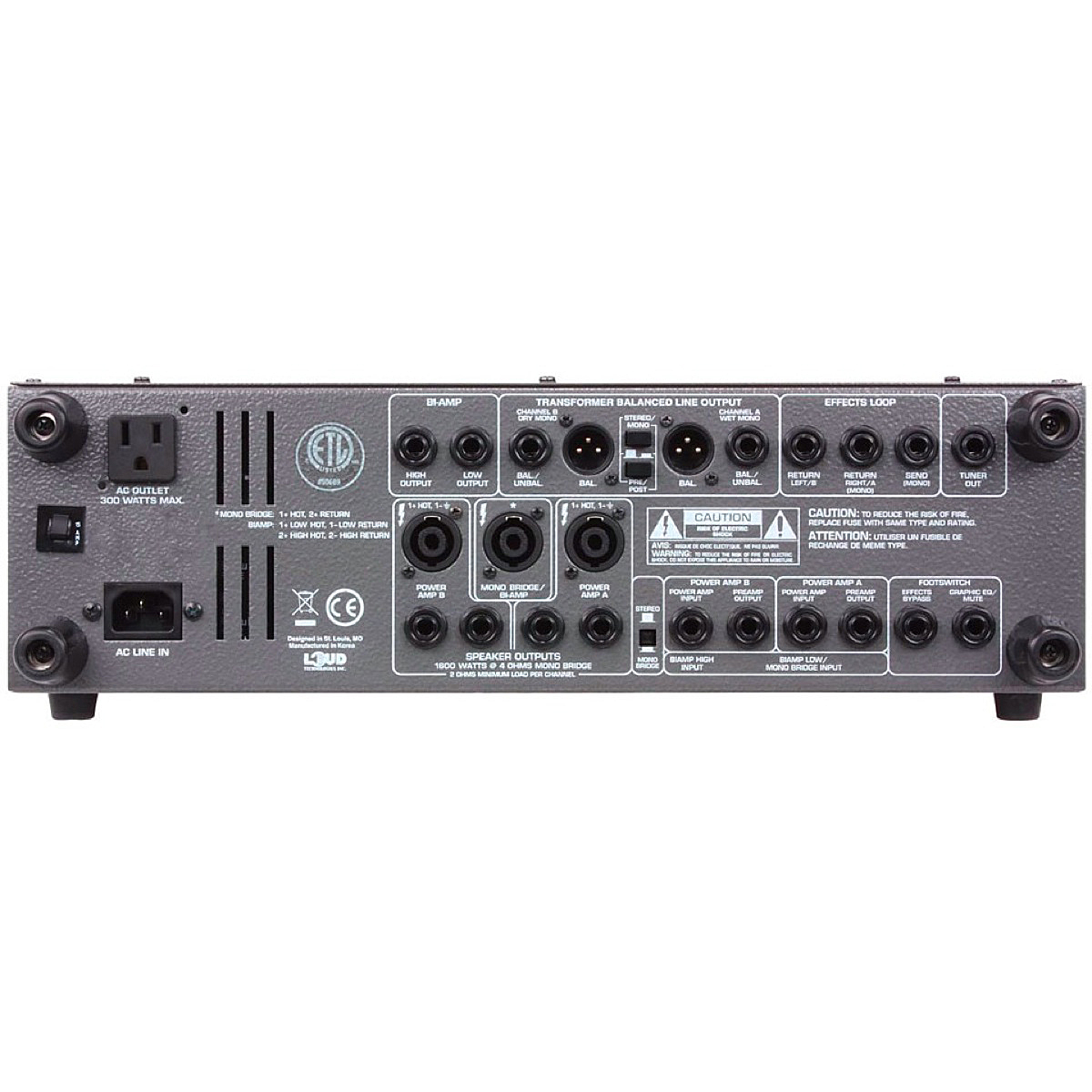
With this amp and two 8Ohm cabs, am i correct in the assumpsjon that each cab gets:
-262W connected to one channel in stereo or input-y mode.
-300W connected to both channels in stereo or input-y mode.
-775W connected to channel one in bridge mode.
Provided one daisy chain them if connected to only one channel?
 
With this amp and two 8Ohm cabs, am i correct in the assumpsjon that each cab gets:
-262W connected to one channel in stereo or input-y mode.
-300W connected to both channels in stereo or input-y mode.
-775W connected to channel one in bridge mode.
Provided one daisy chain them if connected to only one channel?
Those are correct numbers per cab, but I want to fix small detail. In bridged mode you combine two channels into one, hense the saying bridged mono. You use channel 1 output terminal but you use both channels together.
 
  • Like
Reactions: Bassdrifter
Just note that with the Crown amps, you can’t use a standard cable in bridge mode, the amp end must be wired 1+/1-. This is common in pro audio, not so common in bass.

The amp end must go to the amp, it won’t work reversed.

[edit for scrambled text]
 
Last edited:
Just note that with the Croe
En amps, you can’t use a standard cable in bridge mode, the amp end must be wired 1+/1-. This is common in pro audio, not so common in bass.

The amp end must go to the amp, it won’t work reversed.

Actually the bridged output connection for 98% of power amps it's Ch.1+ and Ch.2+ with Ch.1 being the + and Ch.2 being -.

Dynacord is one of the few different ones where you connect to Ch.1 + and Ch. 2 - for the bridged output.

If you set a power amp for bridged mono and connect speakers to each of the channels outputs the speakers will be 180 degrees out of phase with each other.

Parallel mono gets confusing, with some amps that is nothing more than Y'ing the inputs so a signal on one channel's input feeds both channels.
On other amps like the Crown Macro's Parallel mono syncs so to speak both channels together and against all human nature of connecting speakers to amps you tie both channels + outputs together as one + output and use the - from either output to drive the load. Doing that would the let the amp operate to 1 ohm.
There were a couple other amps that also had that mode.
 
Actually the bridged output connection for 98% of power amps it's Ch.1+ and Ch.2+ with Ch.1 being the + and Ch.2 being -.

Dynacord is one of the few different ones where you connect to Ch.1 + and Ch. 2 - for the bridged output.

If you set a power amp for bridged mono and connect speakers to each of the channels outputs the speakers will be 180 degrees out of phase with each other.

Parallel mono gets confusing, with some amps that is nothing more than Y'ing the inputs so a signal on one channel's input feeds both channels.
On other amps like the Crown Macro's Parallel mono syncs so to speak both channels together and against all human nature of connecting speakers to amps you tie both channels + outputs together as one + output and use the - from either output to drive the load. Doing that would the let the amp operate to 1 ohm.
There were a couple other amps that also had that mode.
Actually, this isn't strictly true because quite a few power amps do have separate bridged output connectors wired conventionally to get away from the whole bridged cable issue. This is an issue our customer service folks see regularly and we have to support. That's why I brought it up.

Crest (and Peavey) has done this for years:
Invalid Link Removed

So has Ampeg:
ampeg-svt-4pro-rear.jpg


So did SWR:
IMG_20230209_172701__1100_x_703_pixel_1600x.jpg
 
50hz even better in this case, the 02 versions can be switched between .775 and 1.4 volt input sensitivity. I can't remember if the 02 version has a different range of frequency choices or not, I have an 00 and 02 version of the XLS's, I take one with me as a spare amp.
Depending on his preamp the fixed 1.4v input could be a form of self limiting.
Manual says 02 can do 30Hz.

How can one know if a pre is ok to use with 1.4V input sensitivity? I only find output impedance in the manuals. Only Noble says in the FAQ that it can be used with any poweramp. What about EBS, Genzler, Mesa, and so on? Is it ok as long as one can tap a line level signal?

Edit: any line level signal?
 
Last edited:
Regardless of what practice might or might not be standard, THIS amp uses +1/+2 on output connector 1 for the bridged output unless Crown has deviated from their usual procedure.

Yes that is correct for the XLS, you either use the binding post 1+ 2+ or wire the Speakon accordingly and plug it into the CH1 Speakon jack.
CH1 Speakon has CH1 outputs on 1+ 1- and CH2 outputs on 2+ 2-. Perfect for running a biamped speaker and using the internal crossover function of the amp.......or with the mentioned bridged wired Speakon.
Mark the Speakon that plugs into the amp.
 
  • Like
Reactions: Redbrangus
Manual says 02 can do 30Hz.

How can one know if a pre is ok to use with 1.4V input sensitivity? I only find output impedance in the manuals. Only Noble says in the FAQ that it can be used with any poweramp. What about EBS, Genzler, Mesa, and so on? Is it ok as long as one can tap a line level signal?

Edit: any line level signal?
The Genzler and Mesa preamps will drive +4dBu balanced inputs.
 
The Genzler and Mesa preamps will drive +4dBu balanced inputs.
So the nominal output signal level is the parameter to look at on the pre?
Can one convert between dBu and V?
Can a preamp with nominal output signal level 0dBu drive a power amp with sensitivity .775V?
Sorry about all the questions. I have seen this mentioned several times, but i have not seen it explained.
 
  • Like
Reactions: BasturdBlaster
A mismatched sensitivity can be your friend.
My SVT-CL pre-amp has an output of .775V max.
My Ampeg 1500 watt power amp has an input sensitivity of 1.5V and is roughly 750 watts at 4 Ohms when driven to maximum levels.
Running just a stereo side does not allow for that much SPL (with a 2x15) which has saved cabinets from user error for many years.
Is there any easy calculation to know approx. how much power is being generated at about 1/2 of the input level?
 
So the nominal output signal level is the parameter to look at on the pre?
Can one convert between dBu and V?
Can a preamp with nominal output signal level 0dBu drive a power amp with sensitivity .775V?
Sorry about all the questions. I have seen this mentioned several times, but i have not seen it explained.
Yes, the output level is a very significant specification if you're not going to be plugging it into an additional preamp downstream, such as at the input of a conventional bass amp. Both dBu and dBV refer to actual voltage values: dBu is referenced to a 0 level of 0.775 volts and 0dBV is referenced to a level of 1.0 volt. So a preamp with a nominal output level of 0dBu will drive a power amp with a .775 volt input sensitivity to full output -- they would, in fact, be a perfect match. Edit: A 0dBV level (1 volt) is equivalent to +2.2 dBu
 
Last edited:
So the nominal output signal level is the parameter to look at on the pre?
Can one convert between dBu and V?
Can a preamp with nominal output signal level 0dBu drive a power amp with sensitivity .775V?
Sorry about all the questions. I have seen this mentioned several times, but i have not seen it explained.

Yes, there are conversion factors between the different dB levels (dBu, dBv and dBm) and voltage.

0 dB is about 0.775V, though nominal means that there should be at least 6dB of headroom above the nominal level to account for the imprecise nature of a non-sine wave audio signal (relates to the crest factor of the signal which is the dynamics ratio between the signal and its steady state cousin.

A mismatched sensitivity can be your friend.
My SVT-CL pre-amp has an output of .775V max.
My Ampeg 1500 watt power amp has an input sensitivity of 1.5V and is roughly 750 watts at 4 Ohms when driven to maximum levels.
Running just a stereo side does not allow for that much SPL (with a 2x15) which has saved cabinets from user error for many years.
Is there any easy calculation to know approx. how much power is being generated at about 1/2 of the input level?

The caution here is that maximum output levels can be imprecise, and your calculation missed the squared factor in the conversion. Going from 1.5V sensitivity driven by .775V will result in 375 watts into 4 ohms from the power amp, not 750 watts.

Yes, there are calculations based on the linear transfer function (not all amp input sensitivities are based on a linear function, this is especially true for any amp with dynamics management as part of the overall transfer function and this is not uncommon).
 
The Genzler and Mesa preamps will drive +4dBu balanced inputs.
My first hit at Google (DECIBELS EXPLAINED) says that +4dBu equals 1.2277V so the Genzler and Mesa preamps should drive the XL1500 relatively close to full output.

The Tonehammer seams to put out 8WRMS, witch should be plenty, but this is the maximum output level. For comparison does the manual for the Genzler state maximum output level as +22dBu witch translates close to 10V!

MXR also only states max, but they use dBV at +13

Both Noble and Sansamp states in their manuals that they will drive any poweramp just fine, but i can not find the numbers.

The EBS Microbass 3 manual states nominal 0dBu and should be a good match for the newer XLS1502 that can be set to .775V, but this is only unbalanced output. Balanced it puts out -20dBu.

Seams like going the poweramp route requires quite some research.
 
  • Like
Reactions: BasturdBlaster
What it takes is understanding the relationships between all the numbers along with what nominal means in the context of sensitivity.

In general, and amp that delivers nominal +4dBu needs to have a maximum output level at least 6dB higher (note that +4dBu references a specific level while 6dB higher is a difference or a ratio of 2x) so that there's adequate drive under all conditions not to clip the preamp before the amp. If there is not adequate margin, small differences or discrepancies throughout the entire preamp can result in cumulative errors and eat up that margin.

This means that the a +4dBu nominal should have a maximum output level (MOL) of ~+10dBu or about 2.5V rms.