Initial testing with the Anagram is done. Before starting I updated both Darkglass Suite and the Anagram firmware to current versions. First impressions are not as glowing as seemingly everyone else that owns one, but it's a net positive. I'm undecided at this point if I'll keep it or not. Here are my, admittedly, scattered thoughts based on two scenarios:
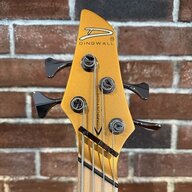
- Dingwall Super J (3X SF2 pickups, Glockenklang preamp set flat, new'ish Dingwall nickel roundwounds) into the Anagram, then into a Trickfish Bullhead 1K powering a Bergantino NV115. I'll repeat this one tomorrow into a Trickfish TF212V cabinet which has a tweeter, unlike the Bergantino.
- Same bass as above into the Anagram with my IEMs connected to the headphone jack (64 Audio N8 custom IEMs).
The most impressive feature of this unit is how successfully Darkglass implemented unity gain from processing block to block, and similarly how well calibrated input and output settings are. If you add a value of X to the input control and then subtract the same value of X from the output the net output from the block remains shockingly consistent. This is implemented much better than on the HX Stomp and on basically any analog pedal I've ever owned. Really nicely done.
The general GUI and user experience of the pedal is very good. I see what some people have mentioned about the touchscreen not being the most responsive thing on the planet, but to me it works just fine provided you're making deliberate and smooth movements. If you attempt to flick your way through things it won't work well, but slow down a little, be more explicit in how you make screen decisions and it works well.
The granularity of the six control knobs leaves a lot to be desired. They seem calibrated to favor making big moves and struggle when making small moves. Not a huge deal as in most cases with this pedal, differences of tenths don't matter to a huge degree, whereas differences of half an integer do make a noticeable difference and are within the range of control for the knobs. If you want to tweak down to the tenth you'll likely struggle.
There's been much discussion about latency with this unit as well as other modelers. As I knew going in, it's a complete and utter non-issue. Yes, there is latency as there is with all digital units, as well as with all airborne transmission of audio since there's no getting around physics and the speed of sound is around 1ms per foot (not super accurate, but close enough depending on elevation and relative humidity as they relate to air density). Don't sweat the latency. It's not a factor worth considering.
The amps are an interesting flavor. As others have noted, they really only modeled the frequency response characteristics of the amps they've included. There's no means of saturating or overdriving an amp. If you want those characteristics you have to add one of the overdrive/distortion/fuzz pedals before or after the amp, which rarely feels like the same thing. For my needs as a predominantly RnB, soul, funk, pop, jazz bassist that's fine as I typically prefer a clean amp with the option to turn on an overdrive pedal when needed. I almost never need an always on drive like you'd get from a pushed tube amp, but for those that play in more rock and metal contexts this could be a downside for them.
Of the amps I found that I liked the Harmonic Booster the best, especially with the character knob somewhere in the 2.5-3.5 range and the blend around 50-65%. Just enough color to be interesting, but still enough of the dry DI signal to retain the character and all-important midrange of my bass. I was surprised by how much I liked the Leo (Fender) amp. I really disliked the Gentle (Noble) for it's odd midrange voicing and the Peggy (Ampeg) which felt bloated down low and pingy up top in a very unpleasant way. The Super California (Mesa, I think) was okay but didn't blow me away. It felt a bit like a less impressive Leo, but in a mix it might have faired a bit better as the Leo has a noticeable scoop to the midrange. The Jim (Marshall) really surprised me. In demos I've not been impressed with it, but it actually sounds quite nice. It might be my second favorite of the factory amps. I'll do more testing with it. The Kallinen Kruukkeri (GK) amp was a mixed bag. With the mid contour turned on it sounded thin and overly crispy up top. With it turned off it sounded uninteresting and kind of honky in the midrange. It's not an amp for me, but I could see it working well in a number of contexts outside of my usual work. I was surprised as I've owned many GK amps over the years and generally get along well with their tone stack.
All of the factory cab models sounded awful to me. Well... the Mountaintino 610 (Bergantino NV610) sounded okay, but had some noticeable bloat going on down low. The artist cabs also had some garbage, but the Nolly captures sounded great. Not surprisingly given how great he is at developing tones. I ended up really liking the Nolly Blend a lot. I'll be sticking with that for the moment. I have the Shiftline IR pack from when I was an HX Stomp user and there were a couple of IRs in there that I really liked. Tomorrow I'll load those into the Anagram and see if any can beat the Nolly Blend IR. Currently running the Nolly Blend at about 50-65% really does the trick of sounding like the best of a cab IR and a dry DI.
I didn't think the high pass filter was going to offer anything exciting, but to my surprise it included a -6db/oct setting, which is something I always really enjoy. I like setting the filter frequency up in the 65-80hz range depending on the gig, but sometimes with a -12db/oct slope that can gut the bottom end a bit more than I'd like so I end up having to roll it down into the 40hz range which can cause interference with the kick drum on certain gigs. A -6db/oct setting let's me set the filter higher, but still retain just enough bottom end to fill out the mix without totally clashing with the kick drum.
Of the octaves I greatly preferred the Sublemon. It was the most OC-2'ish, which is really my home base when it comes to octave pedals. It sounded somewhere between just okay and decent doing the typical 50/50 Sledgehammer type tone. The other two octaves sounded pretty bad doing the 50/50 thing to my ears. The filter cutoff frequency control can be used to generate some Mantic Hulk type tones or to make the octaves sound more crunchy, but in general I think Darkglass did a good job of tuning where the midpoint setting (5.0) places the filter cutoff. Disappointingly I thought all of the octaves did a poor job of doing the Tim Lefebvre and Janek Gwizdala 100% set OC-2 sound. No matter the settings I could not emulate that type of sound effectively. It's not a sound I need often, but I do have gigs where it's called for and in those instances I'd be forced to either bring my 3Leaf Octabvre or to just deal with a bad sounding version of it from the Anagram. Also of note, when I engaged Subcitri, the polyphonic octaver, I could detect noticeable latency through my IEMs. Not bad enough to make me unable to play tight to a groove, but enough for me to notice and feel "off" with it engaged. There may be some processing that requires lookahead to achieve polyphony, so this might be a necessary evil if you need an octave-down effect on chords. I never do and I also don't like the sound of that processing block, so for me it's a non-issue but I wanted to mention it. Lastly on octaves; The tracking is incredible. Better even than digital octave pedals I've used in the past like various POG iterations and what's included in Helix. The tracking is glitch-free and capable of sustaining notes far lower than I ever use an octave-down effect to play. Really top notch execution in the tracking department. I have an MTD that I play in one band and my 3Leaf Octabvre struggles to track the Bb on the D string where that bass has this weird dead spot. That's not a fault of the 3Leaf pedal at all, it's just a wonky spot on that MTD that I have to accommodate when using it. I'm going to try it into the Anagram tomorrow to see how it fares given how impressive the tracking was with my Dingwall. I doubt it will be able to track it meaningfully, but I was so impressed I simply have to try it.
As for other effects, outside of distortions and envelop filters, which I'll talk about separately, I really only ever use the occasional chorus and reverb. The Mint Chocolate chorus sounds nice with the depth set around 5.0 and the rate down around 1.25khz. It's not quite as nice sounding as my Analogman Mini Chorus with the deep mod, but unlike the Analogman the Mint Chorus doesn't come with a built-in volume jump. It's a chorus that sounds nice and achieves unity gain when engaged. For the limited amount I use a chorus pedal I'll happily deal with slightly lower effect quality for one that doesn't all of a sudden at 2-3db to my output volume. The reverbs all generally sound nice as do the delays. The only use I have for reverb is on gigs where I'm playing an electric upright. A little reverb helps an EUB sound a bit more like an acoustic upright. Tomorrow I'm going to try building a patch for EUB gigs with a split to only apply reverb to the upper midrange and higher frequencies while leaving the bottom end dry. I think the room reverb processing block will sound really nice for this application. I never use delay, but I will say that the delays all sounded great with my preference being the digital delay for it's precision and how clean the repeats are.
Envelope filters... they're... sigh... they're trash. I hate them. The Mu-Tron'ish one and the Moog'ish one. I don't know what to say. The filter action is unresponsive in all but the most extreme of settings. The filter sounds are either bloated and muddy or overly thin and plinky sounding. I rarely need an envelop filter. In fact, of all my gigs there's only one band where I use one and it's in a solo feature where I could easily omit it and be just fine. I typically use a 3Leaf Proton mkIV for this task and it sounds incredible. I hated the envelope filters in the HX Stomp and have heard that the ones in the Quad Cortex are also awful. I was hoping the Anagram would be better, but I could not get anything usable out of either block. Tomorrow I'll explore some of the factory and user presets from the Darkglass Suite to see if I'm just misunderstanding the settings, but something tells me I'm just not going to be a fan.
Distortion pedals are tough. I always struggle with them. Generally speaking the overdrive that's consistently worked well for me is the B3K. I currently have a B1K on my analog board and it works great. It's well voiced for bass, and even though it has a reputation of being this rock and metal de facto sound, I use it in my RnB, pop, soul, funk, etc. contexts all the time and it works great. The version in the Anagram sounds like the hardware one to me. Good enough. Moving on. I've own the VMT in the past and didn't like the way it softened the attack of notes. The Anagram version does the same, although arguably feels a bit more usable than the actual pedal it's emulating, so in this case I think I like the Anagram version more than the real one. I've never owned an Alpha-Omega/Omicron, but if they're anything like the Anagram model I wouldn't like them anyway. Not for me. I've owned the small verison of the X pedal and the Anagram version feels like a good recreation. It's not a sound I prefer, but overall it's probably my second favorite Darkglass distortion sound. Usable, just not my thing. I've owned a Duality before and the Anagram version sounds a little more gated and synthy than the actual pedal. I think I prefer the sound of the Anagram version as it's more like my 3Leaf Doom2 than the Duality pedal to my ears. Not quite as interesting sounding as the Doom2, but it'll do in a pinch. The Anagram version felt very touchy to changes in input level. I don't remember if that was the case on the actual pedal or not. Either way, it's passable and may have uses for me in low gain applications paired with a 100% wet octave to generate synth tones. The Chinchilla sucks. I hate it. Maybe in a crossover split it would be better, but I didn't bother. It's not for me. I've never really gotten along with Rat-based distortions, so this is no surprise.
The biggest problem I've got with the Anagram is something I also didn't like about the HX Stomp, which is the introduction of audible inharmonic content. This occurs with two specific processes; The pitch shifting block, and non-linear processes (aka various forms of distortion). I'm not sure if these are introducing harmonic content that exceeds Nyquist thus resulting in aliasing that folds down into the audible spectrum inharmonically to the sound source or what, but once you hear it you can't unhear it. The Anagram operates internally at a sample rate of 48khz, which puts Nyquist up at 24khz. I'm not sure how Darkglass implemented their anti-aliasing filter, but if aliasing is the cause of these inharmonic sounds, an oversampling option for processing blocks that introduce non-linearities could be a nice inclusion. A harmonic series generated by a bass guitar, even a bright one, has to be pretty significant to generate content above 24khz resulting in aliasing and inharmonic audible fold down, so I'm not convinced that aliasing is actually the culprit, but I have no other ideas as to what could be the source of this with two digital pedals from two wholly separate manufacturers. Curiously, with the HX Stomp it was more noticeable in my IEMs and less noticeable in my cabs, but with the Anagram it was the opposite. When testing through my NV115 I could hear it clearly, particularly on the pitch shifter, but also on the various distortions once the saturation was set high enough. When I switched to my IEMs it was improved but not totally eliminated. Again, the HX Stomp was the opposite in this regard. With no pitch shifter block or distortion is't a complete non-issue. Once they're introduced it becomes a guessing game as to whether I can deal with it or not. If anything causes me to sell the Anagram it will be this. It made me sell my HX Stomp, so I wouldn't be surprised if it kills my desire to keep the Anagram. Only time will tell.
Speaking of the pitch shifter; It worked well enough in terms of tracking and lowering my bass from E standard to Eb standard, which is a function I was hoping to utilize with a band I play in occasionally. Their entire set is in E standard except for one song where they switch guitars to Eb standard. I never want to bring two basses and don't want to bother tuning all of my strings down, so I just play it up an octave (i.e. sixth fret of the A string for the root), but it really does sound better tuned down a semitone. The problem is the introduction of inharmonic content as described in the previous paragraph. It was so present through my NV115 that it was unusable. Through my IEMs it was mitigated to some degree, but still present. The band where I want that functionality doesn't use IEMs, so unless I can figure out a way to eliminate the inharmonic content it won't be an option.
Last, but not least an interesting note about the compressors. I did not try the limiter as I've never met a limiter I liked. I tried the Hyper Luminal (FET) compressor and found that no matter the setting, I could not hear any audible compression occurring. I set the compressor for a 20:1 ratio with the fastest attack and slowest release possible, then cranked the input control and nothing changed. Thinking that perhaps the compressor worked by lowering the input control, thus marking it more of a threshold control, I tried the opposite approach and the results remained unchanged. Frustrated, I switched to the Buss Compressor which I assume is some sort of VCA emulation like what you'd find on an SSL console. I set the compression ratio to the maximum setting of 10:1, the fastest attack, the shortest release, and lowered the threshold control to the bottom so that ANY signal entering the block would trigger the compression. This sounded like it was doing something, but nowhere near what a 10:1 compressor should sound like with a -40db threshold in place. I recorded a loop into the Anagram and then sent the output into Logic to get a visual representation of what I described above. I've included a screenshot of that below with the various settings described in the track header.
My compressor conclusions:
- The 'No Comp' track (blue) has no compressor processing block inserted into the Anagram at all.
- The Luminal default settings, and then both of the input/output min/max versions are all shockingly close. So close that there's no way a 20:1 compression ratio was being applied. It's as if this compressor does nothing. I could not get it to null against the 'No Comp' version, so either it's doing something very subtle outside of compression, or I wasn't perfectly time-aligning the two tracks despite zooming into to sample levels of visibility for time alignment. Regardless, in my testing, the Hyper Luminal provided zero actual compression. None. Nada. Zip. Zilch. At this point I wouldn't even call it a compressor. I'll do more testing and would be happy to learn that I'm using the Hyper Luminal wrong, but as an audio engineer I feel well qualified to navigate a compressor. Still, I've done dumber things, so if anyone can clarify how to get this thing to actually compress I'd love to hear it. For now, it's simply a compressor in name only, not at all in function.
- The buss compressor with a threshold setting of -40db at 10:1 provides clearly visible compression, but to my ears it sounded nothing like a 10:1 compressor. The last track in the last uses a Fabfilter C2 compressor in Logic with identical settings and it makes a visible difference in the level of compression and it actually sounds like 10:1 compression. Fabfilter C2 measures perfectly in Plugin Doctor, so I know that it's actually providing a 10:1 ratio. The Anagram's Buss compressor is at least doing something, as compared to Hyper Luminal which is not compressing at all, but despite the 10:1 option, it is not in fact providing 10:1 compression but rather something less than that.
- Ultimately I went with the Buss compressor set for maximum squash, or rather as much maximum squash it's capable of which is very limited, and then set the blend to 65% and was happy enough with the result.
- The Hyper Luminal is useless, the Buss is fine enough but pretty underwhelming, and both absolutely stink when compared to my Keely Compressor Pro which sounds better, has more pleasing compressor attack/release and knee characteristics, as well as also providing believable levels of gain reduction with visible metering.
- Darkglass really needs to implement gain reduction metering in the Anagram. People have been screaming for it with the HX Stomp for years, so it's a real oversight on the part of Darkglass to omit such an often-requested feature from arguably their biggest competitor.
View attachment 7244946
So there we go. An overly long-winded post of mostly positives, some middling bits, and a few outright negatives. Time will tell for me and the Anagram. I really want to like it. I hope the negatives don't win out. More testing and verbose opinions to come in the next few days. To be continued...