• TalkBass has been independent since 1998. Add your voice.
    Create a free account to reply to discussions, view embedded media, and browse with fewer display ads.
    Join freeLog in
    Want zero display ads or expanded classifieds tools? Compare plans.

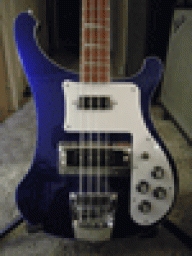
Dead rickenbacker, smashing.

Hey...wait a minute...

Anyone receive a new Ric in the last year or so with colored ball ends?

Yup, bought my MID from the MF sale and it has the same colored ball ends on it.

You know, it would be cool to have a guitar-style custom bass like the ones JohnK builds and put these Ric parts on it. Or maybe build yourself a 3000-series-style body. If only I had time and money to learn how to do that stuff this'd be a ball.
 
If someone buys it for $300, has a luthier fix the neck for another $300 (leave the finish alone), buy a new pickguard for $30, add shipping to and from the luthier and for the pickguard, someone still gets a hell of a good deal!

well, it already at $355 + shipping and there's still more than 3 days to go with 3 bids so i'm guessing that it'll end up closer to $500 or more.
 
Does this mean that Musiciansfriend sells off their broken Ricks to a third party to liquidate through Ebay?:eyebrow:
I wonder if PMagers knows about this since he sent it back to MF for a refund according to his post.

MF has a used section that broken basses are sold in BUT sometimes they dont sell them and they are sold bya 3rd party , i know this for a fact as I bought a used jazz 24 from them , wrote down the serial number and a few months later it was on ebay , I posted a thread about MF doing that just to inform people and everyone here jumped on me like sharks , people can be moody
 
Is my experience somehow less valid on talkbass because I'm a bad musician? I'm glad you've all had a laugh at my attempt to share layman's experience with wood breakage and repair. I do not claim to be a professional at anything. I have forged iron with a maple handled sledge thinner in all dimensions than the lower neck of a Rickenbacker. The wood is up to task if the lumber is sound. Something terrible happened to that Rickenbacker but the weak link was found. I couldn't care less who manufactured the bass or who broke it. I am only commenting on the wood.

Following the auction link and looking at the 4th picture from the bottom I can see what I believe to be grain run out. It is visible on the exposed portion of the body and also on the matching part of the neck. You can see that on one half of the break the wood grain is long and unsplintered from the body to the radiused portion of the heel, but the opposite side (lets call that the right side) has diagonal splinters going upwards at an angle. You can follow the angle of that run out into the body where the neck pickup cavity begins.

In the 3rd image from the bottom you can see the cracked wood and paint on the heel of the right side of the neck. The paint makes it a dead giveaway. Please notice how the wood grain here is also at an angle and not straight across. It follows a similar grain pattern to the broken area of the neck just millimeters below it.

The evidence I used to conclude the existence of grain run out was found in the same images everyone else has been looking at. So yes, that is exactly the kind of guitar expertise that comes from replacing a bunch of axe and shovel handles. If no one else can find the relationship between the two then you better stick to paying a luthier for all your work since you can't follow lines on a computer screen.

If it were not damaged so severely I think that bass would have lived a long life of normal use until potentially breaking disastrously upon first hard impact.

Good luck to the high bidder. I do think it is repairable with simple methods, but don't take my word for it, I'm just a cook!
 
I think without knowing exactly what force(s) took place to break the bass in the first place this whole "good wood/bad wood" argument is kind of mute. If seen a high quality maple baseball bat snapped in two over the knee by an lumpy pitcher.

 
Its at 400$ now, thanks to me , i threw my hat in the ring on it but anymore then that and I didnt want it.

Good luck!
I hope someone does make a bass out of it again if possible.

As far as the grain issue goes, I know nothing about the vagaries of wood grain, and had only the initial pic to view.
The rest were added later, unless my PC wasn't showing the whole auction page for some reason.

I still don't know what you folks mean by 'runout'.
 
I think without knowing exactly what force(s) took place to break the bass in the first place this whole "good wood/bad wood" argument is kind of mute. If seen a high quality maple baseball bat snapped in two over the knee by an lumpy pitcher.

It's strange that the case pic only shows damage in the corner, but obviously the majority of the damage to the bass occurred near the base of the neck since the 'guard was destroyed.
 
I've been playing a Ric since 1980 and people come up to me all the time to talk about it. It is a genuine curiosity amongst most musicians. I can't think of another piece of gear that raises so much opinion. Look at this thread argument about a busted up instrument. Really?..
I recently added a Jazz Bass and have been using it onstage with my ol Ric on the stand as a spare. I have dudes coming up between sets and yelling out to play the Ricky. They certainly can cast a spell.
 
I think without knowing exactly what force(s) took place to break the bass in the first place this whole "good wood/bad wood" argument is kind of moot. If seen a high quality maple baseball bat snapped in two over the knee by an lumpy pitcher.

Good point.

I personally think the issue with the wood grain (runout) is irrelevant. Nobody here knows what forces were involved in the accident (was it a 2 foot drop onto concrete? was the case launched 25 feet in the air when the parcel truck made a sudden stop? did someone look at it the wrong way and question its pedigree?) so guessing that the integrity of the neck wood was a factor in the breakage is just that - a guess.
 
I wonder if you can run over the plastic case with a car or drop something heavy on it, crush the bass inside, and the case rebounds to normal shape? Doesn't seem likely, given how easily the corners crack.
Actually, the tolex case can probably rebound very easily on the sides because it is just flexible tolex over a layer of air. The actual protection element is styrofoam lined only on the inside by that soft black material. The reason the feet always crack is because SKB stupidly mounts them just on the tolex, not in the foam. If they were longer and foam-mounted those cracks would not happen; the tolex would flex and bounce back under pressure.
 
This is fun, can I play? I think Grebnaws is correct that the break follows the line of the grain. I am not a luthier, but was a professional cabinet maker for over two decades, and that, ladies and germs, is almost without exception, how wood breaks. In this case, it's a nice clean break with minimal grain disruption.

However- there isn't so much grain run out as one might think. Looking at picture #5, the break on the heel piece attached to the body appears to run at a considerable angle. Look at #6 just below which shows a fairly straight side view of the broken neck; the fracture runs nearly parallel to the neck, as would be expected for a high end, USA made instrument with good QC. Innocent on the run out grain charge, IMO.

Now I'm going to get in trouble. It's kind of a weak design. The heel doesn't appear to add that much to the strength of the neck/body transition area. The neck itself doesn't extend very deeply into the body, along the long axis, before the PU rout, and there are two truss rod cutouts further weakening the area. Neither is there very much depth in that section.

Granted, there are thousands of Rics that have managed to not spontaneously self-destruct. The instrument was clearly subjected to forces it was never designed for, and it failed at a weak point. Stuff happens, and it ain't really the Rics fault. In the interest of full disclosure, I pretty much don't care about Rics one way or another. They're pretty cool, just don't do much for me. Chacun à son goût.
 
Now I'm going to get in trouble. It's kind of a weak design. The heel doesn't appear to add that much to the strength of the neck/body transition area. The neck itself doesn't extend very deeply into the body, along the long axis, before the PU rout, and there are two truss rod cutouts further weakening the area. Neither is there very much depth in that section.

Granted, there are thousands of Rics that have managed to not spontaneously self-destruct.

Yes, I had a '77 4001 for years that was subjected to unreasonable abuse. Falling face first from stages, and being slammed to the ground after leaning against an amp. Multiple times. What can I say? I was young, drunk, and stupid. At any rate, the bass never even hiccuped after all that carnage. The finish is a different story...