
Enjoy the benefits of a premium membership!
Upgrade Account
-
TalkBass has been independent since 1998. Add your voice.
Create a free account to reply to discussions, view embedded media, and browse with fewer display ads.
Join free Log in
Want zero display ads or expanded classifieds tools? Compare plans.
You are using an out of date browser. It may not display this or other websites correctly.
You should upgrade or use an alternative browser.
You should upgrade or use an alternative browser.
Dead spot on Fender MIA.
- Thread starter julo
- Start date
More options
Who Replied?
I dont think a bass without deadspots exists, i think people who cant hear them exist but every bass i ever tried had some sort of dead spot i own a 1966 and 2008 jazz a G&L SB2, a HumanBase Class X and all of them have some sort of dead spot.

Sometime a dead spot is due to a loose part, like a tuner or pick guard.
Try playing the dead note and pushing on the suspected loose part at the same time.
It was a slightly vibrating pick guard on one of my American made basses, that deadened the B at the 12th fret area. I finally found it after pushing and poking at everything thinkable in the realm of hardware.
Worth a try, maybe.
Try playing the dead note and pushing on the suspected loose part at the same time.
It was a slightly vibrating pick guard on one of my American made basses, that deadened the B at the 12th fret area. I finally found it after pushing and poking at everything thinkable in the realm of hardware.
Worth a try, maybe.
This pretty much sums up why dead spots occur.
Invalid Link Removed
guese it down to the wood and not the actual build quality and since you cant exactly genetically engeneer a chunk of maple so theirs no dead spots guess were just gonna have to live with it.Luck of the draw really.
Actually since graphite is man-made does that mean graphite necks dont have dead spots?
Invalid Link Removed
guese it down to the wood and not the actual build quality and since you cant exactly genetically engeneer a chunk of maple so theirs no dead spots guess were just gonna have to live with it.Luck of the draw really.
Actually since graphite is man-made does that mean graphite necks dont have dead spots?

Dead spots can happen on any string instruments of any caliber.
Absolutely right. I had several lengthy exchanges of e-mails with Roger Sadowsky on the subject a few years ago when after receiving my NYC dream bass from him, realized that it had a terrible dead spot at the 5th fret on the G string. The long and short of it is that is inherent in the design and there is not much that can be done about it except one of the weights that attaches to the headstock like a fat finger. I used one for a while but got tired of everyone asking me what the doodad was on my headstock and sold the bass.
The good news for me is that after selling the NYC bass I found a Metro with minimal dead spots


how would you describe a "dead spot"?
can you provide some mp3 examples or something?
I've noticed on some basses certain notes just don't resonate as much... and I wonder if that's what you're talking about here. If it is... then almost evry bass I've tried had them. From the ones I own, only the Warwick Corvette would be free from them. But I'm not sure if we're describing the same thing.
For me a dead spot is a note that does not have enough fundamental sustain to play a reasonably punchy note. It is a resonance/sustain issue. I have one bass where the spot is between two frets, so it shows up only when you slide or hammer on. Its not a fret or setup issue.
Almost all basses have variations in sustain across the neck, but its a matter of degree. I've played some nice basses where you might as well have not plucked one or two notes, they're just gone. Like Roger says most people, even pros, don't notice or just work around them.
I have had graphite neck basses with dead spots, there seems to be no guaranteed solution.
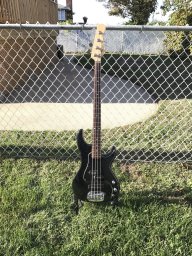
I never ever played a deadspot on any Fenders ever since i first started playing ages back...guess I'm just luckey.

It's not a design flaw,but I think it's most noticable on 34" scale instruments. My 73 jazz has one in the typical spot,but I never really notice it. The question is,how much sustain to you really need?
Thanks guys for all the feedback.
I agree with the statement that all instruments have a dead spot; it's just more or less noticeable.
I was just surprised by how noticeable it was on those MIA.
Would an Alembic or a Fodera have dead spot or is it because Vic doesn't need sustain when he does the crazy thumping?
I'm just curious to hear about the high end instrument?
Yes I meant dead spot = lack of sustain.
Well sometimes you need sustain for example with a Synth pedal when you have long release on the filter. It will die sooner than any other notes.
The solution is to play the note somewhere else on the neck but still.
Btw, I tuned my MIM P to CFA#D# with a set of Roto Swing 130->65 and the dead spot is less noticeable.
I know I shouldn't worry too much, I was just surprised about the MIA.
J
I agree with the statement that all instruments have a dead spot; it's just more or less noticeable.
I was just surprised by how noticeable it was on those MIA.
Would an Alembic or a Fodera have dead spot or is it because Vic doesn't need sustain when he does the crazy thumping?
I'm just curious to hear about the high end instrument?
Yes I meant dead spot = lack of sustain.
Well sometimes you need sustain for example with a Synth pedal when you have long release on the filter. It will die sooner than any other notes.
The solution is to play the note somewhere else on the neck but still.
Btw, I tuned my MIM P to CFA#D# with a set of Roto Swing 130->65 and the dead spot is less noticeable.
I know I shouldn't worry too much, I was just surprised about the MIA.
J

I've always heard that most fender basses have the "usual" dead spots,
which I don't remember now what they are.
The 7th fret "D" on the G-string doesn't seem to ring out like other notes on
my two MIM Classic '50s P's.
which I don't remember now what they are.
The 7th fret "D" on the G-string doesn't seem to ring out like other notes on
my two MIM Classic '50s P's.

I gotta deadspot on my MIJ fretless Jazz, 7th position on G string.
Instead of "mwaahh", it seems to go something like "bVow-".
Instead of "mwaahh", it seems to go something like "bVow-".
Yeah, the MIM I just picked up has a dead spot on the 13th fret of the D string.. Kind of annoying but Rarely in a band setting do i venture into the upper register anyway.
Other than that it's great. My main player as far as I know has no dead spots..Which is cool, but again..If it did and they were out of my way it wouldn't matter.
Other than that it's great. My main player as far as I know has no dead spots..Which is cool, but again..If it did and they were out of my way it wouldn't matter.

My low end Peavey Milestone developed a fairly serious number of deadspots on the octave of the d string and on the 7th fret of the g string. The wood in the bass must have changed over the year I've so far owned it. I played around with a small c-clamp on the headstock and noticed that it did improve things if it were attached near the far tip. Ultimately I glued a large nut on the back of the headstock which was barely noticeable from the front and it improved things very well. Occasionally I use the nut as a flag-holder...on Canada Day when I play Rush songs. 
Yes, it does look bizarre but it works REALLY well.
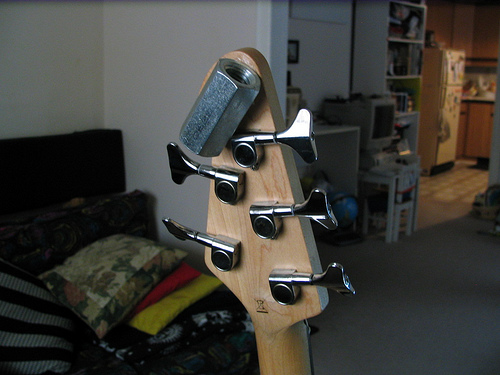
Yes, it does look bizarre but it works REALLY well.
I've owned well over 20 Fender basses in my time.
MIM, Japan, USA, etc.
All had deadspots on the 1st string, middle frets.
Death & Taxes...and deadspots.
MIM, Japan, USA, etc.
All had deadspots on the 1st string, middle frets.
Death & Taxes...and deadspots.



I'd wear steel-toed boots if I played that bass!
Oh, and all my basses suffer to some degree from dead spots on the G string.

Before I read a single post in this thread, I said "G string, 5th and 6th fret." Lots of Fenders have a dead spot there. I changed the neck on one, and it went away. It's not uncommon at all.
It isn't so bad, you can't even see it from the front:
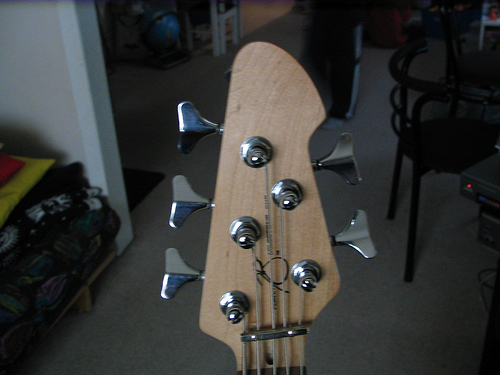
I'd wear steel-toed boots if I played that bass!
Oh, and all my basses suffer to some degree from dead spots on the G string.

I have tried basses at *every* price point, with every construction type (yes, including graphite necks and neck troughs) that had dead spots. I've bought dozens of basses where the seller told me "no dead spots" and they had one. Some people really don't seem to notice or mind, but they drive me nuts. The only real solution is try before you buy.
I also have played a handful of Fender style basses that are extremely even across the whole range -- keepers!
+1
Every bass has it.

Yep, my '08 Am.Std. P has the normal one, at the 5th and 6th fret, G string. But it's not bad, really. Much less than some I've encountered. Hardly noticeable in a live context.
I do own a bass that has NO deadspots, at all. Absolutely none. But it's a weirdo, a Westone Rail.
I do own a bass that has NO deadspots, at all. Absolutely none. But it's a weirdo, a Westone Rail.
Latest posts
-

-

-

-
 Misled by Talkbass Seller on Recent Trade
- Latest: MultiScaleMale
