

Enjoy the benefits of a premium membership!
Upgrade Account
-
TalkBass has been independent since 1998. Add your voice.
Create a free account to reply to discussions, view embedded media, and browse with fewer display ads.
Join free Log in
Want zero display ads or expanded classifieds tools? Compare plans.
You are using an out of date browser. It may not display this or other websites correctly.
You should upgrade or use an alternative browser.
You should upgrade or use an alternative browser.
dead spots in all fender jazz basses???
- Thread starter DEFELDUS
- Start date
More options
Who Replied?


As a result of this thread I just checked my 2009 Fender Am Std Jazz V.
There are other issues, like the B string doesn't seem totally connected to the other 4.
It notices acoustically, though not so much through an amp, but there are no dead spots on any string.
There are other issues, like the B string doesn't seem totally connected to the other 4.
It notices acoustically, though not so much through an amp, but there are no dead spots on any string.
If my Steinberger XP2 composite neck has a deadspot, I can't hear it. I don't understand the science of it, but it seems intuitive that a neck made of a consistent material throughout would be less prone to dead spots. I know Ned Steinberger did a lot of research on this from an Engineering standpoint back in the 80's, don't know if he ever published anything.
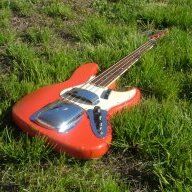
My 1966 Jazz has a dead spot on the 6th fret of the G string. I have it since 1980, but I started to notice it only a couple of years ago.
Either it's getting older or I am more aware of it. Anyway I think it's more noticeable with flats on.
One thing that helped me a little was tightening any screw available on the bass.
I used to have a Squier Vintage Modified Telecaster Bass which had a couple of dead spots as well.
I read somewhere that it's a common issue with bolt on necks, in fact, my 2 other basses, Ibanez agb140 and
Ibanez aeb 10 don't have any problem, since the necks are glued to the body.
Either it's getting older or I am more aware of it. Anyway I think it's more noticeable with flats on.
One thing that helped me a little was tightening any screw available on the bass.
I used to have a Squier Vintage Modified Telecaster Bass which had a couple of dead spots as well.
I read somewhere that it's a common issue with bolt on necks, in fact, my 2 other basses, Ibanez agb140 and
Ibanez aeb 10 don't have any problem, since the necks are glued to the body.
Attachments


None on my '96:
I've researched this topic as there is a dead spot on another guitar I own. Apparently, if weight is added (a hole routed underneath a tuning machine head was suggested) this will alleviate the problem:
http://www.google.ca/url?sa=t&rct=j&q=&esrc=s&source=web&cd=2&cad=rja&uact=8&ved=0CCoQFjAB&url=http://www.bestbassgear.com/ebass/gear/hardware/tuner/treating-your-basses-deadspot.html&ei=7S8UVZLKGomTyASUn4DQCw&usg=AFQjCNEfSwXTw3Jp12yNXMX9GlUSqcbx3w
I've researched this topic as there is a dead spot on another guitar I own. Apparently, if weight is added (a hole routed underneath a tuning machine head was suggested) this will alleviate the problem:
http://www.google.ca/url?sa=t&rct=j&q=&esrc=s&source=web&cd=2&cad=rja&uact=8&ved=0CCoQFjAB&url=http://www.bestbassgear.com/ebass/gear/hardware/tuner/treating-your-basses-deadspot.html&ei=7S8UVZLKGomTyASUn4DQCw&usg=AFQjCNEfSwXTw3Jp12yNXMX9GlUSqcbx3w

GW writes:
My experience is that lighter weight tuners increase the dead spot problem. Using heavier gears has a similar effect to using a Fatfinger---it increases mass at the headstock.
Roger
Agree, my fretless had some gotoh super light tuners and a very noticeable dead spot, I switched to stock heavier fenders and it is much better, still noticeable but only if you really try.
A couple of caveats here.
1) You are not just adding weight to the headstock; you are tuning the headstock. How much weight makes a difference; where you place it makes a difference. Heck, even the weighting materials you use may make a difference.
2) Drilling and adding weights beneath the tuners may work; or not. Swapping in heavier tuners may work; or not. It's a good idea not to commit to any irreversible mods until you are sure they deliver what you want.
3) Regarding fat) fingers and Fender-style headstocks: Every time I tried to get rid of the dead spot(s) on Fender-style necks -- for years -- I failed epically. Nothing -- including three baseplates from disc brake shoes attached to the headstock -- made any difference. I recently bought (got ambushed by a going out of business sale, actually) a MIM P-bass (no NBD yet) which had dead spots under the G-string from frets four through seven, almost right up to that sweet ninth-fret E which I regard as the "honey" note on that string.
I recently had great success with fat) fingers on some 2+2 headstocks, so I figured "Why not try the fat) finger? on the P" I tried almost every inch of real estate on that headstock; nothing. Then, purely out of desperation, I stuck the f) f on a spot I had never tried before: dead up against the nut on the treble side, with the finger crossing beneath three strings.
Bingo!! THE magic spot. All those dead notes made it into the "honey" zone, and I consider this bass now functionally dead spot free.
It's not just what you do, it's where you do it.
1) You are not just adding weight to the headstock; you are tuning the headstock. How much weight makes a difference; where you place it makes a difference. Heck, even the weighting materials you use may make a difference.
2) Drilling and adding weights beneath the tuners may work; or not. Swapping in heavier tuners may work; or not. It's a good idea not to commit to any irreversible mods until you are sure they deliver what you want.
3) Regarding fat) fingers and Fender-style headstocks: Every time I tried to get rid of the dead spot(s) on Fender-style necks -- for years -- I failed epically. Nothing -- including three baseplates from disc brake shoes attached to the headstock -- made any difference. I recently bought (got ambushed by a going out of business sale, actually) a MIM P-bass (no NBD yet) which had dead spots under the G-string from frets four through seven, almost right up to that sweet ninth-fret E which I regard as the "honey" note on that string.
I recently had great success with fat) fingers on some 2+2 headstocks, so I figured "Why not try the fat) finger? on the P" I tried almost every inch of real estate on that headstock; nothing. Then, purely out of desperation, I stuck the f) f on a spot I had never tried before: dead up against the nut on the treble side, with the finger crossing beneath three strings.
Bingo!! THE magic spot. All those dead notes made it into the "honey" zone, and I consider this bass now functionally dead spot free.
It's not just what you do, it's where you do it.


Not every Fender has a dead spot.
Many, maybe most, but not all.
Adding weight can help, but sometimes reducing weight can also help.
The thing is that you are not really getting rid of the dead spot,
you are retuning the neck to move it,
hopefully to someplace you will never encounter it again.
Many, maybe most, but not all.
Adding weight can help, but sometimes reducing weight can also help.
The thing is that you are not really getting rid of the dead spot,
you are retuning the neck to move it,
hopefully to someplace you will never encounter it again.

Dead spots are not unique to Fenders. Or to long-scale basses. Or to bolt-on necks. But they exist, and the only options seem to be either to fix them or just live with them, unless you are one of the lucky few whose basses do not have them.
Good questionAre dead spots more or less noticable with any particular type of string...roundwounds, flatwounds, tapewounds?

Can't say I ever had that problem with mine maybe a dud but science its in both of yours it must be something else ?

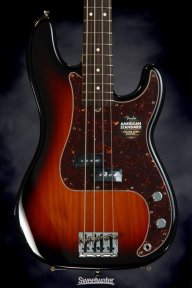
Fortunately, neither of my AmStd ('14 P4, '15 J4) nor my '63 AVRI have any appreciable dead spots.



BassHappy
Supporting Member

If you slowly play long notes, several seconds each, up the G string, you notice absolutely no difference in sustain on any note, especially as you get to the 5th- 7th fret? It's very common. It it usually very subtle too.Non of the Fenders I have owned or the Fender I currently own have had any dead spots. Perhaps the problem lies elsewhere.
If you slowly play long notes, several seconds each, up the G string, you notice absolutely no difference in sustain on any note, especially as you get to the 5th- 7th fret? It's very common. It it usually very subtle too.
I have an American Standard Jazz. Every note is consistent over all the strings and frets. Sustain is no problem anywhere.
I think many people don't notice dead spots and they have no real effect on their playing - but you can often point them out when you pick up the bass and say - so listen, that note has slightly less sustain than those around it - but it may make no difference to you and is certainly inaudible to any audience.
Add in things like an octaver or a synth trigger and your dead spots come leaping out at you.


