• TalkBass has been independent since 1998. Add your voice.
    Create a free account to reply to discussions, view embedded media, and browse with fewer display ads.
    Join freeLog in
    Want zero display ads or expanded classifieds tools? Compare plans.

Dead Spots on Fenders..Huh?

Great flaming cat whiskers! Are we back here again? I thought we had the definitive thread on this a just few months ago, and therefore very little new or original appears in this one. So, referencing those other threads, and in an effort not be redundant, I'm just going to say:

1) What we are generalizing as "dead spots" actually manifests itself in three different ways.

2) I have bolt-on basses, set-neck basses, neck-though basses, acoustic bass guitars, upright basses, fretted and fretless basses, short-, medium-, long-scale basses, 2 +2 headstocks, four-in-lines, new basses, old basses, jurassic basses. Some of them had/have dead spots; some do not. I have yet to find a dead spot on a medium-scale bass. (Behave yourself! BassHappy)

3) Things I have done (singly or in combination) to combat dead spots:
a) loosen the truss rod;
b) go to lighter-gauge strings;
c) tune down a whole step
d) tune the headstock.
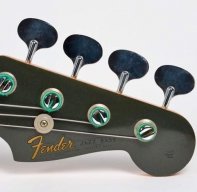
This goes beyond just sticking a c-clamp, Fathead, or Fatfinger on the headstock, which in addition to being beastly heavy in many instances adds weight to only one place on the headstock. My approach is similar to JohnTK104's (?), only a lot less professional. I simply get odd bits of metal from the local hardware store and move them about on the rear of the headstock
using poster putty. Once I find the optimum position for them re the dead spot, I make a "permanent" reversible attachment using a small bit silicone adhesive (aka Shoe-Goo).

How much weight, where you put the weight, even what kind of weight: in my experience all of these make a difference.
 
BH - I gotta admit, I was skeptical about medium scale basses being free of dead spots but since I saw your post on it several months ago I've tried a number of 32" scale basses and have yet to find one with a dead spot. I did find a very mild dead spot on a short scale but you really had to listen for it.

Thanks for this GBass -

Listen I am not trying to be controversial, arrogant, a know it all - or any of those things....

But the truth is the truth. That's all. And I suppose I am not evolved enough in this lifetime to ignore a blanket statement that simply isn't true - about all instruments having dead spots.

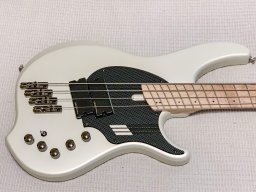
I have asked on here repeatedly - and I have only found one or maybe two guys on here with medium scales who have discovered dead spots. You would have to look back at the threads to know for sure - but my recollection is that one was possibly a Dingwall and the other was a Gretsch B5123. I have a B5123 and mine is fine as far as the four count test goes. Yes, every note every string rings like a bell.

I am very curious about this and I would ask anyone with a medium scale - regardless of price or category/brand - please let me know about any dead spots on your medium scale instrument. I have experienced dead spots on long scales and a couple of times on short scales - but mediums seem to be reasonably immune.

Just my opinion, I would love to be proven wrong.

BassHappy
Link Removed
 
Sorry if 34 years as a gigging musician isn't proof enough for you, but dead spots do exist, and if you do a search (gee, that request again?) you'll see that there are solutions. It's all about headstock to body mass ratios - these define the resonance frequency of the instrument as a whole. People talk about adding weight to the headstock or replacing aluminum bridges with more dense brass, etc. That may work, but the most desirable solution in my book, which addresses two issues, that of dead spots and neck dive (something I've never cared about, but apparently, others do), is to switch to light-weight tuners. It may not work, but it's a simple way of changing the headstock to body mass ratio and it helps with neck-dive.

I have experience with this working very well on a Rick 4003 FL and a Fender P FL. You don't eliminate the dead spot, you move it to a place that doesn't matter. YRMV. This is the last time I'll post this.
 
The Exploratorium in San Francisco has some great exhibits about sound and frequency (among other things). Very cool to be able to visualize and manipulate some of these phenomena. The unfortunately do not have a Fender bass on display, but nonetheless a worthwhile way to spend an afternoon if you are in the Bay Area.
 
  • Like
Reactions: faulknersj
One nice thing is, all the notes above the low G# are at least doubled, so if you have a dead spot on a note that you need to ring out for more than a beat or 2, just play it somewhere else.

Dead spots make me think of a friend of mine. He's always trippin' on noises that he thinks his truck is making. It's not a POS at all, and it's been running fine for years, but every time I go somewhere with him, he's like..
"You hear that rattle?"..
"Um, no"..
"You sure? I think it's coming from under your feet"..
"Nah, I don't hear anything."
15 minutes later..
"You sure you don't hear that?"
"Hahahaha, you want your truck have problems, huh?"
 
  • Like
Reactions: faulknersj
Neck stiffness also plays a big part in resonant frequency. It's a lot harder to change than headstock mass, though.

Neck stiffness is another reason why medium and short scale necks can be better at controlling dead/hot spots. A shorter neck is inherently stiffer than a longer neck would be if made from the same piece of wood. I've had precisely one long scale wood neck that didn't exhibit a dead spot to some degree. It's a P bass neck from Allparts that's very stiff.
 
Last edited:
IME,every bass has dead spots. Some are very noticeable where a note will only sustain for a second before stopping or being reduced to a harmonic. Others dead spots are non-issues; this note sustains for 9 seconds instead of 11. With an instrument made of wood and metal, different notes sustain for different amounts of time. Sometimes and for some people this is a problem.

I believe I am the G5123B owner BassHappy was talking about. I do not believe that 32" scale basses are immune, but I think the change in scale is similar to changing the mass of the headstock . Either can shift the dead spot so that it is less of an issue. I think the shorter scale can effectively shift the worst dead region off the end of the fingerboard, thus eliminating it.

So, with a 32" scale you are very likely to find one with acceptable sustain at every note. Far better odds here than with a 34" scale.

Blaming Fender or QC for this is silly. Blame physics instead.
 
This topic has been covered a number of times and has been beaten half to death. But - since you asked - and since I am a dead spot survivor I will tell my tale. First of all - ditto for medium scales as above from Mongo 2 - I have 15 mediums and nary a dead spot among em - although there was a report that a TB'er actually did find a dead spot once on a Gretsch B5123 medium scaler. But I have the same model and mine is fine.

I had a 1972 Fender jazz I bought brand new through the PX in Germany when I was in the army - natural ash finish with black block fingerboard. I replaced the pick guard with a clear one:

RIck%20&%20Stan3.jpg


The notes were COMPLETELY dead on both the G string and the D string from frets four to seven. I mean the notes would not even sustain for even a full second. I have no clips of it - sorry this was 1972. I guess I am one of the few bassists on here that occasionally play whole notes, because many folks say they have them but 1)it doesn't bother them for the style of music they play or 2)they rearrange their playing with work-arounds.

During the rehearsals for the song "Open Book" the song required three second whole notes. I soon realized the Fender Jazz just couldn't cut it and it became history. Until I found TB and realized dead spots were fairly common - I thought Fender was sending all their "seconds" to the GI's overseas. What I use for a little dead spot test on ANY bass I consider buying (when I am able) - is simply start on the G string (the most common culprit) with the first fret, pluck the note as you normally would and give it a one-mississippi, two mississippi, three mississippi, four. I would say if you make it to four you are looking good. Repeat for each note on each string exactly as described and please don't hate me. :thumbsup:

If anyone cares, this is the song that signaled the demise of my Fender Jazz. A little ditty in 5/8.


BassHappy
www.innertainment.net


Happy The Man! I did college radio (University Of Richmond) from '79 to '83 and used to play you guys all the time. Very cool.
 
Happy The Man! I did college radio (University Of Richmond) from '79 to '83 and used to play you guys all the time. Very cool.

Hey thanks for the airplay! Always appreciated - we have a lot of success with college radio - especially along the Eastern seaboard. And of course DC/Baltimore/ Virginia was always our stomping ground.

There is a pretty new website with some toons to stream for free here: http://www.everythinghappytheman.com/music.html

We finally got the rights back to our most recent release "The Muse Awakens" which has been out of print for a while. We are getting that sucka back on the market soon.

David who replaced Kit is pretty busy with Billy Joel these days, but there could be something fun happening soon....

BassHappy
www.innertainment.net
 
Every string instrument has notes that don't resonate as clearly as others. The body and neck have a resonance. When that resonance competes or interferes with the resonance any note, you get phase cancellation. Sometimes that is very mild maybe barely noticeable and sometimes, depending on the instrument, it can be horrific.

If you do a little research, you will find volumes on this subject including some remedies. All string instruments suffer from this to one degree or another. This is not a "Fender" problem. Double basses, Guitars, Violins, Violas, cellos and any brand of string instrument can have dead notes.

If you do not detect dead notes on your instrument, good for you. I assure you, the phenomenon is real. The deal is... when you buy an instrument, that is one of the first things you need to look for. While there are remedies, I suggest you find an instrument where you detect little or no dead spots.
 
  • Like
Reactions: Tim Skaggs
Not sure if this has been mentioned yet, but no less an authority than Roger Sadowsky has said that dead spots are common on bolt-on basses (he may have said they're virtually unavoidable); all we can do is try to minimize them. I'm lucky in that I've never had one serious enough to really bother me.
 
Here is something weird....the 'dead spot' I found on one of my J basses (C# on the G string) sounds basically normal when I play the bass unamplified/acoustically. It is only when I play it thru my amp that I can tell it decays slight faster than the other notes on my bass.
 
I've had dead spots on bolt-ons, neck-throughs, set-necks, wood necks and graphite necks. Worst bass I ever had for dead spots was a neck-through Warwick Streamer Stage I. One of the most dead-spot free basses I've owned was a bolt-on Warwick Thumb.
 
My neck through Carvin Icon 6 has dead spots at every B when I use TI flats. I have D'Addario Pro Steels on it now and they are barely noticeable. My theory on that is that since the TI flats produce a lot of fundamental and not many highs it is more noticeable when the fundamental dies than on the brighter Pro Steels. Just a guess though.