I once heard Cheap Trick when the whole show was 12-string bass, with a little vocal and guitar in the background. Soundmen can make a great band sound like a disorganized mess. Unfortunately, dropping the volume of the bass would have easily corrected this. Goes with the territory, and you have to do the best you can. Playing at lower volume is good advice.

Enjoy the benefits of a premium membership!
Upgrade Account
-
TalkBass has been independent since 1998. Add your voice.
Create a free account to reply to discussions, view embedded media, and browse with fewer display ads.
Join free Log in
Want zero display ads or expanded classifieds tools? Compare plans.
You are using an out of date browser. It may not display this or other websites correctly.
You should upgrade or use an alternative browser.
You should upgrade or use an alternative browser.
Dealing with Mediocre Live Sound Support
- Thread starter Discount Saint
- Start date
More options
Who Replied?I've heard many many bands complain bitterly that the soundman got it wrong etc etc, when the real reason without a shadow of a doubt is that they were simply too loud on stage.
It's hard on the ego to admit it might be so, but it's often the case.
Back to the OP, the original thing that struck me was that perhaps (as this was a BOTB's) the band is young and relatively inexperienced (I don't mean not any good, I haven't listened to them yet), and that their setup is quite complex (lots of effects intensive stuff going on).
In a rehearsal, you have lots of chances to adjust levels and you are familiar with the room and relaxed. None of these apply to a gig situation - especially a BOTB's. The band on first probably had a better sound because they were simpler. 99% of the time I have found this to be so.
When I see a band bring a whole music shop full of equipment on stage its almost always underwhelming - or overwhelming, but not in a good way.
But yeah, I'd ditch the BOTB's pretty quick if I were you, they're just exploiting you really.
Gonna take a listen now anyway...
It's hard on the ego to admit it might be so, but it's often the case.
Back to the OP, the original thing that struck me was that perhaps (as this was a BOTB's) the band is young and relatively inexperienced (I don't mean not any good, I haven't listened to them yet), and that their setup is quite complex (lots of effects intensive stuff going on).
In a rehearsal, you have lots of chances to adjust levels and you are familiar with the room and relaxed. None of these apply to a gig situation - especially a BOTB's. The band on first probably had a better sound because they were simpler. 99% of the time I have found this to be so.
When I see a band bring a whole music shop full of equipment on stage its almost always underwhelming - or overwhelming, but not in a good way.
But yeah, I'd ditch the BOTB's pretty quick if I were you, they're just exploiting you really.
Gonna take a listen now anyway...
Most people would be surprised how SMALL of a bass rig is really necessary for a room. As an example, I regularly work in a 900 seat theatre. A 4x10 with 400 watts cranking is wayyyy to much, even though the muso cannot hear it onstage. There's a lot more physics involved besides standing in front of the amp. For example, a sound wave for 100hz is roughly 11 feet long. Stand 11 feet in front of your amp vs 2 and see if you can hear things any different.
To generalize a bit more, sound is like water. How much water can you squeeze into a glass? You hit a point with volume where there is so much sound pressure in a room, mostly smaller ones, where turning up the volume does not make things louder.
A good band mixes themselves, a not so good bad is combat audio for the engineer.
To generalize a bit more, sound is like water. How much water can you squeeze into a glass? You hit a point with volume where there is so much sound pressure in a room, mostly smaller ones, where turning up the volume does not make things louder.
A good band mixes themselves, a not so good bad is combat audio for the engineer.
Most people would be surprised how SMALL of a bass rig is really necessary for a room. As an example, I regularly work in a 900 seat theatre. A 4x10 with 400 watts cranking is wayyyy to much, even though the muso cannot hear it onstage. There's a lot more physics involved besides standing in front of the amp. For example, a sound wave for 100hz is roughly 11 feet long. Stand 11 feet in front of your amp vs 2 and see if you can hear things any different. To generalize a bit more, sound is like water. How much water can you squeeze into a glass? You hit a point with volume where there is so much sound pressure in a room, mostly smaller ones, where turning up the volume does not make things louder.
A good band mixes themselves, a not so good bad is combat audio for the engineer.


I should clarify here that I'm not arguing whether we were too loud -- I think its clear we WERE indeed too loud.. however I disagree with the statement that we should automatically know exactly what volume to play at for every room at any given time, without the benefit of a proper sound check.
I think perhaps what I am describing as the stage mix is different than what some of you are talking about as well. When I say "stage mix" I am not talking in general terms about how loud each of our instruments are relative to each other -- I'm talking about what we are hear on-stage, as opposed to what the audience hears coming at them from the combination of mains / amps / etc.
We don't generally adjust our rehearsal settings to a great extent at shows unless we know that we need to (i.e. the sound guy checks us and says "Hey can you adjust this, etc). We hear what we hear on stage, and maybe it sounds fine, maybe it doesn't, but we all know that we're not hearing the same thing on stage as what the audience hears, and that makes it very difficult to gauge whether our amps our too loud in one circumstance and not in another. Our experience is that this varies WILDLY from venue to venue. I imagine that over time we will start to see patterns and hopefully come up with a sort of mean volume that is generally optimal in most rooms, but we're not at that point quite yet.
If the answer is simply "Turn down, and keep turning down" I guess I can accept that, but with drums, etc, that does make it hard, especially if the monitoring situation is sub-par. All of the best shows we have played we had a complete sound check and we were all given the opportunity to adjust our levels accordingly, as well as adjusting our monitor mix.. in this case it was like "Play a riff on guitar" -- "Play a little keyboards" -- "Sing into the mics" -- "Okay, go!".
In terms of the demo stuff on our myspace, I don't know if that is terribly representative of our live sound in terms of who sets the volume, etc .. we mix obviously to create our ideal sound, but the instrument setting the standard is different depending on the song. In a lot songs the bass is quite dominant, for example, just not necessarily in the recordings we have done up until now. I appreciate you all checking them out, though!
I think perhaps what I am describing as the stage mix is different than what some of you are talking about as well. When I say "stage mix" I am not talking in general terms about how loud each of our instruments are relative to each other -- I'm talking about what we are hear on-stage, as opposed to what the audience hears coming at them from the combination of mains / amps / etc.
We don't generally adjust our rehearsal settings to a great extent at shows unless we know that we need to (i.e. the sound guy checks us and says "Hey can you adjust this, etc). We hear what we hear on stage, and maybe it sounds fine, maybe it doesn't, but we all know that we're not hearing the same thing on stage as what the audience hears, and that makes it very difficult to gauge whether our amps our too loud in one circumstance and not in another. Our experience is that this varies WILDLY from venue to venue. I imagine that over time we will start to see patterns and hopefully come up with a sort of mean volume that is generally optimal in most rooms, but we're not at that point quite yet.
If the answer is simply "Turn down, and keep turning down" I guess I can accept that, but with drums, etc, that does make it hard, especially if the monitoring situation is sub-par. All of the best shows we have played we had a complete sound check and we were all given the opportunity to adjust our levels accordingly, as well as adjusting our monitor mix.. in this case it was like "Play a riff on guitar" -- "Play a little keyboards" -- "Sing into the mics" -- "Okay, go!".
In terms of the demo stuff on our myspace, I don't know if that is terribly representative of our live sound in terms of who sets the volume, etc .. we mix obviously to create our ideal sound, but the instrument setting the standard is different depending on the song. In a lot songs the bass is quite dominant, for example, just not necessarily in the recordings we have done up until now. I appreciate you all checking them out, though!
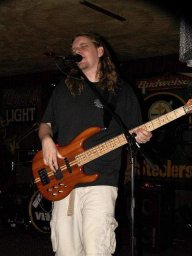
Okay, here are some tricks I've used in situations like that. But still remember, using the least volume you can on stage will help in many more cases than turning up louder. You should also press the sound guy for more of whatever you need in the monitors provided. But you should definitely get some local expert, experienced engineer/soundguy/etc. to help tighten things up on your end. You should sound closer to what you want to audience to hear, than not, up on stage and that is ALL your responsibility. (You'll enjoy it more if this is the case, and that DOES translate to the crowd)
Unless you're in a band that (for appearance reasons or stage design) needs to setup with all your amps facing forward, rotate them in kinda like you do at practice (I hope you're not practicing all setup like its a huge stadium concert with your amps facing straight forward). You don't need your amp blasting straight at the guitarist, but kinda rotate it towards the rest of the band. If you can only see the side of the guitarists amps you aren't going to hear much of it at all. Put the amps further upstage if you have room. Everyone can use less stage volume this way.
I used to carry a little powered 12" monitor no matter what the gig and if someone couldn't hear me clear enough with the provided monitors, I would have that to give the bass a boost for them. Now I have the modular TC Electronic system and that stays at home
In-Ear Monitors. You're not going to get away with that at a BOTB. But with all the stuff thats going on for you guys (instrumentally), the investment might be worth it if this is more than just a hobby and you plan on playing full gigs yourself. An IEM setup is just about the same cost as an exceptable floor monitor rig (for a bar or similarly small room).
Unless you're in a band that (for appearance reasons or stage design) needs to setup with all your amps facing forward, rotate them in kinda like you do at practice (I hope you're not practicing all setup like its a huge stadium concert with your amps facing straight forward). You don't need your amp blasting straight at the guitarist, but kinda rotate it towards the rest of the band. If you can only see the side of the guitarists amps you aren't going to hear much of it at all. Put the amps further upstage if you have room. Everyone can use less stage volume this way.
I used to carry a little powered 12" monitor no matter what the gig and if someone couldn't hear me clear enough with the provided monitors, I would have that to give the bass a boost for them. Now I have the modular TC Electronic system and that stays at home
In-Ear Monitors. You're not going to get away with that at a BOTB. But with all the stuff thats going on for you guys (instrumentally), the investment might be worth it if this is more than just a hobby and you plan on playing full gigs yourself. An IEM setup is just about the same cost as an exceptable floor monitor rig (for a bar or similarly small room).
Seems to me that if your band can't set their own stage mix, they're not ready to play out yet - and blaming that problem on the soundman isn't going to fix the problem... It's not uncommon in multi-band shows to go without a proper soundcheck - that's why it's SO important for your band to play at consistant levels, and to form your own basic mix w/out any PA help... That sort of thing is supposed to be sorted out in rehearsals, before you play out...
Generally speaking, the drummer sets the volume - and the other instruments match up to that... Once you've dialed those settings in, mark your amps so that atleast you're "in the ballpark", if you have to take the stage with nothing more than a line check...
- georgestrings
My personal experience has always been that the only way to learn setting stage mixes is to learn the hard way, by doing alot of shows at alot of different venues. There isn't a better learning school IMO. How else are you going learn to adjust to the different room acoustics/ wooden stages etc.
Or for instance, most bands are set up in a circle in rehearsal studio's while on stage everything is pointing the same way. Suddenly the guitar on the left becomes too hard to hear for the guy on the right of the stage. Learning how to deal with these situations, especially when dealing with non- monitor or PA support, comes from experience.
A good place to start is indeed to not overpower the drummer.
This is all IMO ofcourse!
Agreed, whole-heartedly. Gotta learn by doing. Live experience is the only way to figure out how to deal with all the various situations you'll run into, and we're definitely learning. Our material and basic musicianship and attitudes are good .. figuring out the baseline goodness for live is still a work in progress, but when we're good, we're really good
It'll probably always be a learning experience.
I also agree with getting a good soundman to do all your shows. Having one that knows what you like and knows your songs is really the best thing to have. It makes set up and sound checking a breeze too. Plus that a good soundman can make any room more or less work. And you always gotta remember that what sounds like crap on stage doesn't neccesarily sound bad in the room. Stage sound is all about making compromises, especially on small stages/ rooms.
Wouldn't be the first time I thought my sound sucked or couldn't hear myself and afterwards getting compliments on how good it sounded in the room.
I also agree with getting a good soundman to do all your shows. Having one that knows what you like and knows your songs is really the best thing to have. It makes set up and sound checking a breeze too. Plus that a good soundman can make any room more or less work. And you always gotta remember that what sounds like crap on stage doesn't neccesarily sound bad in the room. Stage sound is all about making compromises, especially on small stages/ rooms.
Wouldn't be the first time I thought my sound sucked or couldn't hear myself and afterwards getting compliments on how good it sounded in the room.


