• TalkBass has been independent since 1998. Add your voice.
    Create a free account to reply to discussions, view embedded media, and browse with fewer display ads.
    Join freeLog in
    Want zero display ads or expanded classifieds tools? Compare plans.

Difference in Capacitors

Thanks Wvbass. Yes, consistency of attack is certainly an issue, and although I feel I made best reasonable efforts to keep it consistent (by playing unmoved and uninterrupted while an assistant did the switching), there are certainly some flubs and changes in attack through the process. In playing each position 8 times total in each test phase however, our hopes were that the errors would balance out, and if there were a difference enough to be certain of it would still come through clearly enough.

For test 5 the change was somewhat subtle, but should be clear if you listen to it through a decent audio reproduction system. In the review (2nd video I linked to) we give the actual results and make clear why we included this. It was essentially an effort to weed through the survey results to only include participants who could demonstrate they were listening through at least decent speakers or headphones. If you haven't watched the 2nd video yet, I would suggest waiting until you've had a chance to listen to test #5 in the first clip through some decent speakers. My guess is that you'll be able to pick out the difference there before being shown the answer key.


What I meant by consistency of attack was this. Every time I thought I heard a difference, the difference would carry on to the next setting. To my ears, the subtle differences in tone would cycle in ways that didn't line up with switch flipping. I finally figured out I was either imagining it or your right hand was picking slightly differently as time went on. So, maybe I should conclude that right and technique is more important than any capacitor.

And you caught me. I watched both your videos on my iPad - not exactly hifi.
 
I didn't post an argument. I posted a report... a PERSONAL, SUBJECTIVE report. I would like to suggest that at the end of everybody's technical speculations and dogma, you're either gonna like what you hear or you're not.

I don't know anybody who buys a bass or an amp or a pickup or a set of strings based solely on a spec sheet. People go into music stores all the time and play expensive basses and amps expecting to hear something they like only to find a low end bass and/or amp that sounds the same or better TO THEM. And the 'TO THEM' part is all that matters.

I said I wasn't looking to be right (certainly wasn't looking to be wrong). I only wanted to share my personal experience and hopefully encourage somebody to do what I did... try different caps for yourself and see.

Plucking consistency? That's something we all strive to get good at, and I think we can mostly rule that out as a variable.

Some may want to hang on to precious theories and prejudices for dear life. I prefer to go with my ears. When I play, people listen with their ears, not their intellect. If my ears are happy, I play better.

And of course, we all know the really good players carry their tone around in their fingers anyway. The rest of us will take whatever enhancements we can find.

Peace, love.

I'm out.
 
Those of you here that are involved in the engineering of audio products like I am know what snake oil this is. When we select a type of cap in a circuit, we select it for it's function such as DC blocking, timing, or power supply filtering, etc. and then measure the cost vs. the physical requirements of size, mounting, stability, accuracy and availability.

In my 40+ years of developing audio products for studio and broadcast as well as consumer products, an audible difference based in the material of the cap has never been experienced by myself or anyone in the industry that I have ever met.

Anyone doing testing between caps that is not using a calibrated capacitance meter and testing them using a double-blind method is not doing any kind of test at all. FYI - Double blind means that the person listening AND the person changing the caps do not know what caps they are until the test is complete - only that they are samples A, B, C, etc. Also - the test sound has to be EXACTLY the same - changing caps in your bass and attempting to play the same line is not even close to being valid.

If you heard a difference in your test, it was most likely due to the real values of the cap being different. Cheap ceramics can be off by 100% or more and change with the temperature by 40%. Polyester "greenies" are certainly good enough for this purpose. The famous "Orange Drop" was used because they were readily available at the time, not for any sonic reason.

And YES - If there WERE a difference you would hear it even if the cap is just sending the HF signal to ground. It is only logical - you hear what is LEFT - what is not removed. IF one cap removed something different than another, the remainder would be different. However, this point is moot.
 
OK. I'm taking all of my caps to work tomorrow and measuring their values with our capacitor tester.

I'll post the results.

Can you please photo document this adventure? I like to see caps in all their forms: one leg soldered to a pot body with the other in its lug, two legs splayed across two lugs, a whole gaggle of caps just spread across a table, entwined in glorious capacitance! I like just holding caps. I have bags of Mallory 150's I like to just run through my fingers like the hair of a wookie.
 
Those of you here that are involved in the engineering of audio products like I am know what snake oil this is. When we select a type of cap in a circuit, we select it for it's function such as DC blocking, timing, or power supply filtering, etc. and then measure the cost vs. the physical requirements of size, mounting, stability, accuracy and availability.

In my 40+ years of developing audio products for studio and broadcast as well as consumer products, an audible difference based in the material of the cap has never been experienced by myself or anyone in the industry that I have ever met.

Anyone doing testing between caps that is not using a calibrated capacitance meter and testing them using a double-blind method is not doing any kind of test at all. FYI - Double blind means that the person listening AND the person changing the caps do not know what caps they are until the test is complete - only that they are samples A, B, C, etc. Also - the test sound has to be EXACTLY the same - changing caps in your bass and attempting to play the same line is not even close to being valid.

If you heard a difference in your test, it was most likely due to the real values of the cap being different. Cheap ceramics can be off by 100% or more and change with the temperature by 40%. Polyester "greenies" are certainly good enough for this purpose. The famous "Orange Drop" was used because they were readily available at the time, not for any sonic reason.

And YES - If there WERE a difference you would hear it even if the cap is just sending the HF signal to ground. It is only logical - you hear what is LEFT - what is not removed. IF one cap removed something different than another, the remainder would be different. However, this point is moot.

This is just what this type of thread doesn't need - someone muddying the water with facts and the scientific method.
 
And you caught me. I watched both your videos on my iPad - not exactly hifi.

And in turn, I realized that I never actually disclosed the answer to test #5 in the review video. That's okay - I won't tell it now either, as I'm sure you'll be able to hear it when you play through some decent speakers. That's of course why we included that clip, to eliminate participants from the survey count who weren't listening through suitable audio systems.

As to the attack differences, they are certainly there. So this survey doesn't ultimately prove no difference exists whatsoever (though it should bring in to serious question the evidence often cited to say it does). I think it does show however that the slightest difference in attack (even when trying to control it as consistent) can greatly outweigh any effect the cap material may have, if there is any at all.
 
nobody in this thread should post another word without watching david collins' demo vid! there's a "hook" in there that will put all this in context very nicely.

and welcome to talkbass DC!
 
What makes more impact to the sound of a bass - tone woods or tone caps?

The wood is incredibly more sound coloring. We are talking about capacitor differences here that you need to record and practice listening to the recordings.

For the record I need to state that I measure the actual capacitance of all the ones I tested. Tolerance is not what makes the difference I think I hear (see my more extensive earlier explanation with two ceramics).
 
Anyone doing testing between caps that is not using a calibrated capacitance meter and testing them using a double-blind method is not doing any kind of test at all. FYI - Double blind means that the person listening AND the person changing the caps do not know what caps they are until the test is complete - only that they are samples A, B, C, etc. Also - the test sound has to be EXACTLY the same - changing caps in your bass and attempting to play the same line is not even close to being valid.

If you heard a difference in your test, it was most likely due to the real values of the cap being different. Cheap ceramics can be off by 100% or more and change with the temperature by 40%.

I don't know if you saw the videos I posted, but let me start by saying that I agree with you 100%. The "tests" that I put forward were hardly a test by any academic or commercial standards, but rather a more familiar and poignant presentation for the relative musician market. The inconsistencies in my playing would no doubt void any validity to my tests in academic context, but part of the point I was trying to make is that if it proves that difficult to control even with real time third party switching (without the player removing their hands from the instrument), how can anyone maintain confidence in comparisons where the tester both knows what is being played, and sets the instrument down or removes their hands to clip in a new cap between runs?

My meter of course was not calibrated, but since I was working with a comparative test absolute value is not so important, just consistency. And I believe we adhered suitably to double blind standards, as although the person flipping the switch was aware of the positions, their actions were regulated by timing, they were positioned behind and out of sight of the player, and did not have any real oppurtunity to influence results. The player (myself) had no knowledge or opportunity to gain clues of the odd positions until the records were opened to present the results, which not surprisingly support wha you have said. Perhaps "support" is a strong word (as even though being much better controlled than typical player comparisons this test was still not without flaws), but I tried to present the concusions you share in a more real and familiar way. Kind of an opportunity for those who believe they hear a difference to demonstrate such, which no one I've surveyed has successfully done to date.

And you are absolutely spot on with temperature variances. Those ceramics would move on the meter if you breathed on them (literally). Furthermore, the ceramics and the PIO cap actually shifted in opposite directions with temperature range. Place them by the window and the PIO would go up while the ceramics went down, warm them up a bit and they would switch the other direction. My assistant had to rearrange the caps with tweezers to keep from touching them and warming them up between test phases.

In short though, I'm just agreeing with you, but trying to say that in spite of the acknowledged flaws the tests I've conducted were still an honest and useful tool in demonstrating the lack of influence of capacitor type in this application.
 
What I don't understand is why either side of the issue is so vehemently against the other.

I think it can be explained away fairly simply. If, like me, you think that capacitor construction type (lets call us the 'no' party) does not alter the tone of an instrument, once you have measured the capacitance of the cap in question, it would appear that the other side of the argument don't have any solid evidence to back up their claims.

Case in point, the Gibson Les Paul community (worse than TGP as far for sticking to obsolete designs both on the inside and outside of their guitars) were royally hosed when Gibson started selling repro Bumble Bee capacitors that were tiny $0.50 Radioshack units in a fancy case. To put it another way, the 'yes' party thought they were using fantastic vintage reproduction capacitors that brought out previously hidden nuances in their tone... until some guy took a scalpel to these units and revealed the con within.

At its worst, the 'yes' party allow themselves to be conned out of a lot of money to buy electrical components that are otherwise obsolete in design. I can understand the desire to be closer to the circuitry of a genuine '50s instrument, but this is a 'heart' argument winning over a 'head' argument.

As for the person asking me if I've done my own tests... I have not carried out anything scientific. I purchased a job lot of capacitors, of which there were many 0.022 uF and 0.047 uF capacitors. Because these were capacitors that actual electricians and electrical engineers might wish to use, there were no PIO caps in there, for obvious reasons. However there were the usual suspects, ceramic, ceramic dic, polyester, tantalum bead etc... for good measure I had a few orange drops kicking around from a previous project.

Now, imagine this. I'm fitting these to a P bass, and every time I make the switch I have to take the strings off the bass, desolder and resolder the various caps. I cannot accurately remember what each cap sounded like from cap to cap. Besides, my bass is hitting the preamp section of my amp as well, which will be further colouring the tone of the instrument. I could argue that each time I re-string the bass the tone changed as the downward force at the nut would be subtly different each time... a totally obtuse argument but no more obtuse than any of the others I've seen here from the 'yes' crowd. :ninja:

As for a double blind test, nobody's chops are good enough, no matter how consistent you think you are playing. We need a machine to play the bass for us. Take a corded drill, fit a pick to the end, use a variac or something to get it revolving at a realistic rate similar to that of a human bassist. Mount it in a jig so that it is always plucking one string. Use a 'decade' switch to give you a number of capacitors to switch through, making sure that the listener and the switcher have no idea which cap is which. Use something like an Alembic Stratoblaster (or other colourless linear booster) to boost the audio signal up to the level a power amp would like to see, connect it thus, then run it through studio monitors or other 'colourless' speakers. This sounds like the road to better unbiased results. :ninja:

I'm curious also about the chat about potentiometer types. Does anybody here actually swell the tone controls on their bass, Roy Buchanan style? I'm not sure of the last time I ever even saw a bassist touch the tone control on their instrument live. Pot sweep is one of these things like 'sustain' that people get hung up on. Tell me a band that frequently make use of the bassist holding a note for 30 + seconds. Tell me a band where the bassist sweeps the tone control for sonic effect. :spit:
 
So in a treble bleed circuit, what is dissipating the charge in the vol pot cap, assuming it is constantly rolled on? Isn't it safe to assume that caps in a bass circuit are seeing relatively constant voltage charges? The voltage dissipates as string movement decreases, but during play, the strings are moving more often than not.

A pickup produces AC so there is no constant charge on any capacitor anywhere in circuit.

What I don't understand is why either side of the issue is so vehemently against the other.

The trouble is that many bass players are an instant expert in electronics by reading a few internet articles by other "instant experts", others have spent a lifetime studying it.

I don't know what your profession is but I would not even consider questioning your knowledge on it.
 
The trouble is that many bass players are an instant expert in electronics by reading a few internet articles by other "instant experts", others have spent a lifetime studying it.

Reminds me of the guy that first came up with the tutorials on shielding a guitar and got mad that Fender didn't star ground their instruments resulting in a bunch of ground loops.

Suddenly forums everywhere were awash with 'er mah gerd' posts as people hurridly, and badly, shielded their instruments.
 
Reminds me of the guy that first came up with the tutorials on shielding a guitar and got mad that Fender didn't star ground their instruments resulting in a bunch of ground loops.

Suddenly forums everywhere were awash with 'er mah gerd' posts as people hurridly, and badly, shielded their instruments.

Yea I remember that, someone missed the point of star grounding completely. Nothing wrong with star grounding a guitar but will probably make no audible difference. Certainly not worth ripping out the stock wiring to fit a possibly badly soldered and executed replacement.
 
As for the person asking me if I've done my own tests... I have not carried out anything scientific. I purchased a job lot of capacitors, of which there were many 0.022 uF and 0.047 uF capacitors. Because these were capacitors that actual electricians and electrical engineers might wish to use, there were no PIO caps in there, for obvious reasons. However there were the usual suspects, ceramic, ceramic dic, polyester, tantalum bead etc... for good measure I had a few orange drops kicking around from a previous project.

Now, imagine this. I'm fitting these to a P bass, and every time I make the switch I have to take the strings off the bass, desolder and resolder the various caps. I cannot accurately remember what each cap sounded like from cap to cap.
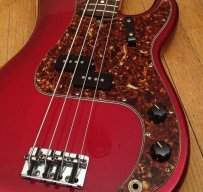
That was me.

Re: your P bass
When I'm in test mode I'll run a couple of wires 6"-8" long out from the control cavity between the body and pickguard. Connect all caps (to be tested) to one lead with a wire nut. Then for testing use the other wire and connect the other end of the cap/s to it one at a time with a wire nut. You can also run two caps in parallel to add the values. It just takes a few seconds so the sound is still fresh in your head. I've done it that way, as well as with a rotary switch; both methods work fine.

Another thing. I've had success just loosening the strings and wedging a rolled up sock, small towel, etc between the strings and the neck. Remove pickguard screws, raise pickguard, and remove. No need to remove the strings.