• TalkBass has been independent since 1998. Add your voice.
    Create a free account to reply to discussions, view embedded media, and browse with fewer display ads.
    Join freeLog in
    Want zero display ads or expanded classifieds tools? Compare plans.

Dingwall Owners Club

View attachment 3072726

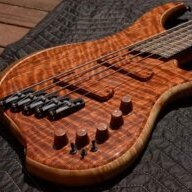
They sure look like super Fatties. These pickups are easy to remove and adjust. The machine threaded bolts are either in brass threaded inserts, or the wood was tapped for the bolt. Both techniques work extremely well. There will be a short length of soft rubber tubing on the bolt, under the pup, which acts as a spring.

It’s worth messing around with pickup height to really dial it in for your style of right hand attack.

The super fattie is wired in parallel from the factory, with four leads (and a ground) going to the rotary switch. Some Dingwalls feature mini switches allowing you to go from parallel to series, which gives a volume bump, and moves the neck pickup more towards a P tone sound. I found changing the bridge pup to series made it more usable solo.

You can change the pickup to series by joining the two coils. You just cut two leads and join them together. It’s quick, easy, and easily reversed. Or some guys add switches.

The photo shows the green and black leads soldered together for series. You can see the date is oct, 2008. I ended up putting a P tone P style pup in the neck position on my Super J, and just hardwired the bridge to series. I didn’t want to mess around with switches.

I love that candy apple red!

That's some great info - thank you! The red and all the colors are amazing.
 
I've always been told that you need to unplug an active bass when you are not using it to avoid draining the battery. I'm not sure if this is true or not, but if it is, does toggling to passive with my active passive switch accomplish the same thing as unplugging?

Feel free to mock my overwhelming lack of understanding of basic electric circuitry.
 
I've always been told that you need to unplug an active bass when you are not using it to avoid draining the battery. I'm not sure if this is true or not, but if it is, does toggling to passive with my active passive switch accomplish the same thing as unplugging?

Feel free to mock my overwhelming lack of understanding of basic electric circuitry.
Nope. Needs to be unplugged entirely, as the jack itself is a switching jack that completes the circuit when a 1/4" jack is inserted. In passive mode (which is not "off", it's actually just a bypass) it'll likely take quite a long time to drain, but, it will still drain, as there will still be a tiny bit of draw on the battery.
 
Now you know why I have trouble sleeping at night.
Truth be told though, I generally just grab the one that lives on the guitar stand next to the amp. More often than not, that is the NG2 or a 1993 G&L L2000.
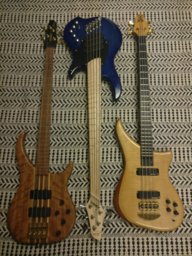
When I go into the other room to take a bass out of the case, I am usually tempted by one of the ones that I hit when I first walk into the room, so I don't have to delicately step over a bunch of cases, such as...
View attachment 3071890 View attachment 3071891

Or the PRS (Peter Roger Stuart) a/k/a SSS (their last name initials) basses:
View attachment 3071952
OK, now you're just showing off!:laugh: Other than the Dingwalls, I might be tempted by that MTD. That is spectacular just to look at. Probably the Foderas just to try one. The Contra 5. the others are beautiful as well, but by then my brain would be scrambled like Robin William's character in Moscow on the Hudson.

 
Hello folks! I am about to start rewiring my Dingwall Combustion V1. Anyone with advice on the best configurations for it?


The video above is for a similar Dingwall to mine so, at the moment, I am thinking of a switch for series/parallel and push/pull for coil tap. Or maybe I should just go with two switches?

Should I be considering Active/Passive switch as well? Here's a diagram of the current Combustion wiring diagram.

Let me know what you guys think!

IMG_3489.PNG
 
If they are made by CNC, they will all be exactly identical. Until somebody adjusts the machine. If they are made by hand, no two will be exactly identical.
On top of that, the setup has a huge influence in how a bass feels. I have turned many basses that I thought were total losers into total winners by spending an hour setting them up properly.
I agree with this. I have had MANY NG2's/NG3's/Combustions in my hands and yes, initial setup, while consistent, inevitably leads to a slightly different feel. Everyone has their own preference for setup and spending a bit of time can lead to a different feel. I have seen no inconsistencies in neck thickness from playing these although I did not bother to take calipers to them.
 
+1000000000000000!
Safe to say, I'm quite excited. I knew from the very first note I plucked on the Super P5 that I'd found my forever-brand. Everything just felt, sounded and played right. I've never quite experienced that before, and I've owned basses from Yamaha, Fender, Ibanez, Warwick (four in total), Peavey, Maruszczyk and MusicMan.

It was definitely love at first note with Dingwall, and I've been playing bass for over 20 years (started at age 10). Ever since I got the Super P5, I've been gassing for an AB as well, and when this opportunity arose, I just couldn't resist it.
 
Hello folks! I am about to start rewiring my Dingwall Combustion V1. Anyone with advice on the best configurations for it?


The video above is for a similar Dingwall to mine so, at the moment, I am thinking of a switch for series/parallel and push/pull for coil tap. Or maybe I should just go with two switches?

Should I be considering Active/Passive switch as well? Here's a diagram of the current Combustion wiring diagram.

Let me know what you guys think!

View attachment 3073502


That is actually a "control layout", not a wiring diagram (which would show wiring connections)

If I were modding this for myself, I would include an active/ passive sw, and series/ parallel switches for each PU.
and probably a passive tone control.
 
I've posted a good bit about one of my Operatic Metal theatre bands. We're (slowly) writing and tracking some tunes that at one point were throw away stuff -- they aren't going to make it into a final production, but, we decided to go ahead and track some of these anyway as a break from the rest of the theatre production process. Here's a short, super rough take from one of the upcoming tunes.
Dingwall Prima Artist -> Axe-Fx II -> Reaper

Ignore the sloppy playing (especially since I put the scratch bass take pretty hot in this) :D

 
I've posted a good bit about one of my Operatic Metal theatre bands. We're (slowly) writing and tracking some tunes that at one point were throw away stuff -- they aren't going to make it into a final production, but, we decided to go ahead and track some of these anyway as a break from the rest of the theatre production process. Here's a short, super rough take from one of the upcoming tunes.
Dingwall Prima Artist -> Axe-Fx II -> Reaper

Ignore the sloppy playing (especially since I put the scratch bass take pretty hot in this) :D


"pretty hot"? Not sure what you are listening through, but I was using a decent pair of headphones and I certainly wouldn't mind hearing more bass in that mix. Cool music, growly tone sounds good and appropriate for that type of stuff. I might try both bringing the bass's overall level as well as the low freqs up a little.
 
"pretty hot"? Not sure what you are listening through, but I was using a decent pair of headphones and I certainly wouldn't mind hearing more bass in that mix. Cool music, growly tone sounds good and appropriate for that type of stuff. I might try both bringing the bass's overall level as well as the low freqs up a little.
It's pretty much all scratch tracks for that. Even the drums are pretty absent. Mostly just wanted to drop a small hint of one of the things I do :D. We don't "play out" every weekend in bars and clubs, so I don't often get to post photos or audio of what we do (we try to drive people to come to the performances in the theatres). We have some other parts to lay down still and then sending it off for mixing. I'll post the final once it is here. The bass will be pretty far back in the mix -- that's just how this band runs on our recorded stuff. It'll likely also end up reamped at some point, as I'm not sure that tone really fits the needs of the song. It's just my "default" with the Prima haha.
 
I'm having a hard time in finding a tonality/key for the segment that starts around 30 seconds in. It seems like bass and keyboard are doing different roots. Could you explain that part briefly?

Bass sounds great, but I'd go for a slightly warmer tone for that kind of music, to fill out the airier segments a bit more. Sorry if I'm sounding a bit harsh, it's just my music education mind trying to make sense of it, haha. :)
 
I'm having a hard time in finding a tonality/key for the segment that starts around 30 seconds in. It seems like bass and keyboard are doing different roots. Could you explain that part briefly?

Bass sounds great, but I'd go for a slightly warmer tone for that kind of music, to fill out the airier segments a bit more. Sorry if I'm sounding a bit harsh, it's just my music education mind trying to make sense of it, haha. :)
I'd have to check the music to be certain but I'm pretty sure F# min.
I'm playing: E, Eb, C, C#, E for the first three measures. Then E, A, C#, C, E, E. Repeat once.
 
That is actually a "control layout", not a wiring diagram (which would show wiring connections)

If I were modding this for myself, I would include an active/ passive sw, and series/ parallel switches for each PU.
and probably a passive tone control.

Oh cool! Thanks Andy! I've decided to go for two switches (Active/Passive and Series/Parallel) for now.

I might change the vol knobs to push/pull knobs to coil split each pickup but maybe for another time!
 

Latest posts