• TalkBass has been independent since 1998. Add your voice.
    Create a free account to reply to discussions, view embedded media, and browse with fewer display ads.
    Join freeLog in
    Want zero display ads or expanded classifieds tools? Compare plans.

Dingwall Owners Club

Yeah, I have a Ric and an Afterburner. Even though the afterburner is passive, it's still a very different sound from the Ric. A little less "character" and more balance.

+1

I'm not sure how you had your amp adjusted but you'd have to basically start from scratch, set everything flat, roll down the tweeter and make adjustments from there.
 
+1

I'm not sure how you had your amp adjusted but you'd have to basically start from scratch, set everything flat, roll down the tweeter and make adjustments from there.

Thanks for the input. My amp is always set flat other than a tiny bit of "Tube Tone" and a smidge of "Bass" (on my amp it's 200 Hz shelving). And of course I changed the gain stage at the preamp based on clipping before playing the bass.
 
Well I know about a Super J/P but I've never known if there is or will be such a thing as the Super P. Get a Super J / P and you'll have the best of both words. And I know a song about that :D
:bassist:
You mean like this bass, that Sheldon fretted a half-fan neck for me for my custom bass I put together some years ago? (starts with a straight nut)
http://www.talkbass.com/forum/f57/different-custom-p-style-bass-755914/
And you can hear it here, strung with Roto Swingbass 45-60-80-105, straight to board with a touch of compression for broadcast, and a slight broad flattening at @ 1.3 kHz to better slot the mix. OK, it is Welk, but I had an incredible fun time, and I did make it on PBS;
precious memories welk - YouTube
 
And you can hear it here, strung with Roto Swingbass 45-60-80-105, straight to board with a touch of compression for broadcast, and a slight broad flattening at @ 1.3 kHz to better slot the mix. OK, it is Welk, but I had an incredible fun time, and I did make it on PBS;
precious memories welk - YouTube

I can attest that this bass is no slouch... I've played it a handful of times, and the gentle curvature of the frets is easy to learn and still plenty beneficial to the resulting sound. Of course Scott's videos speak for themselves, that must have been quite a gig.
 
I mean something like this:

[Invalid or Expired Link Removed]

Sheldon,
if you read this. Are there plans for this? Or only dreams of dingwall fans:)?
WOW! That's almost enough to make me consider a 5-string after all these years.

One thing: consider reversing the headstock so the proper string break angles over the nut can be adjusted. If I were to do my bass all over again, that's the only thing that is a nit I would fix in order to get a tad more growl out of the E string so it doesn't thump by having a slightly shallower break angle, and damping a tad of twang in the G string by getting it to break as hard over the nut as possible.
 
WOW! That's almost enough to make me consider a 5-string after all these years.

One thing: consider reversing the headstock so the proper string break angles over the nut can be adjusted. If I were to do my bass all over again, that's the only thing that is a nit I would fix in order to get a tad more growl out of the E string so it doesn't thump by having a slightly shallower break angle, and damping a tad of twang in the G string by getting it to break as hard over the nut as possible.

Due to the compound scale length, you don't usually need to dampen any 'twang'. I know that Sheldon micro-manages all aspects of the basses' designs, and he's effectively dealt with string break at the nut in the past without flipping the headstock (although one of the earliest proto-Super J's does have a reverse headstock).
 
BurningSkies said:
Due to the compound scale length, you don't usually need to dampen any 'twang'. I know that Sheldon micro-manages all aspects of the basses' designs, and he's effectively dealt with string break at the nut in the past without flipping the headstock (although one of the earliest proto-Super J's does have a reverse headstock).

Woah... I'd love to see that bass!!
 
Woah... I'd love to see that bass!!

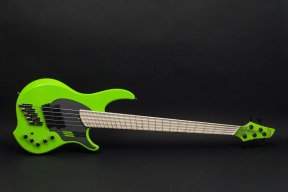
fcm_super_j_front_599_314.jpg
 
We are working on a P. We're changing up the scales and designing an innovative new bridge so are a ways off yet.

Crap, I guess I must start squirreling money away now that it's confirmed. Thanks for nothing! /sarcasm

Seriously excited about this, maybe a Dingwall really is in my future. A P (or Ric) with all the benefits of a Dingwall design is kind of my dream bass. Of course we all know it's not happening with a Ric design, but a P would be equally great. What are you doing with the scales/bridge, can you divulge any more?

I have always thought a 33'' G would sound good as a starting point. Sometimes 34'' is a bit too bright and soulless.