• TalkBass has been independent since 1998. Add your voice.
    Create a free account to reply to discussions, view embedded media, and browse with fewer display ads.
    Join freeLog in
    Want zero display ads or expanded classifieds tools? Compare plans.

Dingwall Owners Club

Hey guys

I reviewed a bunch of posts at the beginning of this thread, but decided to just post here and hopefully get some advice from you Dingwall experts. I arrive here after seeing and hearing a DVD of a Toto live show in which Lee Sklar is playing a Dingwall, what appears to be his Signature Series. I've been playing Sadowskys lately and it's definitely a different vibe. I absolutely loved the sound Lee was getting and became intrigued by the fanned fret thing.

Can I ask you guys a few questions and save some time going through every page of Parts I, II and III?

1. Which Dingwall for someone who wants a 4 banger, narrow nut a la Jazz width (my Sad Will Lee is actually 1.45", narrower than a 'stock' 1.5" Jazz), darkwood fretboard and it needs to be on the light side. I am assuming it's the Super J only that fits this description. Thing is, it says the Super J is 2" shorter in scale than the other Dingwalls. Am I somehow missing out on what makes these instruments great by going with a shorter scale instrument? Not sure if it's just me but the Super J looks shorter in scale than my stock Fender Jazz.

2. What's the deal with scale length vis-a-vis availability of strings? I have been playing Rotosound RS66LD's for (gulp) 30 years (and yes, keeping my guitar tech in business dressing my frets). I'll obviously have to switch, right? What's necessary for these basses?

3. I reviewed the descriptions of the basses on the website. It seems the Afterburner series is the full line of passive basses, and it says that they're swamp ash. The Z series is also described as a Swamp Ash line, with the Z2 and Z3 being designed for more flexibility in terms of sound. Is the Z series a slightly higher end take on the Swamp Ash sound?

4. It looks like the Lee Sklar does not come in a 4. This is too bad because that's the sound I heard, then one I want to experience. I'm wondering if the Super J is going to be anything like it at all?

I assume that the Prima series is primarily for those who want the beautiful exotic woods and custom shop handwork? Basically, it seems to me that a few of the instrument lines are meant to provide Dingwall's legendary build quality and tone/playability in an instrument that looks amazing, using exotic woods/finishes. I need to know which ones they are, because although I play quite a bit and I have a decent budget, I don't need the really exotic finishes at all. Ferrari under the hood and Honda body is fine with me.

Okay, that's enough for now I guess. I will try to do some of my own research this weekend. Any info or comments is appreciated. Unfortunately, I am in Toronto and there doesn't appear to be a dealer here so I won't be able to go check one of these out.


My first instinct is that if you want the benefits of the longer scale length, liked Leland's tone is that you should look at both the Afterburner series AND the Z series.

There's some not quite right assumptions though. The AB-Z and AB-1 are passive and have alder bodies. The AB-1 traditionally has a wenge fretboard, while the AB-Z tends to be maple fretboard. The older AB-1 basses are maple bodied. The AB-2 is a walnut body currently with a wenge fretboard, and semi-hollow and active (tops are subject to Sheldon's discretion). The older ones were mahogany with bubinga tops and solid bodies. Over the years there have been a few different preamps. There are also some AB 1.5's and special issues out there with combinations of features between the AB1 and AB2, and other 'random' features.

The Z series CAN be nearly as custom as the Primas (at least they used to be). They usually feature swamp ash bodies. They come in several configurations (Z1, Z2,Z3, LSS). And have more options than the ABs. And there are different pickup build options for those.

The Primas are very limited and very optionable. All bets are off with what you could have done.
 
I have both the 4 and 5 string Super PJ's, and 5 and 6 string AB-1.

Besides the scale length, the big difference is string spacing at the bridge: 19mm on the Super J's and 18mm on the AB's and all the other models in the line. You'll feel it, if you switch back and forth. The 19 works better (for me) for slapping. The 18 is very comfortable. I thought it was going to be a big deal, but it's not.

I tend to get that "home again" feeling when I go back to the SJ's, the shorter scale and wider spacing, seem more wide open to me. ( except for the four string, which now feels like its missing something...oh yeah that low string!) I had tried to like fivers before but they never really came through on the lows. That's all changed with the Dingwalls.

The SJ's have preamps, I tend to run both passive, mostly on the P pups. The pre's are super nice and very quiet, they do a great job. These are really punchy basses with superb balance across the strings. No more weak D and G strings.

The SJ necks are super sleek, especially the four string. With my first Dingwall, I went from a Fender Jazz to the SJ-4 and there was no looking back. Everything was more refined in the fit and finish and playing feel, plus it was 2 lb lighter. (just over 8lb). Every bit of fat and flab trimmed off, until it was the essence of a J bass. The sound was far beyond the Fender J, plus the P option and the preamp to boot. I just measured the SJ4 at the nut, from the outside of the G to the out side of the E string: 1 3/16", the nut of course is longer, but it's on the diagonal. The SJ four neck is slim side to side and very comfortable.

The AB-1 is getting tons of play now that I dropped the Ptone pup in the neck spot. With the ground wound flats, it's a blast to play. Both AB-s are very light. The longer scale is noticeable but not uncomfortable. The sound of the longer strings is amazingly clear and defined. Chords sound great all over the neck, and the string to string balance across the board is super.

Strings can be hit or miss with the long scales. There is an extensive thread over on the Dingwall forum. Payson does a great job with strings for the long scale Dingwalls, he has three flavors going at the moment, SS and nickel roundwounds, and some very cool nickel groundwound "flats". These can be swapped out in minutes once cut and wound. Sheldon's strings are the place to start. They are a light stainless steel. The Infeld superalloy superlongs are nice too.

For the Super J's, you have lots of options, I use DR Hellborgs (they only come in sets of four) on the four and DR nickel Lowriders on the five. I only play nickel strings. I've also used TI jazz flats on the four.

If you are strictly a four string guy, and lean towards the Jazz, the SJ is a great place to make the leap. There tend to be more AB-1's and SJ 4's available used, the SJ 5's are still fairly rare used and the Sklar's are like hen's teeth. If you are at all tempted to make the change and suffer through the long "oops, wrong string" period, the Dingwall will make it worthwhile. ( the sixer is still kicking my butt)

I bought three of mine sight unseen without any test drives and I have never been even a little disappointed. The one I did pick up in person, the guy asked if I wanted to plug it in, and I declined. "Nah, it'll sound bitchin, it's a Dingwall." A little set up to work with the local weather and they are ready to go. And the hardware is excellent on these basses, set ups are a breeze.
 
My first instinct is that if you want the benefits of the longer scale length, liked Leland's tone is that you should look at both the Afterburner series AND the Z series.

There's some not quite right assumptions though. The AB-Z and AB-1 are passive and have alder bodies. The AB-1 traditionally has a wenge fretboard, while the AB-Z tends to be maple fretboard. The older AB-1 basses are maple bodied. The AB-2 is a walnut body currently with a wenge fretboard, and semi-hollow and active (tops are subject to Sheldon's discretion). The older ones were mahogany with bubinga tops and solid bodies. Over the years there have been a few different preamps. There are also some AB 1.5's and special issues out there with combinations of features between the AB1 and AB2, and other 'random' features.

The Z series CAN be nearly as custom as the Primas (at least they used to be). They usually feature swamp ash bodies. They come in several configurations (Z1, Z2,Z3, LSS). And have more options than the ABs. And there are different pickup build options for those.

The Primas are very limited and very optionable. All bets are off with what you could have done.
Spiritbass and Burningskies, thanks for the responses. Burningskies, as an alder/rosewood guy for so long, I am tempted to stick with a similar configuration for this buy. Thanks for all that detail, it helps. I spoke to Dingwall yesterday and mentioned the fact that I was going to buy one from here in order to demo it. The gentleman I spoke to was very insistent that he had no problem with me ordering one from them for demo purposes, with the idea that I could return it if I wanted to, within 7 days. Clearly these guys don't get too many returns : )

I may just do that, it will probably be cheaper than buying one here and taking a hit when I flip it (I never seem to be able to get as much when turning something around as what I paid for it, plus there's the shipping). Problem with that is that the one I want is ready here but I'd have to wait for one through them.
 
Besides the scale length, the big difference is string spacing at the bridge: 19mm on the Super J's and 18mm on the AB's and all the other models in the line.

I had tried to like fivers before but they never really came through on the lows. That's all changed with the Dingwalls.

(just over 8lb). I just measured the SJ4 at the nut, from the outside of the G to the out side of the E string: 1 3/16", the nut of course is longer, but it's on the diagonal. The SJ four neck is slim side to side and very comfortable.

Strings can be hit or miss with the long scales. There is an extensive thread over on the Dingwall forum. Payson does a great job with strings for the long scale Dingwalls, he has three flavors going at the moment, SS and nickel roundwounds... The Infeld superalloy superlongs are nice too.

For the Super J's, you have lots of options

If you are strictly a four string guy, and lean towards the Jazz, the SJ is a great place to make the leap.
This is really helpful, thanks for taking the time to put that together. Sounds like there are a few similarities in our situation. The Will Lee I'm playing now has the 20mm bridge spacing and I'd much rather go down than up, so that should be no problem. I think I mentioned that after such a long time on J basses, I have a hard time on anything wider than 1.5" nut width, especially on the longer gigs. Your measurement on the diagonal nut gives me some hope that this will be very comfortable for me. Even going from 1.5" on my main player J bass to the 1.45" on the Will Lee felt better, and that's nut width as opposed to the outside-of-string measurement. I just measured the WL and it's 1 1/4" from outside of G to outside of E.

I know exactly what you mean about the refinement thing. I experienced it the first time I picked up a Sadowsky RV4. It was what I had been missing in most J basses, and, as you know, what is a bit hit and miss when you're buying a new J bass.

I can't seem to get my head around flats for some reason. I've been on stainless steel for a long time but I'm willing to give nickel a try. I'll for sure try a set of the Payson SS roundwounds.

I recently had to play a 5 string on a gig, for the first time. I went to rent but the ones my local shop had were all crap, so I had to borrow one from a buddy! There wasn't much problem, but I know what you mean about the 'oops. wrong string' thing. I won't go into too much detail here, but there was an issue with the way the low B string reads. Kind of woolly and undefined on the bass I was playing. So many guys say that these problems are mitigated by the Dingwall scale. Just another reason to check them out, I guess!

Thanks again for the detailed response.
 
Just a heads up, the ABZs are swamp ash, not alder.

Tells you how much I've been paying attention to the AB-Z specs. ;)

I find my AB-1 to be more of an aggressive tone than my Z which has a bit more balance to it, when I compare them side by side. A bit more upper mid and punch. My Zebra/Voodoo has a bit more polite palate, but I feel like I can take it a couple more places tonally...although I'd say that I would never be unhappy with just an AB1, I could have happily gigged it by itself fo-ever.
 
Some pics from my new band's first live show last Friday, with me and my ABI Elite:

I swear I'm not that short (just 5'8) but the bass looks gigantic!
IMG_0159.jpg


IMG_0161.jpg


IMG_0168.jpg
 
Been lurking around looking at these basses for a bit now. I have been very happy with my Warwick Thumb 5 BO. However, I am currently recovering from an injury that limits my left hand and arm mobility. I've found playing higher up on the B and E strings is my best range for getting to notes I'd have played near the open E and A before. Not like I need an excuse for buying gear, but this seems like a good reason :)

I'm currently eyeing the ABZ and the Combustion, though leaning toward the ABZ for the lighter weight factor, though I'm a bigger fan of the looks of the Combustions. Anyone here make the jump from a Thumb to either of these basses care to comment on how they compare/contrast? FYI - my current rig is a Mesa M6 with a PH 212 cab set and some occasional effects (wah, Blowtorch, POG), though I've been considering changing that up too (looking into the Acme/TC/Baer cabs and a Streamliner head, though the Orange Terror/212 rig has my attention... but that is another story and thread).

Edit - since ergonomics are are currently a huge issue for me, how are the light ABZ bodies with balance and neck-dive?
 
Smallmouth_Bass said:
I have an ABI in the low 8 lb range and it balances and plays really well and feels great (especially on the shoulder). I think that most of the ABZs are in the 7 lb range. The way it balances, I don't think it should be a problem.
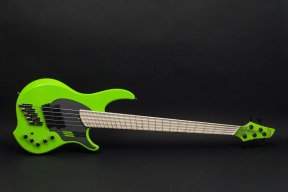
Good to hear. The light weight on a 5 string made me pause for the neck-dive thought. I'm already retraining my finger movement from scratch, so I'm not worried as much about the fret system . . . actually, I think it might be helpful.

Now, if I could only find a place to test drive one in Los Angeles. Any suggestions? The dealer page on their site didn't have any shops I recognized as near me.
 
Head over to the Dingwall forums and ask for a test drive; members close to your location would probably let you try their own Dingwalls. It's common practice, we like spreading the word.
 
I'm not sure I understand your ergonomic needs fully but if left arm extension is an issue a 3rd flush mount strap pin can be installed on the back of the bass to shift the on-strap neutral position about 1-1/2" to the right.

I'm recovering from a broken neck that was supposed to leave me as a quadraplegic for life. That was a year ago, so my healing is still in the early stages, but I've recovered enough to start playing a limited amount of bass again.

The nerve damage makes it hard for me to move my left arm into position to play lower than the 7th fret. I've been using my Warwick Thumb 5 to play higher up on the B string in place of lower on the E. It works, but the tone changes a bit from string to string in that range, making it hard to dial in an EQ setting I like (so far, I'm just jamming with mp3s in the living room). The legendary Dingwall tonal balance has started to get my attention for this reason.

Down the road, I see the issue of balance while playing standing up. I have noticed my Warwick does tend to be heavier on the left than I like, though not as bad as my T-bird which I sold. I'd hate to plunk down the price of an ABZ to find neck-dive an issue in the future. As I said, the light weight overall on a 5 string is what set off that warning light. Sounds like a non-issue with a back-up work-around :)