
I happen to have a friend in London right now that will be coming back in a few days…. Hmmm.

Enjoy the benefits of a premium membership!
Upgrade Account
-
TalkBass has been independent since 1998. Add your voice.
Create a free account to reply to discussions, view embedded media, and browse with fewer display ads.
Join free Log in
Want zero display ads or expanded classifieds tools? Compare plans.
You are using an out of date browser. It may not display this or other websites correctly.
You should upgrade or use an alternative browser.
You should upgrade or use an alternative browser.
Dingwall Owners Club
- Thread starter FroggyOne2
- Start date
More options
Who Replied?

I happen to have a friend in London right now that will be coming back in a few days…. Hmmm.
I was gonna say I may be able to help ya out if you need someone to collect it as I have a bunch of family and friends not too far away.
I’d love for someone else to get hands on this. It’s not in the budget but I’d also sure try to help get it back across the pond. And I really don’t need another 5 stringI was gonna say I may be able to help ya out if you need someone to collect it as I have a bunch of family and friends not too far away.

I’d be GASSIN harder too. Turns out my buddy comes back tomorrow. No time to think on this one.If it was a 6 string, I would be trying to figure something out.
Anybody has information on the Dingwall x Darkglass pedal? I'm really curious now
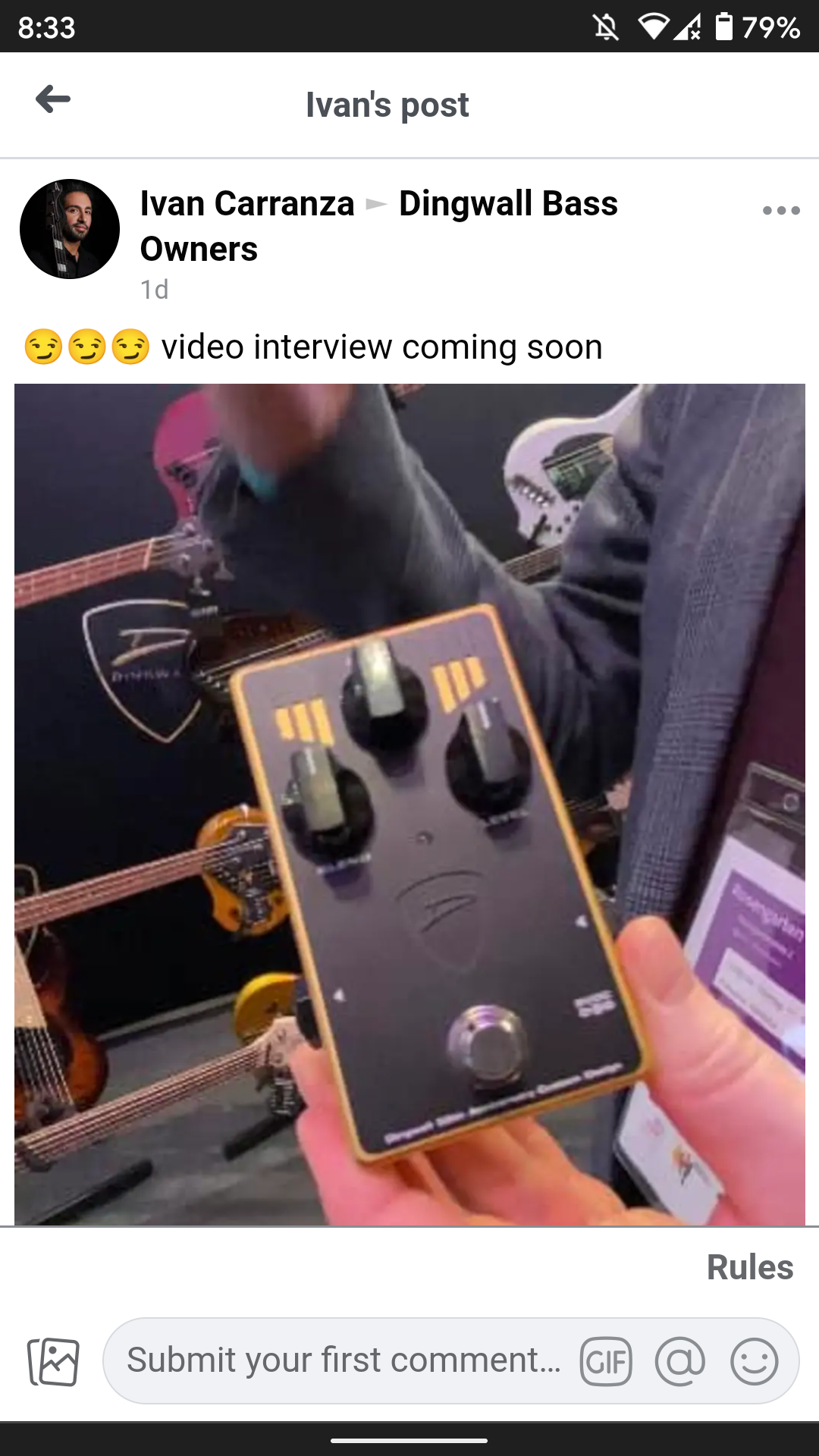
I wonder if it’s something like the drive circuit in the hellboyAnybody has information on the Dingwall x Darkglass pedal? I'm really curious now
View attachment 4811626

@IvanBassist is going to release the interview on YouTube and we'll find out thenAnybody has information on the Dingwall x Darkglass pedal? I'm really curious now
View attachment 4811626



Whats the inlay? Limited edition of some sort?
Someone on instagram guessed a John Taylor signature..
That would be a very reasonable guess! The colour scheme and lines as well as the R on the headstock match the Rio album cover. The 12th fret inlay looks like that thing in the bottom right.
It’s because they’re NOT designed for fanned fret basses. They will not be the best option. Life’s too short. Use fanned string sets designed for fanned basses to bring out the absolute best tone and balance string to string. Order now so you have them on hand.
There is nothing different between a string with a 38" winding and the ones you claim are "fanned fret" strings. A string doesn't know the scale length or overall length the instrument is on. The only difference is the tension of the strings and that is determined by the speaking length of the string and the instrument, not the string on its own. You will end up with a set that may have tensions that are not ideal for one tuning, but will be ideal for others. So you choose the strings based on those tensions (gauges) and the overall string length that fits for you. A 45-105 set on a Multi Scale will just have higher tension on the E A D strings compared to the same set on a parallel scale instrument. If you want to market strings as "fanned fret" that is fine, you can do that, but there is no reason why you can't get strings extra long strings in say 45 60 80 100 that are "parallel fret strings" and it not be just the same.
This reminds me of a time when a customer called Jason complaining that he got a G string rather than a D string. The string was a .055 and it was labeled as a "G" because that manufacturer chose to use the pitch along with the string gauge for the packaging. The string doesn't know what note it is being tuned to. As long as the string length is correct, there is no such thing as a fanned fret string.
Last edited:
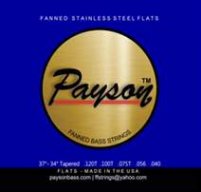
Fanned Fret Sets. Sets. Designed to work as a set on a Fanned Bass 37”-34” (36.25”-34”) I’m speaking of design and winding of the strings so their proprietary manufacturing inputs work @ the absolute best, optimized, for a fanned fret bass, as a set.
Fanned Fret Sets. Sets. Designed to work as a set on a Fanned Bass 37”-34” (36.25”-34”) I’m speaking of design and winding of the strings so their proprietary manufacturing inputs work @ the absolute best, optimized, for a fanned fret bass, as a set.
It is the same as ordering singles in the same gauges, as long as the winding lengths clear the nut. Technically, you can be slightly short on the B or even the E for that matter, and just shim the nut higher so the string clears the first fret and then slot the nut deeper for the other strings. We do that a bit for users who want to use a more readily available 38" winding string in the B-string position as going up to a 39" winding your available options go way down.

Your own website has a section for fanned fret strings. Probably time to drop that if it's not necessary?There is nothing different between a string with a 38" winding and the ones you claim are "fanned fret" strings. A string doesn't know the scale length or overall length the instrument is on. The only difference is the tension of the strings and that is determined by the speaking length of the string and the instrument, not the string on its own. You will end up with a set that may have tensions that are not ideal for one tuning, but will be ideal for others. So you choose the strings based on those tensions (gauges) and the overall string length that fits for you. A 45-105 set on a Multi Scale will just have higher tension on the E A D strings compared to the same set on a parallel scale instrument. If you want to market strings as "fanned fret" that is fine, you can do that, but there is no reason why you can't get strings extra long strings in say 45 60 80 100 that are "parallel fret strings" and it not be just the same.
This reminds me of a time when a customer called Jason complaining that he got a G string rather than a D string. The string was a .055 and it was labeled as a "G" because that manufacturer chose to use the pitch along with the string gauge for the packaging. The string doesn't know what note it is being tuned to. As long as the string length is correct, there is no such thing as a fanned fret string.
Your own website has a section for fanned fret strings. Probably time to drop that if it's not necessary?
They all "Fit" fanned fret instruments length wise. Some sets will not be ideal tension wise for standard tuning for some, but they are liked for others. The "Dingwall" section for example has all strings that fit the appropriate length. The tensions are different than the original strings, but we hope that would be obvious as the gauges are different. However, every string in that section will fit a Dingwall appropriately for example. It also lets you see what available gauges there are for the most important strings (B and E). For the A D G positions a standard "Long Scale" string will work on a Dingwall from most brands. In other words, you can look at the sets available in that section, and use the B / E in combination with Long Scale singles from those makers to make sets that fit your tensions more ideally.
According to Payson, those sets don't work for "Fanned Fret Strings." That is where the argument is. Not with what we sell, but with what other companies sell as "Specifically for Fanned Fret and no other strings will work"
When a player gets his first multi scale bass and doesn't know which strings to get (the situation that is happening in this thread), the correct answer is to get a full string set designed for multi scale. We should not be recommending getting individual strings of the correct length and gauge and maybe shimming the nut.It is the same as ordering singles in the same gauges, as long as the winding lengths clear the nut. Technically, you can be slightly short on the B or even the E for that matter, and just shim the nut higher so the string clears the first fret and then slot the nut deeper for the other strings. We do that a bit for users who want to use a more readily available 38" winding string in the B-string position as going up to a 39" winding your available options go way down.
When a player gets his first multi scale bass and doesn't know which strings to get (the situation that is happening in this thread), the correct answer is to get a full string set designed for multi scale. We should not be recommending getting individual strings of the correct length and gauge and maybe shimming the nut.
If that is what marketing gets you to spend more money on sure. Not necessary, but OK.
Every string in our "Dingwall Fanned Fret Multi Scale" section will work on a Dingwall without modifications.
There is no shimming required. That was an extreme example to show that strings do not need to be multi scale.
Pay more money for strings.
I mean, you could go to a company like D'Addario, GHS, or SIT and get an Extra Long .110 and then Long Scale 85 65 50 strings and reproduce the same string that another company will a "Fanned Fret Drop D" set. It will fit appropriately and be far less costly than one labeled "Fanned Fret Multi Scale"
The longer scale strings should have a lower than normal gauge to retain balance across the strings, a set of strings balanced for a single scale will not be optimal on fanned frets. These are details that someone new to these instruments shouldn't have to worry about.If that is what marketing gets you to spend more money on sure. Not necessary, but OK.
Every string in our "Dingwall Fanned Fret Multi Scale" section will work on a Dingwall without modifications.
There is no shimming required. That was an extreme example to show that strings do not need to be multi scale.
Pay more money for strings.
I mean, you could go to a company like D'Addario, GHS, or SIT and get an Extra Long .110 and then Long Scale 85 65 50 strings and reproduce the same string that another company will a "Fanned Fret Drop D" set. It will fit appropriately and be far less costly than one labeled "Fanned Fret Multi Scale"
The longer scale strings should have a lower than normal gauge to retain balance across the strings, a set of strings balanced for a single scale will not be optimal on fanned frets. These are details that someone new to these instruments shouldn't have to worry about.
It is not necessary. Some people want a higher tension on the E position. There is no right or wrong way for someone to have a personal preference.
45-105 works for some
45-100 works for some
45-60-80-105 works for some
45-60-80-100 works for some
There are plenty of options that fit and play appropriately on a multi scale fanned fret instrument, that do not require modifications to the instrument, fit appropriately, and are not labeled "multi scale fanned fret" at a markup.
If you want a more "finely tuned" set, you can get singles to accommodate those gauges / tensions (again, without the mutli-scale fanned fret" labeled markup.


