• TalkBass has been independent since 1998. Add your voice.
    Create a free account to reply to discussions, view embedded media, and browse with fewer display ads.
    Join freeLog in
    Want zero display ads or expanded classifieds tools? Compare plans.

Dingwall Owners Club

When I run my Super J in parallel, I could definitely use a little boost. But I only have three holes (volume, selector, tone) I don't think I'd be able to add the Neve to it.
Kick in a boost pedal :bassist::hyper:
 
I have a Canadian d bird (avi) , Canadian d roc and a import d bird blackburst (brand new in the box) which I probably will sell in Australia.

The new shape kills me unfortunately and it’s the one DW I’m thinking of getting rid of for another (besides the import but that’s only because I have the Canadian model now). But given it’s a 5 and I’ll probably never play it out with the other ones I have I might just keep it for the studio. I think some colours work ok with the roc but the Jack recess change kills many for me.


Who bought that Z in Japan too?!)!? :(
 
Last edited:
I hope so, heh

The Z3X I'm getting doesn't have those extra switches, but I'm planning to get a 6 way selector from fretnation installed, I really enjoy it on my NG and would miss the "bridge & middle in parallel in series in series w neck" mega setting from both that and my D-Roc if I didn't do that.

Who knows though, maybe it won't be as necessary with the FDVs.
 
Oh boy. NBD incoming, and it’s my freaking white whale.

Guys and gals, it’s been more than two months coming, but it’s finally here with me. Believe it or not: After seven and a half years in the fanned fold, I bought my first Dingwall five string. Bear with me, please, while I take you on a little ride.

"Umm … Dude. What took you so long?", is your first question, and rightfully so. Well, I don’t necessarily need fivers for my band, as BEAD works really well for me. But then I stumbled upon a few songs I‘d like to try my hands at which actually do make use of a five string. So … I had to, right?

For a few brief months over the summer, I was hemming and hawing what fiver I would like next to its passive four string stablemates from Saskatoon. I considered a guardless Combustion ("a solid workhorse made from ash and maple"), an Ibanez SR5005 ("wenge neck and top and back - that’s just lovely!"), a Stingray Classic Five ("an active five might be a nice addition, right?"), but most of all: A masterbuilt Warwick Thumb ("those woods! that build quality!")

But during this thought process, something else happened.
A faded memory of a picture awoke in the back of my mind and climbed back up into my conscience.
Something I had almost forgotten, honestly given up on, and which actually combines all of the coveted elements above.
It was in July 2016, when I had been a Dingwall player for only a few short months, that I first stumbled upon this picture:
ABHS_workshop.jpeg


"Dingwall meets Warwick? Is this the best crossover episode ever?" were my immediate thoughts back then and I had been looking for one of these ever since. Had, because there’s a slight problem, there: These are rare. Like, really rare - and that’s coming from someone who regularly plays a D-Bird Custom: Dingwall made exactly eight of these basses, four in 2014 and four in 2015.

I came close to acquiring one once before, in 2021, when it was offered over on Link Removed - a unicorn sighting! and even in europe, where I live! - and for a really good price. But, as it is with used Dingwalls: You snooze, you lose - I wasn’t quick enough to gather the funds and the bass sold to someone else in a matter of three days. Three days. That’s my personal "the one that got away" and it still hurts a bit.

I came across another one on reverb a little more than a year ago, but not only would it have had to travel all the way from south east asia, it also had a badly chewed up and corroded bridge. I thought about, but ultimately decided against it - if the metal parts were that worn out, possibly by being close to saltwater and breeze, I didn’t want to take a gamble with the condition of its timbers.

And thus, I almost forgot about the existence of these heavy unicorns (rhinos?) …

… until the stars finally aligned.

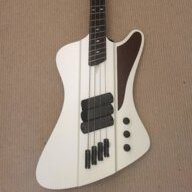
You‘ve already endured far too many wordy paragraphs, so you deserve it: I present to you, in all its glory, my new-to-me Dingwall ABHS, which of course stands for Afterburner Heavy Solid.
ABHS_full.jpg


And yes, it is indeed heavy solid. Very much so. We‘ll get to the details, but let me tell you the rest of the story first.

When the ABHS came up for sale september first, I didn’t even have to think about it: As I have learned about myself,
I really seem to like wenge.

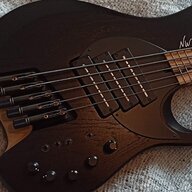
- so, what better purchase to make than a Dingwall with not only a wenge neck, but an actual wenge top, as well? It’s a beautiful dark wenge top, by the way, which doesn’t fully come across in pictures, unfortunately. In reality, it matches the much deeper and more uniform chocolate brown of the neck perfectly.

And it get‘s better: Not only does this ABHS have the beautiful wenge neck many of us here came to love through our Dingwalls:
ABHS_head1.jpg


Its neck has also been topped with a beautifully streaked macassar ebony fingerboard - a very pleasant surprise, as I had expected the familiar wenge/wenge neck. But no:
ABHS_board.jpeg


It also has FD-3 pickups and a Glockenklang 3-band, both of which I‘ve had in an AB-I 4 before and which I really enjoy having back in the quiver (all my other current forever Dingwalls have FDVs or P-Tones). As I want to use this bass for recording, I had the shop also add on the individual s/p-switches (using the orginal Dingwall part) and the nuances available from this setup are really just astounding.

The next bit I’m about to say, I do so completely aware of my being ridiculously spoiled for years by my expertly carved D-Bird and D-Roc, but as much as the FD-3s and the Glock, if not more, I missed having the refined body shape of an AB at my disposal:
That heel joint / fret access! That back contour going far up into the upper horn and thereby actively hugging you when wearing the bass just below the rib cage!
ABHS_horn.jpg


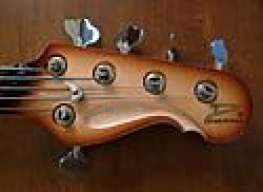
And while it’s not exactly part of the body, those recessed tuners and the counterbored headstock are still one of my favorite Dingwall elements:
ABHS_head2.jpg


I know, I’m gushing a little, but I really do love these little details that show just how much care went into the Afterburners‘ design.

Having spent a little time with the ABHS by now, I’m most surprised by how easily I can maneuver the ABHS’s fretboard and its neck in general: I had imagined a much longer transition period coming from my four strings, as I definitely didn’t feel that comfortable on the Strandberg Boden 5 I had for a while (it was okay, but to me, not great) and I actually really struggled with a Super-J 5 I could try out about a year ago: I wanted to love that one but yikes, that fretboard was far too wide for me.

The ABHS sounds, just as I had hoped, absolutely crushing: There’s a sense of immediacy and heft to the notes no matter which pickups are in use and as you can expect, it also growls - even more so when the tuning is dropped to A - like it was built not in Saskatoon but in Markneukirchen. Still, there’s lots of variation to be found.

Also, it actually took me a couple of days until I changed the strings and the ABHS responded remarkably to a new set: Usually, I enjoy a slightly worn-in set of nickels the most - highs have mellowed a bit (which in my experience works well with distortion), mids are doing their thing beautifully, string noise is of minimal concern - and the ABHS came this way, so everything was fine and a change didn’t seem too necessary. But when I did change to a new set of Dingwall Nickels, the ABHS simply came alive in a whole other way. It’s an overused analogy, so let me try to tweak it a little bit: If my D-Roc and D-Bird have the weight and articulation of a piano, the freshly strung ABHS feels like a concert grand.

As massive as it sounds, it’s definitely not for the faint of heart and spine: With a weight of 5,5 kg (12.125 lbs), practice with the ABHS will mainly take place seated for the time being - but I knew that going in, of course, and I‘ve never been more motivated to keep strengthening my back muscles than I am now with the prospect of actually wielding this beast.

What’s most mind-blowing to me about this whole story, though, is that, after all these years of looking merely for one of eight, I’m actually now playing the first ABHS ever made.

If you’re looking for me, I‘ll be in the shed, most likely sitting down, grinning from ear to ear.
 
Last edited:
Guys and gals, it’s been more than two months coming, but it’s finally here with me. Believe it or not: After seven and a half years in the fanned fold, I bought my first Dingwall five string. Bear with me, please, while I take you on a little ride.

"Umm … Dude. What took you so long?", is your first question, and rightfully so. Well, I don’t necessarily need fivers for my band, as BEAD works really well for me. But then I stumbled upon a few songs I‘d like to try my hands at which actually do make use of a five string. So … I had to, right?

For a few brief months over the summer, I was hemming and hawing what fiver I would like next to its passive four string stablemates from Saskatoon. I considered a guardless Combustion ("a solid workhorse made from ash and maple"), an Ibanez SR5005 ("wenge neck and top and back - that’s just lovely!"), a Stingray Classic Five ("an active five might be a nice addition, right?"), but most of all: A masterbuilt Warwick Thumb ("those woods! that build quality!")

But during this thought process, something else happened.
A faded memory of a picture awoke in the back of my mind and climbed back up into my conscience.
Something I had almost forgotten, honestly given up on, and which actually combines all of the coveted elements above.
It was in July 2016, when I had been a Dingwall player for only a few short months, that I first stumbled upon this picture:
View attachment 5252022

"Dingwall meets Warwick? Is this the best crossover episode ever?" were my immediate thoughts back then and I had been looking for one of these ever since. Had, because there’s a slight problem, there: These are rare. Like, really rare - and that’s coming from someone who regularly plays a D-Bird Custom: Dingwall made exactly eight of these basses, four in 2014 and four in 2015.

I came close to acquiring one once before, in 2021, when it was offered over on Link Removed - a unicorn sighting! and even in europe, where I live! - and for a really good price. But, as it is with used Dingwalls: You snooze, you lose - I wasn’t quick enough to gather the funds and the bass sold to someone else in a matter of three days. Three days. That’s my personal "the one that got away" and it still hurts a bit.

I came across another one on reverb a little more than a year ago, but not only would it have had to travel all the way from south east asia, it also had a badly chewed up and corroded bridge. I thought about, but ultimately decided against it - if the metal parts were that worn out, possibly by being close to saltwater and breeze, I didn’t want to take a gamble with the condition of its timbers.

And thus, I almost forgot about the existence of these heavy unicorns (rhinos?) …

… until the stars finally aligned.

You‘ve already endured far too many wordy paragraphs, so you deserve it: I present to you, in all its glory, my new-to-me Dingwall ABHS, which of course stands for Afterburner Heavy Solid.
View attachment 5252026

And yes, it is indeed heavy solid. Very much so. We‘ll get to the details, but let me tell you the rest of the story first.

When the ABHS came up for sale september first, I didn’t even have to think about it: As I have learned about myself,


- so, what better purchase to make than a Dingwall with not only a wenge neck, but an actual wenge top, as well? It’s a beautiful dark wenge top, by the way, which doesn’t fully come across in pictures, unfortunately. In reality, it matches the much deeper and more uniform chocolate brown of the neck perfectly.

And it get‘s better: Not only does this ABHS have the beautiful wenge neck many of us here came to love through our Dingwalls:
View attachment 5252028

Its neck has also been topped with a beautifully streaked macassar ebony fingerboard - a very pleasant surprise, as I had expected the familiar wenge/wenge neck. But no:
View attachment 5252029

It also has FD-3 pickups and a Glockenklang 3-band, both of which I‘ve had in an AB-I 4 before and which I really enjoy having back in the quiver (all my other current forever Dingwalls have FDVs or P-Tones). As I want to use this bass for recording, I had the shop also add on the individual s/p-switches (using the orginal Dingwall part) and the nuances available from this setup are really just astounding.

The next bit I’m about to say, I do so completely aware of my being ridiculously spoiled for years by my expertly carved D-Bird and D-Roc, but as much as the FD-3s and the Glock, if not more, I missed having the refined body shape of an AB at my disposal:
That heel joint / fret access! That back contour going far up into the upper horn and thereby actively hugging you when wearing the bass just below the rib cage!
View attachment 5252038

And while it’s not exactly part of the body, those recessed tuners and the counterbored headstock are still one of my favorite Dingwall elements:
View attachment 5252042

I know, I’m gushing a little, but I really do love these little details that show just how much care went into the Afterburners‘ design.

Having spent a little time with the ABHS by now, I’m most surprised by how easily I can maneuver the ABHS’s fretboard and its neck in general: I had imagined a much longer transition period coming from my four strings, as I definitely didn’t feel that comfortable on the Strandberg Boden 5 I had for a while (it was okay, but to me, not great) and I actually really struggled with a Super-J 5 I could try out about a year ago: I wanted to love that one but yikes, that fretboard was far too wide for me.

The ABHS sounds, just as I had hoped, absolutely crushing: There’s a sense of immediacy and heft to the notes no matter which pickups are in use and as you can expect, it also growls - even more so when the tuning is dropped to A - like it was built not in Saskatoon but in Markneukirchen. Still, there’s lots of variation to be found.

Also, it actually took me a couple of days until I changed the strings and the ABHS responded remarkably to a new set: Usually, I enjoy a slightly worn-in set of nickels the most - highs have mellowed a bit (which in my experience works well with distortion), mids are doing their thing beautifully, string noise is of minimal concern - and the ABHS came this way, so everything was fine and a change didn’t seem too necessary. But when I did change to a new set of Dingwall Nickels, the ABHS simply came alive in a whole other way. It’s an overused analogy, so let me try to tweak it a little bit: If my D-Roc and D-Bird have the weight and articulation of a piano, the freshly strung ABHS feels like a concert grand.

As massive as it sounds, it’s definitely not for the faint of heart and spine: With a weight of 5,5 kg (12.125 lbs), practice with the ABHS will mainly take place seated for the time being - but I knew that going in, of course, and I‘ve never been more motivated to keep strengthening my back muscles than I am now with the prospect of actually wielding this beast.

What’s most mind-blowing to me about this whole story, though, is that, after all these years of looking merely for one of eight, I’m actually now playing the first ABHS ever made.

If you’re looking for me, I‘ll be in the shed, most likely sitting down, grinning from ear to ear.

Congratulation. Enjoy that beauty thoroughly. :)
 
Guys and gals, it’s been more than two months coming, but it’s finally here with me. Believe it or not: After seven and a half years in the fanned fold, I bought my first Dingwall five string. Bear with me, please, while I take you on a little ride.

"Umm … Dude. What took you so long?", is your first question, and rightfully so. Well, I don’t necessarily need fivers for my band, as BEAD works really well for me. But then I stumbled upon a few songs I‘d like to try my hands at which actually do make use of a five string. So … I had to, right?

For a few brief months over the summer, I was hemming and hawing what fiver I would like next to its passive four string stablemates from Saskatoon. I considered a guardless Combustion ("a solid workhorse made from ash and maple"), an Ibanez SR5005 ("wenge neck and top and back - that’s just lovely!"), a Stingray Classic Five ("an active five might be a nice addition, right?"), but most of all: A masterbuilt Warwick Thumb ("those woods! that build quality!")

But during this thought process, something else happened.
A faded memory of a picture awoke in the back of my mind and climbed back up into my conscience.
Something I had almost forgotten, honestly given up on, and which actually combines all of the coveted elements above.
It was in July 2016, when I had been a Dingwall player for only a few short months, that I first stumbled upon this picture:
View attachment 5252022

"Dingwall meets Warwick? Is this the best crossover episode ever?" were my immediate thoughts back then and I had been looking for one of these ever since. Had, because there’s a slight problem, there: These are rare. Like, really rare - and that’s coming from someone who regularly plays a D-Bird Custom: Dingwall made exactly eight of these basses, four in 2014 and four in 2015.

I came close to acquiring one once before, in 2021, when it was offered over on Link Removed - a unicorn sighting! and even in europe, where I live! - and for a really good price. But, as it is with used Dingwalls: You snooze, you lose - I wasn’t quick enough to gather the funds and the bass sold to someone else in a matter of three days. Three days. That’s my personal "the one that got away" and it still hurts a bit.

I came across another one on reverb a little more than a year ago, but not only would it have had to travel all the way from south east asia, it also had a badly chewed up and corroded bridge. I thought about, but ultimately decided against it - if the metal parts were that worn out, possibly by being close to saltwater and breeze, I didn’t want to take a gamble with the condition of its timbers.

And thus, I almost forgot about the existence of these heavy unicorns (rhinos?) …

… until the stars finally aligned.

You‘ve already endured far too many wordy paragraphs, so you deserve it: I present to you, in all its glory, my new-to-me Dingwall ABHS, which of course stands for Afterburner Heavy Solid.
View attachment 5252026

And yes, it is indeed heavy solid. Very much so. We‘ll get to the details, but let me tell you the rest of the story first.

When the ABHS came up for sale september first, I didn’t even have to think about it: As I have learned about myself,


- so, what better purchase to make than a Dingwall with not only a wenge neck, but an actual wenge top, as well? It’s a beautiful dark wenge top, by the way, which doesn’t fully come across in pictures, unfortunately. In reality, it matches the much deeper and more uniform chocolate brown of the neck perfectly.

And it get‘s better: Not only does this ABHS have the beautiful wenge neck many of us here came to love through our Dingwalls:
View attachment 5252028

Its neck has also been topped with a beautifully streaked macassar ebony fingerboard - a very pleasant surprise, as I had expected the familiar wenge/wenge neck. But no:
View attachment 5252029

It also has FD-3 pickups and a Glockenklang 3-band, both of which I‘ve had in an AB-I 4 before and which I really enjoy having back in the quiver (all my other current forever Dingwalls have FDVs or P-Tones). As I want to use this bass for recording, I had the shop also add on the individual s/p-switches (using the orginal Dingwall part) and the nuances available from this setup are really just astounding.

The next bit I’m about to say, I do so completely aware of my being ridiculously spoiled for years by my expertly carved D-Bird and D-Roc, but as much as the FD-3s and the Glock, if not more, I missed having the refined body shape of an AB at my disposal:
That heel joint / fret access! That back contour going far up into the upper horn and thereby actively hugging you when wearing the bass just below the rib cage!
View attachment 5252038

And while it’s not exactly part of the body, those recessed tuners and the counterbored headstock are still one of my favorite Dingwall elements:
View attachment 5252042

I know, I’m gushing a little, but I really do love these little details that show just how much care went into the Afterburners‘ design.

Having spent a little time with the ABHS by now, I’m most surprised by how easily I can maneuver the ABHS’s fretboard and its neck in general: I had imagined a much longer transition period coming from my four strings, as I definitely didn’t feel that comfortable on the Strandberg Boden 5 I had for a while (it was okay, but to me, not great) and I actually really struggled with a Super-J 5 I could try out about a year ago: I wanted to love that one but yikes, that fretboard was far too wide for me.

The ABHS sounds, just as I had hoped, absolutely crushing: There’s a sense of immediacy and heft to the notes no matter which pickups are in use and as you can expect, it also growls - even more so when the tuning is dropped to A - like it was built not in Saskatoon but in Markneukirchen. Still, there’s lots of variation to be found.

Also, it actually took me a couple of days until I changed the strings and the ABHS responded remarkably to a new set: Usually, I enjoy a slightly worn-in set of nickels the most - highs have mellowed a bit (which in my experience works well with distortion), mids are doing their thing beautifully, string noise is of minimal concern - and the ABHS came this way, so everything was fine and a change didn’t seem too necessary. But when I did change to a new set of Dingwall Nickels, the ABHS simply came alive in a whole other way. It’s an overused analogy, so let me try to tweak it a little bit: If my D-Roc and D-Bird have the weight and articulation of a piano, the freshly strung ABHS feels like a concert grand.

As massive as it sounds, it’s definitely not for the faint of heart and spine: With a weight of 5,5 kg (12.125 lbs), practice with the ABHS will mainly take place seated for the time being - but I knew that going in, of course, and I‘ve never been more motivated to keep strengthening my back muscles than I am now with the prospect of actually wielding this beast.

What’s most mind-blowing to me about this whole story, though, is that, after all these years of looking merely for one of eight, I’m actually now playing the first ABHS ever made.

If you’re looking for me, I‘ll be in the shed, most likely sitting down, grinning from ear to ear.

Awesome - it's beautiful. Thanks for the write up :)
 
  • Like
Reactions: wavemaker
Guys and gals, it’s been more than two months coming, but it’s finally here with me. Believe it or not: After seven and a half years in the fanned fold, I bought my first Dingwall five string. Bear with me, please, while I take you on a little ride.

"Umm … Dude. What took you so long?", is your first question, and rightfully so. Well, I don’t necessarily need fivers for my band, as BEAD works really well for me. But then I stumbled upon a few songs I‘d like to try my hands at which actually do make use of a five string. So … I had to, right?

For a few brief months over the summer, I was hemming and hawing what fiver I would like next to its passive four string stablemates from Saskatoon. I considered a guardless Combustion ("a solid workhorse made from ash and maple"), an Ibanez SR5005 ("wenge neck and top and back - that’s just lovely!"), a Stingray Classic Five ("an active five might be a nice addition, right?"), but most of all: A masterbuilt Warwick Thumb ("those woods! that build quality!")

But during this thought process, something else happened.
A faded memory of a picture awoke in the back of my mind and climbed back up into my conscience.
Something I had almost forgotten, honestly given up on, and which actually combines all of the coveted elements above.
It was in July 2016, when I had been a Dingwall player for only a few short months, that I first stumbled upon this picture:
View attachment 5252022

"Dingwall meets Warwick? Is this the best crossover episode ever?" were my immediate thoughts back then and I had been looking for one of these ever since. Had, because there’s a slight problem, there: These are rare. Like, really rare - and that’s coming from someone who regularly plays a D-Bird Custom: Dingwall made exactly eight of these basses, four in 2014 and four in 2015.

I came close to acquiring one once before, in 2021, when it was offered over on Link Removed - a unicorn sighting! and even in europe, where I live! - and for a really good price. But, as it is with used Dingwalls: You snooze, you lose - I wasn’t quick enough to gather the funds and the bass sold to someone else in a matter of three days. Three days. That’s my personal "the one that got away" and it still hurts a bit.

I came across another one on reverb a little more than a year ago, but not only would it have had to travel all the way from south east asia, it also had a badly chewed up and corroded bridge. I thought about, but ultimately decided against it - if the metal parts were that worn out, possibly by being close to saltwater and breeze, I didn’t want to take a gamble with the condition of its timbers.

And thus, I almost forgot about the existence of these heavy unicorns (rhinos?) …

… until the stars finally aligned.

You‘ve already endured far too many wordy paragraphs, so you deserve it: I present to you, in all its glory, my new-to-me Dingwall ABHS, which of course stands for Afterburner Heavy Solid.
View attachment 5252026

And yes, it is indeed heavy solid. Very much so. We‘ll get to the details, but let me tell you the rest of the story first.

When the ABHS came up for sale september first, I didn’t even have to think about it: As I have learned about myself,


- so, what better purchase to make than a Dingwall with not only a wenge neck, but an actual wenge top, as well? It’s a beautiful dark wenge top, by the way, which doesn’t fully come across in pictures, unfortunately. In reality, it matches the much deeper and more uniform chocolate brown of the neck perfectly.

And it get‘s better: Not only does this ABHS have the beautiful wenge neck many of us here came to love through our Dingwalls:
View attachment 5252028

Its neck has also been topped with a beautifully streaked macassar ebony fingerboard - a very pleasant surprise, as I had expected the familiar wenge/wenge neck. But no:
View attachment 5252029

It also has FD-3 pickups and a Glockenklang 3-band, both of which I‘ve had in an AB-I 4 before and which I really enjoy having back in the quiver (all my other current forever Dingwalls have FDVs or P-Tones). As I want to use this bass for recording, I had the shop also add on the individual s/p-switches (using the orginal Dingwall part) and the nuances available from this setup are really just astounding.

The next bit I’m about to say, I do so completely aware of my being ridiculously spoiled for years by my expertly carved D-Bird and D-Roc, but as much as the FD-3s and the Glock, if not more, I missed having the refined body shape of an AB at my disposal:
That heel joint / fret access! That back contour going far up into the upper horn and thereby actively hugging you when wearing the bass just below the rib cage!
View attachment 5252038

And while it’s not exactly part of the body, those recessed tuners and the counterbored headstock are still one of my favorite Dingwall elements:
View attachment 5252042

I know, I’m gushing a little, but I really do love these little details that show just how much care went into the Afterburners‘ design.

Having spent a little time with the ABHS by now, I’m most surprised by how easily I can maneuver the ABHS’s fretboard and its neck in general: I had imagined a much longer transition period coming from my four strings, as I definitely didn’t feel that comfortable on the Strandberg Boden 5 I had for a while (it was okay, but to me, not great) and I actually really struggled with a Super-J 5 I could try out about a year ago: I wanted to love that one but yikes, that fretboard was far too wide for me.

The ABHS sounds, just as I had hoped, absolutely crushing: There’s a sense of immediacy and heft to the notes no matter which pickups are in use and as you can expect, it also growls - even more so when the tuning is dropped to A - like it was built not in Saskatoon but in Markneukirchen. Still, there’s lots of variation to be found.

Also, it actually took me a couple of days until I changed the strings and the ABHS responded remarkably to a new set: Usually, I enjoy a slightly worn-in set of nickels the most - highs have mellowed a bit (which in my experience works well with distortion), mids are doing their thing beautifully, string noise is of minimal concern - and the ABHS came this way, so everything was fine and a change didn’t seem too necessary. But when I did change to a new set of Dingwall Nickels, the ABHS simply came alive in a whole other way. It’s an overused analogy, so let me try to tweak it a little bit: If my D-Roc and D-Bird have the weight and articulation of a piano, the freshly strung ABHS feels like a concert grand.

As massive as it sounds, it’s definitely not for the faint of heart and spine: With a weight of 5,5 kg (12.125 lbs), practice with the ABHS will mainly take place seated for the time being - but I knew that going in, of course, and I‘ve never been more motivated to keep strengthening my back muscles than I am now with the prospect of actually wielding this beast.

What’s most mind-blowing to me about this whole story, though, is that, after all these years of looking merely for one of eight, I’m actually now playing the first ABHS ever made.

If you’re looking for me, I‘ll be in the shed, most likely sitting down, grinning from ear to ear.

Wow!!! Major congrats on that thing. I’ve always had that same DAS. I’ve let a few of them pass me by. @Bassheart365 has had a few I think and @Flabzilla has a six that I’ve always listed for. That’s a very special looking AB!!

I bet it sounds incredible with that wood spec!
I think I recall trying to put @Katoosie onto the one you missed in 2021.
Hopefully you’ll share some sound samples?!?
 
Guys and gals, it’s been more than two months coming, but it’s finally here with me. Believe it or not: After seven and a half years in the fanned fold, I bought my first Dingwall five string. Bear with me, please, while I take you on a little ride.

"Umm … Dude. What took you so long?", is your first question, and rightfully so. Well, I don’t necessarily need fivers for my band, as BEAD works really well for me. But then I stumbled upon a few songs I‘d like to try my hands at which actually do make use of a five string. So … I had to, right?

For a few brief months over the summer, I was hemming and hawing what fiver I would like next to its passive four string stablemates from Saskatoon. I considered a guardless Combustion ("a solid workhorse made from ash and maple"), an Ibanez SR5005 ("wenge neck and top and back - that’s just lovely!"), a Stingray Classic Five ("an active five might be a nice addition, right?"), but most of all: A masterbuilt Warwick Thumb ("those woods! that build quality!")

But during this thought process, something else happened.
A faded memory of a picture awoke in the back of my mind and climbed back up into my conscience.
Something I had almost forgotten, honestly given up on, and which actually combines all of the coveted elements above.
It was in July 2016, when I had been a Dingwall player for only a few short months, that I first stumbled upon this picture:
View attachment 5252022

"Dingwall meets Warwick? Is this the best crossover episode ever?" were my immediate thoughts back then and I had been looking for one of these ever since. Had, because there’s a slight problem, there: These are rare. Like, really rare - and that’s coming from someone who regularly plays a D-Bird Custom: Dingwall made exactly eight of these basses, four in 2014 and four in 2015.

I came close to acquiring one once before, in 2021, when it was offered over on Link Removed - a unicorn sighting! and even in europe, where I live! - and for a really good price. But, as it is with used Dingwalls: You snooze, you lose - I wasn’t quick enough to gather the funds and the bass sold to someone else in a matter of three days. Three days. That’s my personal "the one that got away" and it still hurts a bit.

I came across another one on reverb a little more than a year ago, but not only would it have had to travel all the way from south east asia, it also had a badly chewed up and corroded bridge. I thought about, but ultimately decided against it - if the metal parts were that worn out, possibly by being close to saltwater and breeze, I didn’t want to take a gamble with the condition of its timbers.

And thus, I almost forgot about the existence of these heavy unicorns (rhinos?) …

… until the stars finally aligned.

You‘ve already endured far too many wordy paragraphs, so you deserve it: I present to you, in all its glory, my new-to-me Dingwall ABHS, which of course stands for Afterburner Heavy Solid.
View attachment 5252026

And yes, it is indeed heavy solid. Very much so. We‘ll get to the details, but let me tell you the rest of the story first.

When the ABHS came up for sale september first, I didn’t even have to think about it: As I have learned about myself,


- so, what better purchase to make than a Dingwall with not only a wenge neck, but an actual wenge top, as well? It’s a beautiful dark wenge top, by the way, which doesn’t fully come across in pictures, unfortunately. In reality, it matches the much deeper and more uniform chocolate brown of the neck perfectly.

And it get‘s better: Not only does this ABHS have the beautiful wenge neck many of us here came to love through our Dingwalls:
View attachment 5252028

Its neck has also been topped with a beautifully streaked macassar ebony fingerboard - a very pleasant surprise, as I had expected the familiar wenge/wenge neck. But no:
View attachment 5252029

It also has FD-3 pickups and a Glockenklang 3-band, both of which I‘ve had in an AB-I 4 before and which I really enjoy having back in the quiver (all my other current forever Dingwalls have FDVs or P-Tones). As I want to use this bass for recording, I had the shop also add on the individual s/p-switches (using the orginal Dingwall part) and the nuances available from this setup are really just astounding.

The next bit I’m about to say, I do so completely aware of my being ridiculously spoiled for years by my expertly carved D-Bird and D-Roc, but as much as the FD-3s and the Glock, if not more, I missed having the refined body shape of an AB at my disposal:
That heel joint / fret access! That back contour going far up into the upper horn and thereby actively hugging you when wearing the bass just below the rib cage!
View attachment 5252038

And while it’s not exactly part of the body, those recessed tuners and the counterbored headstock are still one of my favorite Dingwall elements:
View attachment 5252042

I know, I’m gushing a little, but I really do love these little details that show just how much care went into the Afterburners‘ design.

Having spent a little time with the ABHS by now, I’m most surprised by how easily I can maneuver the ABHS’s fretboard and its neck in general: I had imagined a much longer transition period coming from my four strings, as I definitely didn’t feel that comfortable on the Strandberg Boden 5 I had for a while (it was okay, but to me, not great) and I actually really struggled with a Super-J 5 I could try out about a year ago: I wanted to love that one but yikes, that fretboard was far too wide for me.

The ABHS sounds, just as I had hoped, absolutely crushing: There’s a sense of immediacy and heft to the notes no matter which pickups are in use and as you can expect, it also growls - even more so when the tuning is dropped to A - like it was built not in Saskatoon but in Markneukirchen. Still, there’s lots of variation to be found.

Also, it actually took me a couple of days until I changed the strings and the ABHS responded remarkably to a new set: Usually, I enjoy a slightly worn-in set of nickels the most - highs have mellowed a bit (which in my experience works well with distortion), mids are doing their thing beautifully, string noise is of minimal concern - and the ABHS came this way, so everything was fine and a change didn’t seem too necessary. But when I did change to a new set of Dingwall Nickels, the ABHS simply came alive in a whole other way. It’s an overused analogy, so let me try to tweak it a little bit: If my D-Roc and D-Bird have the weight and articulation of a piano, the freshly strung ABHS feels like a concert grand.

As massive as it sounds, it’s definitely not for the faint of heart and spine: With a weight of 5,5 kg (12.125 lbs), practice with the ABHS will mainly take place seated for the time being - but I knew that going in, of course, and I‘ve never been more motivated to keep strengthening my back muscles than I am now with the prospect of actually wielding this beast.

What’s most mind-blowing to me about this whole story, though, is that, after all these years of looking merely for one of eight, I’m actually now playing the first ABHS ever made.

If you’re looking for me, I‘ll be in the shed, most likely sitting down, grinning from ear to ear.
Congratulations! That’s a stunning bass!
 
Wow!!! Major congrats on that thing. I’ve always had that same DAS. I’ve let a few of them pass me by. @Bassheart365 has had a few I think and @Flabzilla has a six that I’ve always listed for. That’s a very special looking AB!!

I bet it sounds incredible with that wood spec!
I think I recall trying to put @Katoosie onto the one you missed in 2021.
Hopefully you’ll share some sound samples?!?
At that weight, I am glad I did not take it! I already think that my ABII is heavy, an ABHS would kill me in half!
 
20210619_063155407_ios-jpeg.5252580


It’s likely been mentioned but I can’t find the reference - what’s the lovely dark top wood on the bass on the bottom? I’m still finalizing mine and gathering ideas as my build slot has yet to come up.
That’s a cocobolo top if I’m not mistaken