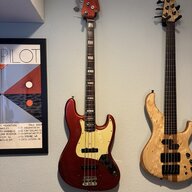
Today I went up to my buddy Sean's place and we did a pickup swap on my Super J. I replaced the stock FDVs with a full set of SF2s. I'll preface this all by saying that I really did love the sound of this bass with the FDVs, and this was driven entirely by two factors:
- Curiosity, and;
- Hoping for a neck-bridge in parallel combination that was closer to a Jazz bass than what the FDVs offered, which I always felt was more Spector'y, or in some ways Wal'y.
The swap was much simpler than I had anticipated with no soldering required due to the Glock preamp using screw terminals for the pickup wires. Dead simple. We kept the same arrangement of N and B pickups as the factory FDVs, such that it goes Neck-N, Middle-B, Bridge-N. We also took measurements beforehand to restore the pickup heights to be the same as the FDVs for as much of an apples-to-apples comparison as possible. Below are my thoughts. First I'll describe the frequency response differences, then the very surprising feel/attack differences, and finally my general feelings on these pickups for use in a Super J.
The FDVs do a good job of what Dingwall describes in their ad copy for these pickups. They feel like updated Fender-style pickups that skew a little more modern than most of what Fender does. As mentioned, the neck-bridge in parallel combination doesn't really sound like an actual Jazz bass, but it's a nice sound regardless. The FDVs have a good but not overly deep bottom end extension, a reasonably high top end extension that feels pretty polite, a bit of a bump in the lower midrange, and what always felt like a slight dip around 500-700hz. It's a nice sound for sure.
The SF2s are a different animal all together. I read an earlier post that described them as being "too MTD" for that particular user. I can see where they're coming from, but I wouldn't totally agree with the MTD comparison. The frequency response difference between the two pickups is largely that the SF2s go both lower and higher, they seem to lack the bump in the lower midrange which presents more evenly, and the slight dip around 500-700hz feels like it's still there. The politeness in the top end on the FDVs is gone with the SF2s, but that's not to say that the SF2s sound super aggressive or snarly up top. It's simply that there's a more even response from the upper midrange to the top of the usable range of the pickups, whereas the FDVs had some sort of dip and swell in the nasty frequencies in the upper midrange. That's a common theme here; The FDVs feel like they're pretty heavily targeted at a specific voice, whereas the SF2s feel much more even through their presentation from top to bottom.
The note attack and general feel of the FDVs was one area where I sometimes struggled. The FDVs are not what I would describe as an "open" sounding pickup. On the contrary I hear them as being compressed, congested, cramped, etc. such that the initial onset of a note's attack was very present, really thumped, and immediately jumped out of speakers in a useful way. By comparison, the rest of the attack envelope of each note felt like it decayed rather quickly. Not quite in the way of comparing fresh rounds to old flats, but the analogy isn't entirely without merit. I feel like the FDVs were designed to highlight the attack of a note in a way that aligns with notions of what "vintage" means when describing tone. They really nailed it with that. A lot of the time I liked that vibe, but there were times, particularly when slapping, that I felt like it was getting in the way.
The SF2s, by comparison, are very different. Much in the way the frequency response is more even, the note attack is more even as well. I did not expect this when making the switch. Every portion of the note seems to come out smoothly and evenly with no aspect of it dominating another. The decay is smooth without any obvious steepness to the drop-off between attack, sustain and release (for lack of better terms to describe what I'm hearing). For my playing style, taste, and choices, this is a MAJOR upgrade. It fixes everything about the one aspect of my bass I never totally loved. Problem solved in a big way, and as a result I'm very happy with the switch.
In general I'd say that the FDVs are a solid choice for anyone who wants their Dingwall to be an updated and refined version of a classic Fender-style instrument. They really nail that vibe in a way that's equal parts modern and vintage. I think the SF2s are a solid choice for anyone who wants their Dingwall to be a very even, open, uncompressed, modern machine that might not be able to do everything, but can get very close. Since I have a passive Super P on order, I wanted my Super J to have the opposite vibe (i.e. modern and active with all the options versus a super simple vintage-inspired passive bass with no added options). I think this achieves that goes more effectively with the SF2s than the FDVs, so I'm quite happy. The real tests will come on my next few gigs. I'm off for a couple weeks, but will be back to gigging a bunch in December. One of our shows is at a very high profile venue that we played in October. I have a board recording from that October show and will get one in December. That will be a fun comparison to see how well the SF2s work compared to the FDVs on actual recorded material. I wouldn't mind trying the FD-3s at some point, but I doubt I'll ever pull the trigger on a set of those given how well the SF2s achieved what I was looking for.
I'll add that the SF2s in the bridge-neck parallel combination still don't sound like a class Jazz bass, but I would say the combination is much closer than the FDVs, particularly when I put each pickup in parallel with itself. I live in bridge-middle parallel with the middle pickup in parallel and the bridge pickup in series 99% of the time, so it's really not that big of a deal.
Addendum: The SF2s are noticeably higher output than the FDVs. Not a big deal either way for me, but worth noting.
View attachment 5254585
View attachment 5254586