

Enjoy the benefits of a premium membership!
Upgrade Account
-
TalkBass has been independent since 1998. Add your voice.
Create a free account to reply to discussions, view embedded media, and browse with fewer display ads.
Join free Log in
Want zero display ads or expanded classifieds tools? Compare plans.
You are using an out of date browser. It may not display this or other websites correctly.
You should upgrade or use an alternative browser.
You should upgrade or use an alternative browser.
Dingwall Owners Club
- Thread starter FroggyOne2
- Start date
More options
Who Replied?
BurningSkies
CRAZY BALDHEAD
- Feb 20, 2005
- 27,956
- 20,348
- Disclosures
- Endorsing artist: Dingwall Guitars
All of this is why I love a 5 string. I can pretty easily transpose just about everything around the neck, and not play an open string. I actually do just that on most of my bands material and cover Eb, C, C#, and standard tuning just fine. There are only two songs out of the 7 sets that we collectively know that I use drop tunings for. That is only because it is not possible for me to ride that low D and hit the stuff higher up the neck fast enough.
Exactly. In fact just last Tuesday our prodigal guitarist (has been living in a bus in the hills of North Carolina for the past 6 months, tends to show up when we have some good gigs and/or important stuff) showed up for rehearsal for Saturday's show and said 'that song we haven't played in 6 months...I'd love to do it, but in Gm instead of our usual key. Easy enough on 5 just to move a couple frets and lay it down rather than rethinking what the open strings are doing, etc. Also it sounds way more uniform between keys as well.
I would love to (and should) get to a point where I can all but transpose on the fly. I'll get there one day.
For simple stuff, I do find myself choosing one over the other with open string versus fretted. There are times when I feel one is more appropriate to the feel of the song. Not sure if they can be differentiated in FoH. But our stage mix is so good that I can usually hear the difference. Call it taking artistic liberties.
Hey Julian, maybe we should start the 5 string cheaters club !
There ain't no cheating. Its finding what works for you and what sounds good for your context. I'm generally not buried by any heavy guitars, so my tone is heard predominantly in the mix. I strive for a uniformity in my playing (minus spots where I try to create a specific emphasis), so my playing style has been built around that, whether it's staying in a hand position or on some cases working a specific string in a 6 to 8 fret range. You do what sounds good to you and FEELS good to you. Phrasing and groove often come from having certain hand patterns that work better for us than others. They sound deep and natural because we've playing them in a certain way for a number of years and there's both muscle memory and also the subconscious at work flexing your time and affecting your timbre.
Or in other words my phrasing is my phrasing. And my tone is my tone. And even if I'm covering someone, I sound like me and not whoever. I don't want to sound like whoever and in most cases have no real interest in doing more than suggesting that as a starting point. Although I'm often more oblique than that and reference a different feel, song or playing style in what I do. Fer instance, one of the few covers we do is Concrete Jungle by the Wailers, yet the Family Man original may be a starting point, my line is closer to what Flabba would do if he was playing with Sagittarius Band instead of Roots Radics.

I'm generally not buried by any heavy guitars, so my tone is heard predominantly in the mix.
I play with heavy guitars, you cant bury me in the mix.


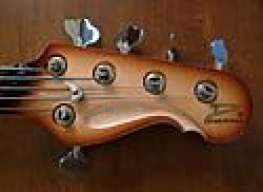
SPYD3R #9 - your friend's Dingwall is sweet. We need more red ones around. 
I hereby nominate Zoomie for the nastiest metaphor of the week award. I absolutely do not even want to know what a "hairy butt" sounds like!
I hereby nominate Zoomie for the nastiest metaphor of the week award. I absolutely do not even want to know what a "hairy butt" sounds like!

Gorgeous!!! Love me some Whale Pool Blue!My Beautiful Dingwall ABXXX5 With Wenge neck,Whalepool Burst and X-top
Invalid Link Removed
Invalid Link Removed
Then you better not play any open notes!!I play with heavy guitars, you cant bury me in the mix.

Then you better not play any open notes!!
Between Dingwall and fEARfuls, I could ride an open string all night and crush the mix.
i think it goes without saying as a bassist to play in all 12 keys closed.
I think the point was sort of missed- there are moment when nothing else will do except an open note regardless of how proficient one is with their technique.
I personally like the sound of an open D and I think it makes more sense to have a 5 string with an extender on the E string than on the B string for tunes where a D drone is needed. if a drone is not needed, then carry on with you regular scheduled programming.
I think the point was sort of missed- there are moment when nothing else will do except an open note regardless of how proficient one is with their technique.
I personally like the sound of an open D and I think it makes more sense to have a 5 string with an extender on the E string than on the B string for tunes where a D drone is needed. if a drone is not needed, then carry on with you regular scheduled programming.
So if your playing an E blues song on a 4 string, you should simply avoid playing the low E? Or is it required to purchase a 5 string so that can never happen ( shame on you!)? And what about the low B? Guess you had better not play Don't Drink the Water by DMB. Or you'll need to drop that low B to an A so you can fret the B.i think it goes without saying as a bassist to play in all 12 keys closed.
I think the point was sort of missed- there are moment when nothing else will do except an open note regardless of how proficient one is with their technique.
I personally like the sound of an open D and I think it makes more sense to have a 5 string with an extender on the E string than on the B string for tunes where a D drone is needed. if a drone is not needed, then carry on with you regular scheduled programming.
I really didn't miss the point, I just don't agree with the premise (or unwritten rule) that it "goes without saying as a bassist to play all 12 keys closed." Or that ONLY under the circumstances where a "drone" low D is required is it OK not to do so. If you're playing with a jazz quartet, or you are recording (and doing vocals separately anyway), maybe someone actually MIGHT be able to hear the difference in character, let alone discern it as being somehow bad or uneven or inconsistent in character.
I've seen Jack Bruce, one of my favorite singing bass players of all time play White Room mostly in first position (he kind of goes back and forth) with open strings. No matter how hard I listen, I can't detect any significant or unpleasant inconsistency in character between the open and closed notes. I guess he must have been buried by Eric and Ginger in the mix, or else I have poor hearing. When I play and sing that song, I usually play it mostly in first position and can get a very nice consistency in character using my Sadowsky P or my Dingwall fiver, along with some left hand muting. Singing and playing bass lines like that is hard enough without trying to obey some unwritten law of bass playing when, under circumstances such as playing in a live rock mix, it frankly serves nothing more than a player's own self-satisfaction.
I could have learned to play Slither on a five string, as well as several other songs that my band does in drop D and C# but the time required to be really good playing a bass line like that on a fiver while singing so I can fret every note is simply not worth it. Not once in nearly five years of doing those songs did a person (even a bass player) ever come up to me and say, "You know, Slither would have sounded so much better if only you had played that on a five string and fretted that low D instead." I suppose I may have been unknowingly ridiculed, but then, ignorance is bliss after all!
I do usually play mostly in a closed tuning, and I really like playing E blues on a fiver because I like that the E shape can be the same as the A. But I'm not going to waste valuable time trying to learn to sing and play a difficult bass line like Slither on a fiver in closed tuning when I have a hundred other songs to learn for the band for no other reason than I met the challenge of never playing a dastardly and apparently illegal open string note.
BTW, I hear what you're saying about putting a drop tuner for a fiver on the E. I have played Drop D tuning on a fiver many times if I didn't have a four with me or I didn't want to take the time to switch to a four. But then again, I don't play much metal and I know those guys do a lot of Drop A and Ab stuff, so I guess whatever works for what you're doing.

I've seen Jack Bruce, one of my favorite singing bass players of all time play White Room mostly in first position (he kind of goes back and forth) with open strings. No matter how hard I listen, I can't detect any significant or unpleasant inconsistency in character between the open and closed notes. I guess he must have been buried by Eric and Ginger in the mix, or else I have poor hearing.
It's because every note sounds like mud on an EB-3!
It's because every note sounds like mud on an EB-3!
 Ahhh! My bad.
 Alas!! Jack did not not have the good fortune we all have to play Dingwalls when he was young!
It's because every note sounds like mud on an EB-3!
Alas!! Jack did not not have the good fortune we all have to play Dingwalls when he was young!

Got a couple new cabs to play my Dingwalls through. Talking about clarity, that's a big step up from my previous Harke rig. If you catch me smiling for no reason... I'm just thinking about my bass rig !
[Invalid or Expired Link Removed]
[Invalid or Expired Link Removed]
Got a couple new cabs to play my Dingwalls through. Talking about clarity, that's a big step up from my previous Harke rig. If you catch me smiling for no reason... I'm just thinking about my bass rig !
[Invalid or Expired Link Removed]
The Streamie compliments Dingwall tone very nicely. Nice set up.
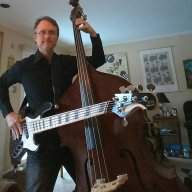
BurningSkies
CRAZY BALDHEAD
- Feb 20, 2005
- 27,956
- 20,348
- Disclosures
- Endorsing artist: Dingwall Guitars
Yep. That's how they once were. Back before Sheldon made his own pickups, I think it was more effective to have them parallel to have the magnetic field cover the string's range.
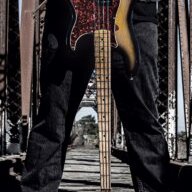
I could be wrong(as always) but I seem to remember that they switched to parallel pick-up mounting for a short time then went back to angled. I think the earlier Voodoo basses had angled pickups.
If that bass pre-dates all angled pick-up basses then it should be a '93.
If that bass pre-dates all angled pick-up basses then it should be a '93.
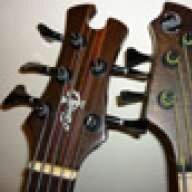

Has anyone talked to Sheldon about zero frets?
EG
Sheldon's been building for a long time... He's probably tried the zero fret and not cared for it enough to use it.


