• TalkBass has been independent since 1998. Add your voice.
    Create a free account to reply to discussions, view embedded media, and browse with fewer display ads.
    Join freeLog in
    Want zero display ads or expanded classifieds tools? Compare plans.

Dingwall Owners Club

Well yeah. They aren't your father's p bass, that's for sure!

But there are a few things that are suggestive of traditional, like split coil pup, body shape and pick guard.
My first pro bass was a '64 Precision. I had a love-hate relationship with that bass that lasted throughout the first and most active phase of my career.

To my mind, Sheldon's take on the Precision Bass is the only really substantial advancement on the original. It fixes everything that honked me off about my pre-CBS Fender, yet it retains enough of the simplicity and iconic shape of the original to hit me like a punch in the gut. Every time I see one.

If they had been around 30 years ago, I would have gone straight from my Fender to a Dingwall SP-5, and never looked back. Considering the horde of instruments that have passed through my hands over that period, that would have saved me a lot of time and money.

It's ironic that my tastes have changed enough over the years, that by the time I finally had the means to go shopping, the ABZ turned my head instead.
 
  • Like
Reactions: BuffaloBob4343
Bob, I have made the switch to 5's out of necessity. And frankly, my brain is too small to jump back and forth between 4's and 5ers.

Trust me, if I could get away with playing 4's, I'd be running the same models I do now.
You would have no problem switching back and forth I assure you. It just takes playing both, and it becomes second nature like anything else. But fives are awesome. I use mine a lot, just not exclusively.

I really like playing drop d songs and songs that do not require a low B with a nice comfy and slick 4 string neck with 19mm spacing.
 
You would have no problem switching back and forth I assure you. It just takes playing both, and it becomes second nature like anything else. But fives are awesome. I use mine a lot, just not exclusively.

I really like playing drop d songs and songs that do not require a low B with a nice comfy and slick 4 string neck with 19mm spacing.

I've only been playing 5's for about nine years, but switching between them and 4's has become second nature for me. The whole 'drop D' thing would definitely confuse my brain!
 
Just to comment on the notion that an open string always sounds better - not necessarily on a fretless. That fretless warmth is missing on an open string, and that's a no-go if you're looking for the fretless warmth. Just saying :D

For this reason, I've gone to great length to avoid playing open strings. Some basslines become a lot harder (Audioslave - Show Me How To Live immediately comes to mind). For a while I even downtuned a half-step just so that I could fret the B, E, A and others close to the nut (increased pitch clarity as opposed to fretting near the 5th fretline in standard tuning).
 
Just to comment on the notion that an open string always sounds better - not necessarily on a fretless. That fretless warmth is missing on an open string, and that's a no-go if you're looking for the fretless warmth. Just saying :D

For this reason, I've gone to great length to avoid playing open strings. Some basslines become a lot harder (Audioslave - Show Me How To Live immediately comes to mind). For a while I even downtuned a half-step just so that I could fret the B, E, A and others close to the nut (increased pitch clarity as opposed to fretting near the 5th fretline in standard tuning).
I concur
 
I don't understand the point of playing in drop D when you have a 5-string.

I don't listen extensively to drop-tuned bands, but based on radio airplay, I haven't heard any bass lines that I couldn't cope with on a conventionally-tuned fiver.

What am I missing?
The best way I can explain it is through an exercise that has been my experience:

1) Try playing the bass line for Slither by Velvet Revolver in a closed tuning on a fiver.

2) then do it while singing the lead vocal.

3) repeat above steps with a bass in drop D. Preferably on a four string.

Some songs are just meant to played in Drop D (or C# if the entire bass is tuned down a half step).

If you actually do the above, it may be the best way to understand.
 
  • Like
Reactions: CL400Peavey
I avoid open notes at all costs. I guess they're fine if you want a handful of random notes to sound nothing like the rest of what you're playing though.
When banging out a tune like Slither by Velvet Revolver with two loud guitarists and a loud drummer, my experience is that no one can tell the difference between an open and fretted note, and if they can, they are likely not the least bit offended or otherwise troubled by it. :D:bassist:
 
drop D makes perfect sense for 2 reasons-
one-an open string always sounds better-
and sometimes it is easier to have an open drone when you are doing other things.
a good example would be "the pot" by Tool
I see your point. I listened to The Pot this evening, and played along with sections of it. Aside from the fact that it would be easier to play in dropped D, that clangy sound on the drone would be easier to get off an open D, as opposed to the fretted note at the third fret.

My half-hearted attempt at a cover sounded most convincing in the sections where the bass part sounded fatter and more conventional.

That said, angular, pissed-off sounding riffs like those aren't part of my normal vocabulary. Other than being an interesting exercise, it had no application to what I do.

Like BurningSkies, I spent years working to smooth out my technique, and avoiding open strings in walking lines was part of that discipline...
 
Interesting.

When it comes to theory, woodshedding, learning rapidly, and functionality in a band environment, we all find what works best for our brains.

Most of my current musical environment requires me to learn or relearn 6-10 songs spread out over two praise bands every week. I typically get the set list 72 hours before service for one, and 72 hours before rehearsal for the other. I play them one time with maybe one or two being carried over, and the remainder get shelved for 6-8 weeks.

To compound matters, because there are a multitude of vocalists, I am constantly transposing, up to two full steps. And we bass players don't have the luxury of using a sissy capo. Well you can, but your bass sounds like hairy butt.

And to add final insult to injury, the arrangement changes regularly. Then we start all over.

So, in my case, there are two main reasons for Low B. The first is that CC basslines are often written by keyboard composers with a left hand fetish. They like the low notes.

The second reason is my own personal crutch. Because we are constantly transposing, I avoid open notes like the plague. Any key using a scale with lots of open strings, gets pushed up 5 frets and dropped a string. That way the pattern stays consistent regardless of transpositions. Yes there are times that only an open note will do. But for the most part, I stick with my plan.

We were playing something complex one time (for me anyway) and I recall using a bunch of open strings. The WP dropped it down a half step and I had to scramble to make it happen. I remember thinking that I had to find a way to avoid wetting the bed go-forward.

Is it a weakness in my playing/skillset that should be addressed? Absolutely. But for now, I will continue to cheat in this manner.

Drop D tuning on a four banger would only confuse me, again, in this environment.
 
Last edited:
Interesting.

When it comes to Theory, woodshedding, learning rapidly, we all find what works for our brains.

Most of my current musical environment requires me to learn or relearn 6-10 songs spread out over two praise bands. I typically get the set list 72 hours before service for one, and 72 hours before rehearsal for the other. I play them one time with maybe one or two being carried over, and the remainder get shelved for 6-8 weeks.

To compound matters, because there are a multitude of vocalists, I am constantly transposing, up to two full steps. And we bass players don't have the luxury of using a sissy capo. Well you can, but your bass sounds like hairy butt.

And to add final insult to injury, the arrangement changes regularly. Then we start all over.

So, in my case, there are two main reasons for Low B. The first is that CC basslines are often written by keyboard composers with a left hand fetish. They like the low notes.

The second reason is my own personal crutch. Because we are constantly transposing, I avoid open notes like the plague. Any key using a scale with lots of open strings, gets pushed up 5 frets and dropped a string. That way the pattern stays consistent regardless of transpositions. Yes there are times that only an open note will do. But for the most part, I stick with my plan.

We were playing something complex on time (for me anyway) and I recall using a bunch of open strings. The WP dropped it down a half step and I had to scramble to make it happen.

Is it a weakness in my playing that should be addressed? Absolutely. But for now, I will continue to cheat in this manner.

Drop D tuning on a four banger would only confuse me, again, in this environment.


All of this is why I love a 5 string. I can pretty easily transpose just about everything around the neck, and not play an open string. I actually do just that on most of my bands material and cover Eb, C, C#, and standard tuning just fine. There are only two songs out of the 7 sets that we collectively know that I use drop tunings for. That is only because it is not possible for me to ride that low D and hit the stuff higher up the neck fast enough.
 
  • Like
Reactions: BurningSkies
All of this is why I love a 5 string. I can pretty easily transpose just about everything around the neck, and not play an open string. I actually do just that on most of my bands material and cover Eb, C, C#, and standard tuning just fine. There are only two songs out of the 7 sets that we collectively know that I use drop tunings for. That is only because it is not possible for me to ride that low D and hit the stuff higher up the neck fast enough.

I would love to (and should) get to a point where I can all but transpose on the fly. I'll get there one day.

For simple stuff, I do find myself choosing one over the other with open string versus fretted. There are times when I feel one is more appropriate to the feel of the song. Not sure if they can be differentiated in FoH. But our stage mix is so good that I can usually hear the difference. Call it taking artistic liberties.;)

Hey Julian, maybe we should start the 5 string cheaters club !
 
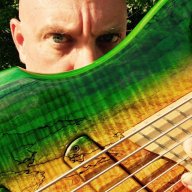
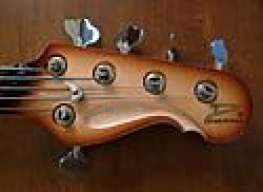
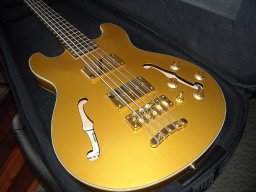
So I've been around in this forum for several years, admiring Dingwall and dream about owned one of those greatness. A good friend of mine just bought a Dingwall, and he gave me a chance to borrow it for my upcoming gigs, am so exciting to test those axe on real war situation!!

so this is some photo shoot taken from the gigs on Friday

IMG_20140509_100249_zps6b0cea17.jpg

IMG_20140509_173320_zps4bb6622c.jpg


and this is from church Sunday Services

IMG_20140511_162933_zpsed354d0c.jpg


now let's hope that will be officially mine in couple of months :D
 
Last edited: