I am not sure how much, if any, the top wood on the body of a bass actually makes. It think it's more for aesthetics.

TalkBass has been independent since 1998. Add your voice.
Create a free account to reply to discussions, view embedded media, and browse with fewer display ads.
Join free Log in
Want zero display ads or expanded classifieds tools? Compare plans.

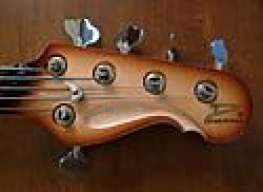
My incoming Dingwall wont have a "fancy top". It is swamp ash, and I have no idea what the wood grain will look like.
No worries on my end though. Sheldon doesnt make bad looking instruments.

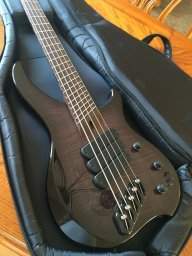
Sheldon spoiled me completely when he built this non-fancy topped SJ for me:
...
I haven't played them all and have no need to. This one is the most perfect five-string bass I have ever played. Sheldon is such a blessing to the bass world.
Wow! Absolutely stunning!!!
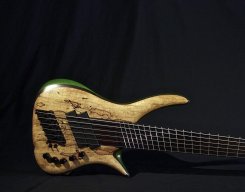
 Sheldon said it kept attracting his eye during the finishing stages. He calls this finish "colaburst" because it is what a sunset viewed through a glass of cola looks like to him.
It all comes down to the figuring of the wood.
Burl
Invalid Link Removed
I keep looking at that one and can't help but think I would love to be on a beach right now.. instead of hrere, at -20!!
I'm calling it the sea bass.
Eric
I started to craft a response to your original post, and then deleted it because your question was so specific.Ask about how usefull series/parallel switches on pickups other then the bridge; get crickets…
Ask about sexy tops; Get a party and 2 pages of bass porn in under half hour.
I started to craft a response to your original post, and then deleted it because your question was so specific.
My experience with two pickup AB's, and also with XXX's, is that coil switches are useful in all positions.
By itself in parallel mode, the bridge pickup can sound either displeasingly weak and thin, or wonderfully bright and open. Ditto for a bridge pickup stuck in series mode, only vice versa- nice and loud and thick for some things, but maybe too dark and congested for others.
Based on my limited experience with the XXX configuration, it's the same with the middle pickup.
Hi,
This morning I was loking at this Z3 control layout and noticed that there are series/parallel swithces for the neck and bridge pickup (none for the midle).
I've read that you can get in the ballpark of a P bass with soloing the neck in series, but I was wondering what kind of sounds was achieved with the bridge switch? Did it come about when the bridge is soloed or is it more usefull when paired up with the midle or neck pickup?
Edit: I'm also curious as to hear how you guys are using those switches on the middle pup!
Thanks,
Eric

Soulvaccination - tone it down, bro - you're going to have everyone ordering three-pickup Dingwalls and swamp the shop!
Simply being in the dingwall club (no matter which one you chose) should be more than enough unless you are a complete idiot.
Don't get me wrong....I love my Z3. However, the thing I love about Dingwalls and what I want to stress to all those who drop by this thread to ask "which one is best?" is that the question is utterly pointless. That's like asking "which victoria secret model would I rather sleep with" or "which Lamborghini would I rather own?"

Steve's exactly correct above. I quoted some of his response which says it best. I'll also add this...
There are no "bad/weak/poor/crappy" tones on a dingwall. They are all good and they are all useful for something, but as Steve said, it's very dependent on the music you make and how you use your technique to bring those tones out. I use every single pickup and switch setting on my Z3, but for lots of different reasons and tones. Here's some examples using some of the music I play.
Neck pickup solo'd in parallel is great for palm muted upright style tones and softer plucked whole notes for ballads such as "high and dry" by radiohead. It's sometimes too thin for rock tones played with a band, but can work in some country songs depending on the song/band.
Neck pickup in series is great for a killer p-bass grind. I use this tone lots as its a killer p-bass on steroids useful for songs like "saving grace" by Tom Petty. Using this setting with palm muting and boosted bass gets a great dub tone as well.
Jazz pickups in parallel are similar to the p-bass above. In parallel the standard jazz configuration is sweet, clear, smooth. I use this setting lots as well, especially for chordal parts in ballads or church worship songs. It's also useful for songs with big dynamic shifts such as " lightening crashes" by live where I can flip into series using the toggles for a quick "boost" setting to help cut through when the bass plays a bit of a lead line. Using these pickups in series makes for a great all around killer jazz bass I use on lots tunes that have minor slap sections in between finger style sections. This is my favorite "Swiss Army knife" tone that I can use for almost any song by altering my technique, playing position, and pre-amp eq.
Humbucking pickup setting is great with the bridge pickup in parallel and the mid frequency set low for a grinding bass tone I use on many rock songs with driving 8'ths like "vertigo" by U2. Flipping up the mid and/or moving the bridge pickup into series makes the grind move higher and louder, to where it's like a chainsaw on steriods. This setting is a killer mid scooped slap tone if I cut the mids, or if I boost them I can own the mix for songs like "by the way" from the chili peppers. Playing hard finger style right over the pickup can sound like you have built in overdrive/distortion going on. Playing slap up by the neck on the same setting gives you a huge scooped sound.
Bridge pickup...first off, you must understand the largest harmonic content from the strings exists closest to the bridge. As such, this pickup can be your best friend and your worst enemy. Soloing the bridge in parallel is also great for softer chordal stuff and harmonics almost leap off the fretboard sometimes when you aren't even trying. Placing the pickup into series is even more of it, almost to the point of being overwhelming. I can play the bridge pickup in series with a treble enhanced/bass reduced eq using root/5th/octave power chords above the 12th fret and you'd be challenged not to believe it was a second electric guitar. The options are almost endless for how to use the bridge pickup on its own.
To summarize....I play a Greenboy cabinet with a clean Aguilar head using a Dingwall. There isn't a single song or bass tone I can't get close to (or nail spot on) in any setting from a bar to a church. As steve pointed out, the eq is almost not needed, but is another tool to help fine tune your tone as required. I get people coming up me after bar shows asking to see what pedals I'm using and not believing I am playing clean. I sometimes use envelope filters, distortions, or modulation pedals for the odd song but you can do a lot without them if your hands have enough skill in them!
Don't overthink the decision on which bass you buy. Get the most versatile, optioned up bass you can realistically afford. Whether that's a primaXXX-6 or a humble superP-4 you'll find good tone and you'll be happy with your purchase.
I too thought about adding a redeemer circuit to my super p. Can you elaborate on your experience with it and going back to passive control.