• TalkBass has been independent since 1998. Add your voice.
    Create a free account to reply to discussions, view embedded media, and browse with fewer display ads.
    Join freeLog in
    Want zero display ads or expanded classifieds tools? Compare plans.

Dingwall Owners Club

Gorgeous. So tighter grains. Perhaps that's where my confusion came in. The lines are closer and more abundant.

Is it heavier I wonder?

They're all 'Fraxinus americana' I believe (American Ash).

The Wikipedia:
Swamp ash may refer to:

And "northern ash" is similarly a euphemism for heavier/harder more dense. Less water, slower growth tighter grain.

Swamp Ash | The Wood Database - Lumber Identification (Hardwood)

Invalid Link Removed
 
Nice ash on that bass!
Northern Ash over swamp ash body.
610E723F-20C2-47F4-8AF4-2598EB80739A.jpeg

381FD2A8-DDA5-4DE3-A361-325C2D57A86E.jpeg

0737F87E-E48D-409E-8F0D-4195BF2E7579.jpeg

Morado with super swanky pearl block inlays.

From the factory, it was a Super J with Baltic Amber.
25EB0EFA-9140-4AA7-8CD3-7878A177EE1A.jpeg


This one is hard to photograph, it wants to look more yellow, or totally washes out with too much light. Top two are accurate for color.
 
Where on the spectrum between Rosewood and Ebony does Morado sit?
In hindsight, I wish I would've bought this bass from you instead of the 6er, when you were selling everything off!!
Janka hardness (lbs.) and specific gravity (at 12% moisture content) of various woods:

Wenge: 1,930 lbs., 0.87
Morado (a/k/a Pau Ferro): 1,960 lbs., 0.87
Indian rosewood: 2,440 lbs., 0.83
Brazilian rosewood: 2,790 lbs., 0.84
Macassar ebony: 3,220 lbs., 1.12 (doesn't float in water!)

So to answer your question: "Where on the spectrum between Rosewood and Ebony does Morado sit?"
The answer is "On the hardness scale, it doesn't." :) On the Density scale, it is just slightly more dense than rosewood, much less dense than ebony.

I'm not an expert, but I imagine the hardness determines how long it will last without wearing away from string contact, and the density might influence how resonant the wood is, i.e. how much sound is transmitted vs. absorbed. (More dense = vibrations transmitted better; less dense = vibrations absorbed/deadened. Just like how sounds travel better in winter than in summer, and better through hardwood than sheetrock.) Since the neck is long and is parallel with the strings, hence vibrating a lot, I imagine the neck wood, and to some extent the fingerboard wood, might affect both the initial attack / responsiveness as well as sustain. (More dense = more responsive attack and more sustain.) Also probably important is how well everything is glued together, and how tightly mated the neck is to the body.

Check your favorite wood's hardness and other characteristics at: The Wood Database

Here are some photos of a Morado FB I recently received. It is certainly a nice looking material. Funny, I hadn't noticed that one dark blemish (knot?) until taking these photos. The bass plays and sounds GREAT. Of course, the fingerboard is but one small piece of the equation.

Interestingly, wenge and morado are identical in density and very close in hardness, with morado being just a tiny bit harder.
 

Attachments

  • 20180227_134403.jpg
    20180227_134403.jpg
    802 KB · Views: 21
  • 20180227_134412.jpg
    20180227_134412.jpg
    763.6 KB · Views: 19
  • 20180227_134429.jpg
    20180227_134429.jpg
    849.4 KB · Views: 18
Last edited:
  • Like
Reactions: natbers78
Morado, Pau Ferro, Bolivian Rosewood - Ed Roman Guitars

Highly opinionated tone wood talk, if you like that sort of thing.

31CB99A0-8297-42D8-8BA5-F68647711A54.jpeg


The morado is a mellower brown, and tighter grained, than the Wenge boards on my AB’s. It finished to glassy smooth on this one.

The skunk stripes on the back actually raised a tiny bit. I’m not sure if it was like that or if it happened after it arrived in the dampish Pacific NW. I can feel them, but it’s no big deal. I’ve though about hitting it with a bit of sand paper. Or, I could just leave it alone.

It’s an awesome neck, I’ve got the action stupid low, almost no relief and not a buzz or dead note to be found.
 
Last edited:
  • Like
Reactions: graphics1988
@AB Nate
Top photo is the back of my vintage burst SJ5, which has a flamed maple top. I specified an all-Northern Ash body for this. Sheldon usually does half Swamp Ash and half Northern Ash. As you can see, the grain is relatively straight on the Northern Ash. Not sure if this is typical.
Bottom shows the contrasting layers on my Z3. It has the "traditional" half Swamp Ash, half Northern Ash body. As you can see, they put a layer of wenge over the ash. The next layer I believe is maple(?), and then the Macassar Ebony top.
So you re going Ebony fretboard on your custom? That will contrast beau with the walnut top.

Have you decided on pickups & preamp (if any)?

14661869073908.jpg

Z3 - 3.PNG
 
Last edited:
Also this:

This showed up towards the end of the week last week, but with a good weekend slate of shows, I held off until last night. P-Tone going into the neck position of my NG-3.

-The operation is pretty easy, you do have to remove the middle pickup to access the channel to the control cavity, but beyond that, simple. I soldered the Black/Green together (coils in series), then a little heat shrink.

-The wiring IIRC is a little different then some of the other variants, but the provided info is intuitive. The 3X switching has you putting the negative (white) and ground (clear) to the switch's pickup-negative terminal rather than a separate ground pole. Easy stuff. I actually did this while sitting on the living room couch.

-I also returned the switch from 'reverse 3X' to standard 3X. I had found that the neck/middle series position that I'd hoped would be a winner wasn't usable on stage. Not in a tonal sense, but I did find that it was just pushing too much signal and I was having hard time with clipping along the way, even after lowering the pickups. I'm not sure where along the line there was a problem (the Monique is pretty forgiving, but that's just one of many gain stages), or if it was the strings overloading the actual pickups. It was also low-end heavy enough that I was pretty much leaving the DG 'low' control flat or result in more popping/overload when digging in, and I like to have a bit of leeway to gain or boost. But either way, back to standard for now, thinking I'll have 2+ viable switch locations between N/B parallel and maybe P-Tone solo?

-Tonight I'll test it out, only had time last night to make sure it was making sound and that the switching options sounded correct. Tonight I'll give it some time, and I want to make sure that it's playing nice with the other pickups in terms of polarity, etc. It'll be fun because I'm also working on integrating a Frazz Dazzler V.2 into my setup, so strange sounds abound.

View attachment 2931573

@BurningSkies

I finally got around to putting the P-tone that I ordered into my SJ5 x3. It has a Glockenklang preamp. Prior to putting in the P-tone I replaced all of the FD3s that were originally installed with FDVs. So now I have a P-tone in the neck position and 2 x FDVs. Switching out the pickups is super easy, at least with the Glock - no soldering required. Anyway, the SJ5 has the three toggles that switch each of the pickups to either parallel or series. It also has the four-position selector switch (bridge, bridge-middle, bridge-neck, neck).
You mentioned that you soldered the green and black wires together. I'm not an electrical engineer and try to avoid soldering if at all possible, but I was wondering why you did this. You say to put the P-tone coils in series, but I'm confused. Do you not have a series/parallel toggle switch for the P-tone?
Also, below is a photo of the Glock preamp where the pickup leads go.
pickups2.jpg

pickups1.jpg
 
Last edited:
  • Like
Reactions: AB Nate
@BurningSkies

I finally got around to putting the P-tone that I ordered into my SJ5 x3. It has a Glockenklang preamp. Prior to putting in the P-tone I replaced all of the FD3s that were originally installed with FDVs. So now I have a P-tone in the neck position and 2 x FDVs. Switching out the pickups is super easy, at least with the Glock - no soldering required. Anyway, the SJ5 has the three toggles that switch each of the four pickups to either parallel or series.
You mentioned that you soldered the green and black wires together. I'm not an electrical engineer and try to avoid soldering if at all possible, but I was wondering why you did this. You say to put the P-tone coils in series, but I'm confused. Do you not have a series/parallel toggle switch for the P-tone?
Also, below is a photo of the Glock preamp where the pickup leads go.
View attachment 2931958
View attachment 2931959

Nope. This is on the newest, the 'NG-3'. My Rastaburst does have toggles and they remain in series 99% of the time. In the cases where I don't have toggles or want to drill out, I run the pickup coils in series. I just have always liked the FD3's better that way. It's what I did on the Voodoo Prima when I upgraded it to modern switch and FD-3 retrofit but didn't want to do any permanent body work. Similarly, I don't see the need on the NG

This is probably even more easy to decide on a P-Tone, since the classic P-Bass sound is two coils in series and I believe that Sheldon's wrap/design is meant to do this as well.

Soldering the black/green gives you series, while if you want series you just red/green & white/black.
 
Nope. This is on the newest, the 'NG-3'. My Rastaburst does have toggles and they remain in series 99% of the time. In the cases where I don't have toggles or want to drill out, I run the pickup coils in series. I just have always liked the FD3's better that way. It's what I did on the Voodoo Prima when I upgraded it to modern switch and FD-3 retrofit but didn't want to do any permanent body work. Similarly, I don't see the need on the NG

This is probably even more easy to decide on a P-Tone, since the classic P-Bass sound is two coils in series and I believe that Sheldon's wrap/design is meant to do this as well.

Soldering the black/green gives you series, while if you want series you just red/green & white/black.
Got it. BTW, I'm thinking about putting back the FD-3s in place of the FDVs now that I have a P-tone in the neck position.
 
Got it. BTW, I'm thinking about putting back the FD-3s in place of the FDVs now that I have a P-tone in the neck position.

Are you finding it unbalanced? I've heard that the P-Tone is pretty hot. I'm really interested to see how big a tonal difference it is. Traditionally they're a bit bumped in the low-mids and rolled off in the deep lows and/or highs. I'm interested to see how Sheldon translated it. I played an old Precision for about a decade before moving to an Afterburner.

14573792487_436cbdd7a0_b.jpg
 
  • Like
Reactions: Lowendtech
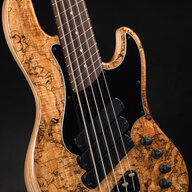
I like how people here have the basses from the official galleries. Something about it is just kind of funny to me...the people in the group has instruments that are so nice, they're the promo images Dingwall uses!

Whoever does the Dingwall gallery photos does an awesome job.

I sure liked the reflective surface and black backdrop they used. The detail photos are excellent.

Not that I would expect anything less than excellence from the Dingwall crew.
 
  • Like
Reactions: AB Nate
Whoever does the Dingwall gallery photos does an awesome job.

I sure liked the reflective surface and black backdrop they used. The detail photos are excellent.

Not that I would expect anything less than excellence from the Dingwall crew.

I think my images were removed. :*(

But I think that happened because I have options that are not really available and they probably don't want people hassling them for that kind of extra work.
 
Are you finding it unbalanced? I've heard that the P-Tone is pretty hot. I'm really interested to see how big a tonal difference it is. Traditionally they're a bit bumped in the low-mids and rolled off in the deep lows and/or highs. I'm interested to see how Sheldon translated it. I played an old Precision for about a decade before moving to an Afterburner.

View attachment 2932031
Yes I'm finding the P-tone to be relatively hot compared to the FDVs (which are a little hotter than the FDs in my estimation). I ended up lowering it. But Sheldon did a good job approximating the Precision tone. Mid-strong and plenty of bark. To really nail it you would need to get it in the traditional P position relative to the neck and bridge. I think the Dingwall 3X neck position s a bit forward of this.
 
Last edited:
  • Like
Reactions: BurningSkies
Yes I'm finding the P-tone to be relatively hot compared to the FDVs. I ended up lowering it.
I had already backed my pickups down a full turn, so they're backed off a bit I can lower if needed but I like to have something there because I tuck my thumb in the nook of the b-string and the front pickup.

Also, this NG is definitely lower and faster than my Z. Although I'm sure I could bring my Z down a bit more if I wanted (it was already near-flat for neck relief). I find the slightly thicker neck profile to be super comfy too.

Although I'll say the 'shoulder' of the profile either had so little finish that I wore it off on the treble side already or the sides of the maple fretboard were unfinished to start.
 
  • Like
Reactions: arrowsun
I had already backed my pickups down a full turn, so they're backed off a bit I can lower if needed but I like to have something there because I tuck my thumb in the nook of the b-string and the front pickup.

Also, this NG is definitely lower and faster than my Z. Although I'm sure I could bring my Z down a bit more if I wanted (it was already near-flat for neck relief). I find the slightly thicker neck profile to be super comfy too.

Although I'll say the 'shoulder' of the profile either had so little finish that I wore it off on the treble side already or the sides of the maple fretboard were unfinished to start.
I added to my post above re my thoughts on the tone of the P-tone compared the the real thing.


I kept threatening promising to do this, so here we have it. A pickup test comparison featuring my boring, sloppy, barebones, basic playing over a Logic Drummer track. Only processing is a high-pass and low-pass at 40hz and 5kHz respectively and light (2:1) compression on the basses, as well as a basic limiter to get things loud enough.

Segments go: ABZ6 (passive, tone wide open, neck pickup internally wired to series): neck > series > parallel > bridge; then SP5 (passive, tone wide open [center detent on Tone Fusion], added FDV bridge pickup): neck > series > parallel > bridge. Strings on both are well worn-in Dingwall nickels.

Each segment is approximately 20 seconds, so you can skimp and jump back and forth to compare. If anyone wants, I can move the segments around to compare one bass to the other (AB > SP >AB > SP, etc.)