
That Fiesta Red with a black pickguard looks amazing. Mine is coming tomorrow, and I'll have to do the same. I'd also love to swap out the hardware for all-black but might start with lighter-weight black tuners.I love the sound of these, but that is very much a personal preference. You get series/ parallel or a true split single coil from the middle rotary switch. Plus a push/push passive boost on V control and a master tone. The neo pickup is so hot it allows for this boost. Honestly its pretty awesome. Nothing shotty on these things in fact they rival high end production but at a fraction of the cost. The necks are fantastic. Maybe the tuners and control plate are thinner and generic I don’t see any issues with them. Only thing I changed are the strings. Both have precision flats and the pickguards look great in black which Sterling sells direct. I’ve owned several rays and sterlings , no these don’t get the extreme bright crispy sound possible on those but they still sound good to me. Just different.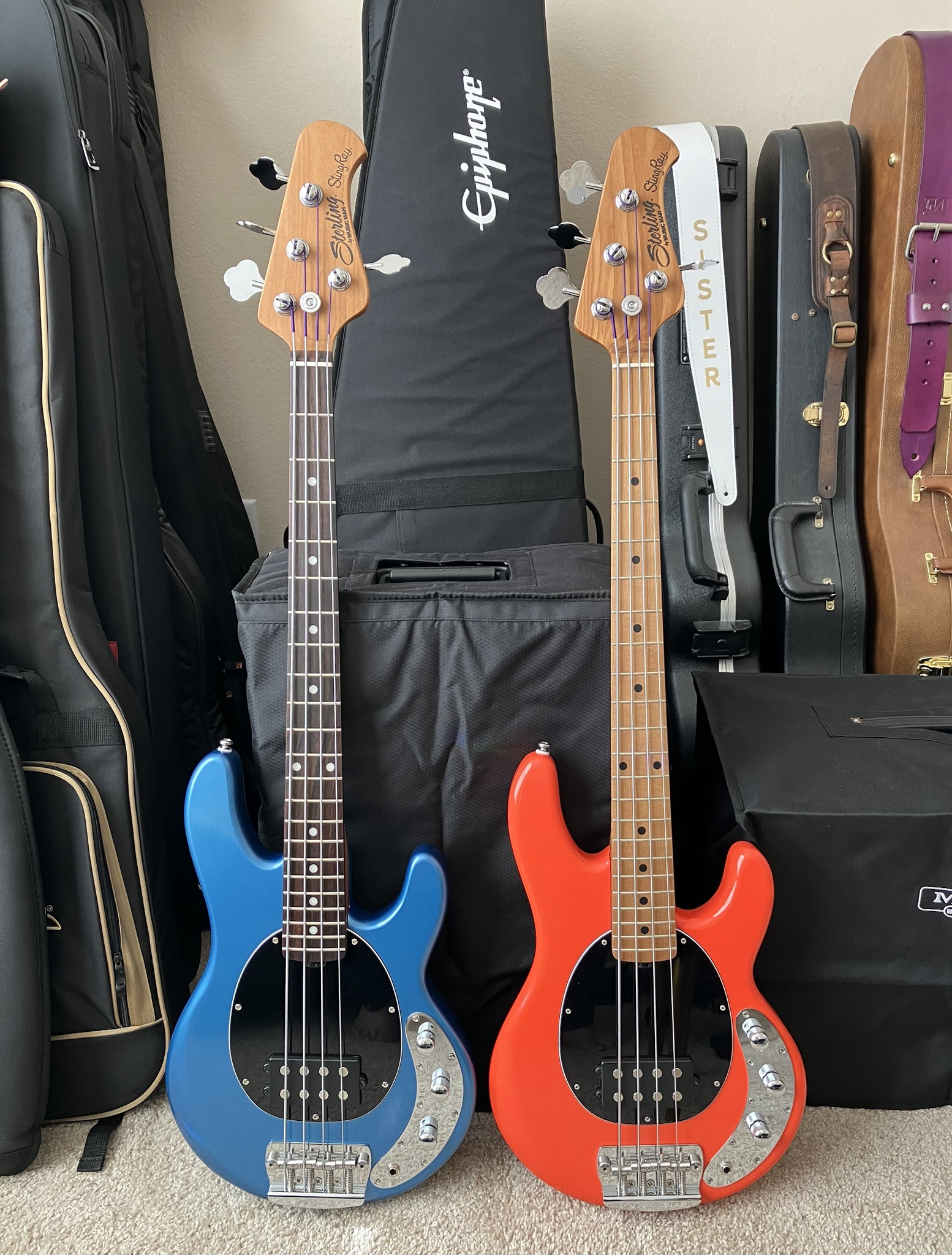

Enjoy the benefits of a premium membership!
Upgrade Account
-
TalkBass has been independent since 1998. Add your voice.
Create a free account to reply to discussions, view embedded media, and browse with fewer display ads.
Join free Log in
Want zero display ads or expanded classifieds tools? Compare plans.
You are using an out of date browser. It may not display this or other websites correctly.
You should upgrade or use an alternative browser.
You should upgrade or use an alternative browser.
Disappointed with SBMM Short-Scale StingRay
- Thread starter Schpeaker
- Start date
More options
Who Replied?

I’ll likely get roasted by the fans here, but I find short scales in general have that flubbiness/boxy character that you are describing. Which is a bummer because stingrays are known for being the dead opposite of that!I tried out a SBMM short-scale StingRay for the first time at a GC. I own 3 different full-scale StingRays so I have a good baseline to compare against. Still, to ensure a fair impression at the GC, I made sure to play the short-scale back-to-back vs. 3 reference points -- a Ray34, an EBMM StingRay Special as well as a P-bass. This was through a Rumble 40. Once I dialed in the amp, all 3 references sounded exactly how I expect (but they played horribly of course because GC simply doesn't set up their instruments).
Onto the short-scale -- for starters the workmanship was a little shoddy. The middle pickup-selector knob was wobbly and overall the guitar didn't feel as well put-together as a Ray34. I mean yeah it's $600, but still. Not a deal-breaker but just left a sour first impression.
But the big thing was the sound - the short-scale sounded "boxy". It wasn't about the lack of higher-order harmonics -- I am perfectly okay with a fundamental-heavy tone. But it just had this fake, boxy, and very compressed tone that reminded me of playing a bass or guitar through a small practice amp.
Is it just a pickup thing or is that fundamental to a short-scale? I'm asking because I was considering ordering an EBMM short-scale which obviously will have better workmanship and better electronics. But if the tone is going to be similar to this then I don't want to waste $2500.

cool I wanna see that! I love this shade of Fiesta. Its a little more like Torino which is more orange.That Fiesta Red with a black pickguard looks amazing. Mine is coming tomorrow, and I'll have to do the same. I'd also love to swap out the hardware for all-black but might start with lighter-weight black tuners.
I'm a fan boy of the EBMM short scale but also own 2 of the SBMMs - 1 I use as a backup up and 1 that I had defretted. My experience is that quality control on the SBMMs is pretty inconsistent. Some are pretty bad. Add that you played one hanging at a GC, I'm not sure you had a good representation.
I have found them to be fairly sensitive to string choice too.
They don't sound the same as an active Stingray but they do bring some of that vibe to the table without the extremes of the boost or cut available.
Clearly no bass is a perfect match for everyone or there would only be one model in production. I love my short scale Stingrays. They are all i play these days. They sit nicely in a mix and IMHO play extremely well. My EBMM is a lifetime bass for me.
I have found them to be fairly sensitive to string choice too.
They don't sound the same as an active Stingray but they do bring some of that vibe to the table without the extremes of the boost or cut available.
Clearly no bass is a perfect match for everyone or there would only be one model in production. I love my short scale Stingrays. They are all i play these days. They sit nicely in a mix and IMHO play extremely well. My EBMM is a lifetime bass for me.
Thanks everyone for all the excellent feedback.
I gave it a second attempt at another GC. This time I got a near-perfect unit. No wobbly knobs, and the neck looked great and felt good (albeit a little dry), and the setup wasn't that bad. Some sharp fret ends but not bad enough to cause injury. It's heavy for a short-scale at 8.4lbs (for comparison, my full-size Ray34 is 8.25lb and my StingRay Special is 7.7lb ).
).
Onto the tone -- once again, A/B'ing it vs. full-sized basses it just comes across as a wildly different beast. After a few minutes of playing I warmed up to it quite a bit, especially the single-coil tone with the boost engaged. I think the series mode is fat but characterless while the parallel mode is thin. But the single coil gives this P or J bass like transient response which I liked. Playability makes such a big difference in how we perceive instruments.
I bought it and brought it home. After some serious truss rod tightening, height adjustment and intonation fix it now plays very well. I tried it in a variety of contexts. In a recording setup, I was surprised to see that it sounds best (to me) when played direct-in without any preamp or cab sims. Just add a touch of compression and the mildest of EQs and it's good to go. Remember I said it sounded boxy to me through an amp? I think this is consistent. For some reason the bass's direct output is already "cabby", so sending it into another real or simulated cab gives it that extra boxy, undefined tone.
I gave it a second attempt at another GC. This time I got a near-perfect unit. No wobbly knobs, and the neck looked great and felt good (albeit a little dry), and the setup wasn't that bad. Some sharp fret ends but not bad enough to cause injury. It's heavy for a short-scale at 8.4lbs (for comparison, my full-size Ray34 is 8.25lb and my StingRay Special is 7.7lb
).Onto the tone -- once again, A/B'ing it vs. full-sized basses it just comes across as a wildly different beast. After a few minutes of playing I warmed up to it quite a bit, especially the single-coil tone with the boost engaged. I think the series mode is fat but characterless while the parallel mode is thin. But the single coil gives this P or J bass like transient response which I liked. Playability makes such a big difference in how we perceive instruments.
I bought it and brought it home. After some serious truss rod tightening, height adjustment and intonation fix it now plays very well. I tried it in a variety of contexts. In a recording setup, I was surprised to see that it sounds best (to me) when played direct-in without any preamp or cab sims. Just add a touch of compression and the mildest of EQs and it's good to go. Remember I said it sounded boxy to me through an amp? I think this is consistent. For some reason the bass's direct output is already "cabby", so sending it into another real or simulated cab gives it that extra boxy, undefined tone.

While it's true that "physics" play a role, my opinion is that it's a much smaller role than the pickup type/placement and strings (and the amp). My short scale stingray is far, far from being muddy. Yes, it's voiced favoring the fundamental, but the only thing it lacks compared to my full-scale Retro Stingray is really, really snappy high-end. And most of that is due to the active preamp on the Retro vs passive electronics on the short scale. Both sound like Stingrays--just slightly different voicings, but in no way "muddy." In fact, I'd say the short scale sits in the mix and is heard better than the my regular Stingray.Its physics. Short scales sound muddy.
On the other hand, there are certainly muddy short scales just as there are muddy long scales. I had a "Pawn Shop Mustang" with the big mudbucker... and that is exactly what it was... muddy. I loved the look of the bass and it played great. But I could never really get it anything but buried in the band mix no matter what I did with the EQ. It either got lost in the mud or sounded completely "fake" (with heavy EQing), which is just as annoying. But the short scale stingray sits great in a mix with no crazy EQing. And if I need a zingier sound, I just hit the contour and bright switch on the amp... instant Louis Johnson snappiness.
Idk, I recently played my Mustang through a newer Rumble 40 and I thought it sounded pretty damn good. Light years ahead of any small practice amp I ever used before.
I strongly disagree that short scales sound "muddy" in general. I have 3 now as my main players, and have owned several others over the years. I use them for jazz, r&b, rock, etc. and dont think they sound muddy at all. To me its a matter of finding the right strings and eq for each bass.
All my basses sound great through my Rumble 800 and Rumble 100. I had a GK rig that costed me four times what the Fender 800 costs. When I compared the two amps side by side, neither sounded bad, but IMO the Fender is just voiced way, way more to my liking. I could never quite get the EQing the way I like it on the GK. There was always a certain range of frequency missing that I wanted to hear. So I ended up getting rid of the GK. I use the Fender Rumble 800 and an extension cabinet at this point. I'm 100 percent happy with the sound and the ability to shape the sound with the EQ and voicing filters. It's just "voiced" the way I like an amp to sound. The only other amp I've had over the years that I've been totally happy with was an SVT and 8-ten cab. But my back is too old for that sort of thing these days.

Most likely reason is the lack of the preamp, which IME is fundamental to the SR sound. After that, old strings and bad setup never do much to sell an instrument. Sure there is some underlying physics that bring a 'character' to 30" scales that you don't get with 34" (lower tension and less string mass for a given note) but IME it is not always a dominant factor nor a universal truth. My guess is that decent strings and a good setup would resolve most of the issues.But the big thing was the sound - the short-scale sounded "boxy". It wasn't about the lack of higher-order harmonics -- I am perfectly okay with a fundamental-heavy tone. But it just had this fake, boxy, and very compressed tone that reminded me of playing a bass or guitar through a small practice amp.
Is it just a pickup thing or is that fundamental to a short-scale?
With that said, I do wonder about the Neodymium pickup - even the Specials (to my ears) have a rounder thicker tone with a bit of natural compression compared to the open untamed nature of the original SR.
Think yourself lucky - mine (from 2012) is a full-bodied 9.5lb!! My short-scale of choice is actually a Hofner Club which checks in at a mere 5.3lb.my full-size Ray34 is 8.25lb
How do you like your fretless one? I bought two with the intent to convert one to fretless. Thinking of swapping the bridge for Babicz solo rails to get tighter string spacing and maybe go thru-body.I'm a fan boy of the EBMM short scale but also own 2 of the SBMMs - 1 I use as a backup up and 1 that I had defretted. My experience is that quality control on the SBMMs is pretty inconsistent. Some are pretty bad. Add that you played one hanging at a GC, I'm not sure you had a good representation.
I have found them to be fairly sensitive to string choice too.
They don't sound the same as an active Stingray but they do bring some of that vibe to the table without the extremes of the boost or cut available.
Clearly no bass is a perfect match for everyone or there would only be one model in production. I love my short scale Stingrays. They are all i play these days. They sit nicely in a mix and IMHO play extremely well. My EBMM is a lifetime bass for me.
I played fretless exclusively before I moved to short scale (a 33 inch scale Bee Bass). I’m still not there with the SBMM. I’ve been through 5 or 6 different sets of strings - flats: EB cobalts & LaBella; rounds: DR Sunbeams, Kallium, maybe something else; and tapes: LaBella white tapes - and none quite worked for me. The fingerboard is very soft and the rounds looked as if they would chew it up pretty quickly. Too bad because they were the sound I preferred. The white tapes were second. I’ve thought of getting the fingerboard coated and then going through the process again… but not sure I want to spend that much more cash on it. I’m playing it rarely. I have a very occasional gig at a synagogue where they like the fretless sound but that is pretty much it.How do you like your fretless one? I bought two with the intent to convert one to fretless. Thinking of swapping the bridge for Babicz solo rails to get tighter string spacing and maybe go thru-body.
That said, the lower register is nice. The highs seem to die off very quickly. Perhaps because of the shorter scale it seems that the tone is a bit more simple/fundamental and you lose some of the midrange vocal quality of a good fretless.
soooo it is still a work in process.
Thanks. Do you have the older ones or the newer ones with roasted necks?I played fretless exclusively before I moved to short scale (a 33 inch scale Bee Bass). I’m still not there with the SBMM. I’ve been through 5 or 6 different sets of strings - flats: EB cobalts & LaBella; rounds: DR Sunbeams, Kallium, maybe something else; and tapes: LaBella white tapes - and none quite worked for me. The fingerboard is very soft and the rounds looked as if they would chew it up pretty quickly. Too bad because they were the sound I preferred. The white tapes were second. I’ve thought of getting the fingerboard coated and then going through the process again… but not sure I want to spend that much more cash on it. I’m playing it rarely. I have a very occasional gig at a synagogue where they like the fretless sound but that is pretty much it.
That said, the lower register is nice. The highs seem to die off very quickly. Perhaps because of the shorter scale it seems that the tone is a bit more simple/fundamental and you lose some of the midrange vocal quality of a good fretless.
soooo it is still a work in process.

I tried out a SBMM short-scale StingRay for the first time at a GC. I own 3 different full-scale StingRays so I have a good baseline to compare against. Still, to ensure a fair impression at the GC, I made sure to play the short-scale back-to-back vs. 3 reference points -- a Ray34, an EBMM StingRay Special as well as a P-bass. This was through a Rumble 40. Once I dialed in the amp, all 3 references sounded exactly how I expect (but they played horribly of course because GC simply doesn't set up their instruments).
Onto the short-scale -- for starters the workmanship was a little shoddy. The middle pickup-selector knob was wobbly and overall the guitar didn't feel as well put-together as a Ray34. I mean yeah it's $600, but still. Not a deal-breaker but just left a sour first impression.
But the big thing was the sound - the short-scale sounded "boxy". It wasn't about the lack of higher-order harmonics -- I am perfectly okay with a fundamental-heavy tone. But it just had this fake, boxy, and very compressed tone that reminded me of playing a bass or guitar through a small practice amp.
Is it just a pickup thing or is that fundamental to a short-scale? I'm asking because I was considering ordering an EBMM short-scale which obviously will have better workmanship and better electronics. But if the tone is going to be similar to this then I don't want to waste $2500.
You have to imaging that you are playing a Gibson EB0 with different pickup placement.
Is muddy the same as boxy? I had an Ibanez TMB30 for awhile. The stock roundwounds were awful - very brash and I don't know what all terms to use. Put flats on it and was much nicer. I sold it though as it wasn't terribly distinctive. I still have a 4-string P/J 34", fretless 34" and active 5 string 35" for variety.
the older, non-roasted neck with the rosewood fingerboard.Thanks. Do you have the older ones or the newer ones with roasted necks?

The one I tried at my local former Sam Ash was really nice. I didn't buy it because it was way overpriced for the product.Disappointed with SBMM Short-Scale StingRay

As another poster has stated, these have very hot neodymium pickups and, as you've noted, the guitar wasn't setup so there's a very good chance the pickup height isn't optimal, which is causing the tone issues you point out. Neos also have a different mid-range curve to them so they won't sound exactly like the others.I tried out a SBMM short-scale StingRay for the first time at a GC. I own 3 different full-scale StingRays so I have a good baseline to compare against. Still, to ensure a fair impression at the GC, I made sure to play the short-scale back-to-back vs. 3 reference points -- a Ray34, an EBMM StingRay Special as well as a P-bass. This was through a Rumble 40. Once I dialed in the amp, all 3 references sounded exactly how I expect (but they played horribly of course because GC simply doesn't set up their instruments).
Onto the short-scale -- for starters the workmanship was a little shoddy. The middle pickup-selector knob was wobbly and overall the guitar didn't feel as well put-together as a Ray34. I mean yeah it's $600, but still. Not a deal-breaker but just left a sour first impression.
But the big thing was the sound - the short-scale sounded "boxy". It wasn't about the lack of higher-order harmonics -- I am perfectly okay with a fundamental-heavy tone. But it just had this fake, boxy, and very compressed tone that reminded me of playing a bass or guitar through a small practice amp.
Is it just a pickup thing or is that fundamental to a short-scale? I'm asking because I was considering ordering an EBMM short-scale which obviously will have better workmanship and better electronics. But if the tone is going to be similar to this then I don't want to waste $2500.
Do you find any difference between the tone of the EBMM vs. SBMM? I'm specifically interested in the middle single-coil mode because it gives it that P-bass (ish) transient that I cannot get out of any full-sized StingRay. As expected, I'm getting some single-coil hum in that mode in my SBMM and I'm wondering if the EBMM is cleaner, perhaps due to additional shielding. Can you tell?I'm a fan boy of the EBMM short scale but also own 2 of the SBMMs - 1 I use as a backup up and 1 that I had defretted. My experience is that quality control on the SBMMs is pretty inconsistent. Some are pretty bad. Add that you played one hanging at a GC, I'm not sure you had a good representation.
I have found them to be fairly sensitive to string choice too.
They don't sound the same as an active Stingray but they do bring some of that vibe to the table without the extremes of the boost or cut available.
Clearly no bass is a perfect match for everyone or there would only be one model in production. I love my short scale Stingrays. They are all i play these days. They sit nicely in a mix and IMHO play extremely well. My EBMM is a lifetime bass for me.
sorry it took me a while.Do you find any difference between the tone of the EBMM vs. SBMM? I'm specifically interested in the middle single-coil mode because it gives it that P-bass (ish) transient that I cannot get out of any full-sized StingRay. As expected, I'm getting some single-coil hum in that mode in my SBMM and I'm wondering if the EBMM is cleaner, perhaps due to additional shielding. Can you tell?
they sound very similar. I do have different strings on each and I can't really tell how much difference is due to strings, individual instruments, differences in materials (body wood, neck wood, fingerboards), differences in hardware or electronic components...
I've not opened any of them but I don't think there is more shielding in the EBMM. The pots though are clearly higher quality.

Could be an issue with typical GC wall hanging fruit.
I tried a short scale Sterling at my local GC it felt like toy neck finish was horrible. I'd have to try one fresh out the box before I pass judgements. Because I played EBMMSRS @ GC that were absolutely trashed & beat up.
I tried a short scale Sterling at my local GC it felt like toy neck finish was horrible. I'd have to try one fresh out the box before I pass judgements. Because I played EBMMSRS @ GC that were absolutely trashed & beat up.
Stanley Clarke, for one. And he’s been at it with a short scale for 30+ yearsHow many pro’s do you see using one?
Jack Bruce (Cream), Lemmy (Motorhead), Chris Squire (Yes) and Paul McCartney (Beatles) are all short-scale players.The sound, of the shorty to me, is inferior vs a full scale bass. And the other odd thing, and again, this is just me, but….they feel like. ….toys. I know. It’s a strong opinion, but…I could not gel with it. How many pro’s do you see using one?


