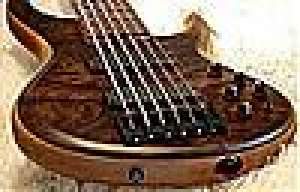
First of all, I think what's happening is you've gotten used to the slightly muted sound of your Ibanez. When the Lull is compared to it, it sounds brighter to your ears, as it does to mine. There are several reasons for this:
First, the Lull is a much higher quality bass than the Ibanez. It is made with better quality wood, better quality pickups, and better quality hardware. What you're hearing in the Lull is the full spectrum of the tone band, which the Ibanez just can't produce. Why? Because it's a mass produced instrument, one made for profit, not necessarily for tone. That's not to say it's a mediocre bass, as you obviously like the tone it produces. But from the sound clips you posted, I think it's quite clear the Lull produces a much more piano-like spectrum of tone over the Ibanez. To me, it's much easier to tone down sound, as in the Lull, through EQ, strings, Amps, even different speakers, than it is to try to "EQ up" areas of tone that aren't there, as in the top end that your Ibanez isn't producing compared to the Lull.
Second, every instrument has a sweet spot. I don't think you've found it yet with the Lull. For example, I changed the active EMG system in my custom bass to passive humbuckers, and it took me a literally a YEAR to find the tone I wanted to hear. I also tried different bridges, different strings, and have finally settled on TI flatwounds, and now can dial in just about any sound I want, short of the "zing" that slap requires. My bass in the beginning with the EMG's sounded like your Lull - too bright and active to my ear. Because I had spent almost $3700 at the time to have my left-handed bass made, selling it was not an option to me, so I went on a parts-swap quest to get and hear what I wanted. I've succeeded, and enjoy the tone I have now very much.
Also, there is a school of thought that years of playing a wooden instrument eventually vibrates and lines up the fibers in the wood, allowing the wood to resonate to its potential. I wouldn't wait for that to happen, because like old Fenders, it will take fifty years or more to happen. You need to understand that your Lull is like a Lamborghini to your Ibanez being a Honda Accord... the Ibanez is will made, comfortable, is quiet, and handles pot-holes and bumps well without rattling your teeth.
The Lull-Lamborghini is a highly tuned sports car - it's not subtle, it starts out loud and gets louder when you "gun it", it needs to be driven with all of your senses and skills, and can jar your teeth when it hits bumps and potholes. It requires you to be a better driver. And in this case, the Lull requires you to be a better bass player. By that I mean, it exposes your warts, which is to say technique, EQ, amp and speaker quality, etc. My custom bass, high-end amp and speakers forced me to learn to be a better bass player, as I could be heard over the band. My Ibanez SR800 and Carvin LB75 five-string had never exposed me like that...
In the end, you have to decide whether the Lull is worth the odyssey it will take you on, or is it simply easier to move it out of your life. I know in my case, the challenges I went through to finally be happy with the tone on my custom bass was well worth it, because not only have I learned more about pickups, bridges, strings, etc., I've learned more about finger technique, neck fingering, and what tone means to me. And as far as the tone I want to hear, I'm about 98% there....
I will say I like the tone produced by both of your basses... you understand of course you will never really be able to make the Lull sound exactly like your Ibanez. I think the Lull has more potential for you, but it also boils down to what you want to hear - old school versus new. If you like R&B, blues, old rock standards etc., then the Ibanez would be a preferred choice. The Lull however, with the right EQ etc., can give you that as well, and much more....
Now aren't you glad you opened this can of worms?....