• TalkBass has been independent since 1998. Add your voice.
    Create a free account to reply to discussions, view embedded media, and browse with fewer display ads.
    Join freeLog in
    Want zero display ads or expanded classifieds tools? Compare plans.

Do Squier Mustangs have through-body stringing?

would you rather:

  • Buy a Fender Mustang

    Votes: 82 61.2%
  • Buy a Squier Mustang and mod it

    Votes: 52 38.8%

  • Total voters
    134
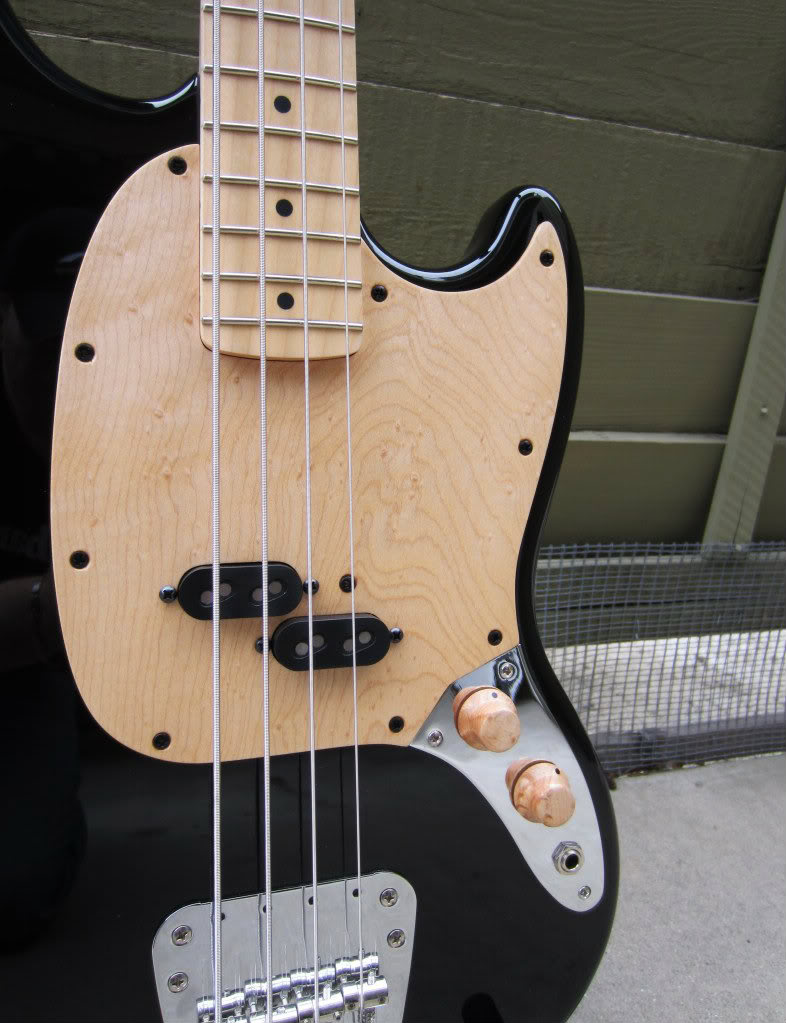
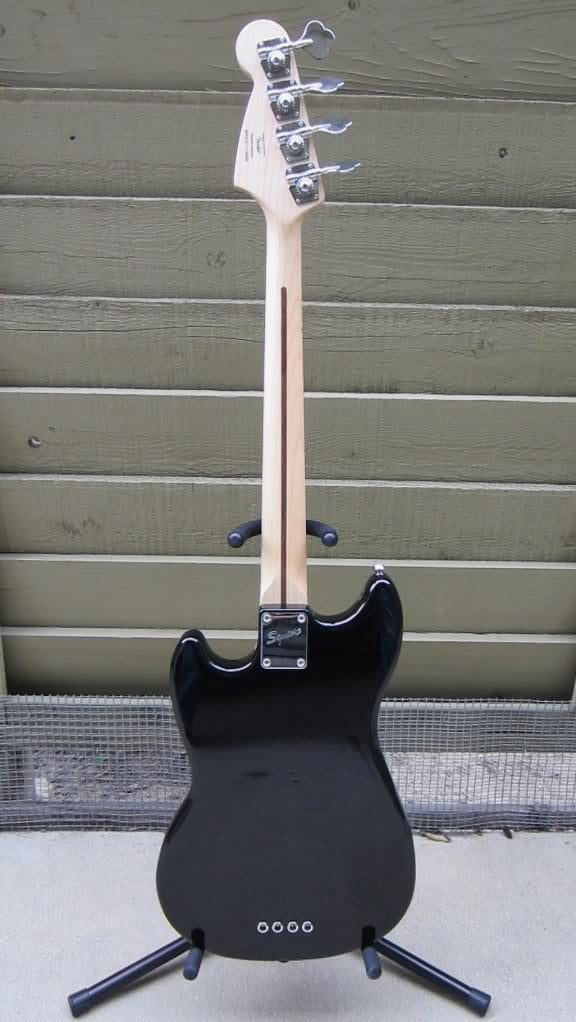
Yup, Squier Mustang's are strung through the body. I am very happy with my Squier Mustang and especially after doing some mods to it. I didn't change the tuners yet cause it stays in tune well already :cool:

011-3.jpg


014-6.jpg
 
Your impressions?
As other Squier Vintage Modified in the past, I have to confirm that necks are definitely not their best parts

I once owned a Squier Vintage Modified Jazz natural and, letting Duncan Designed pickups alone (really poor IMHO) the neck was incredibly "bowing", even if a full step downtuned...
Then I bought a Squier Vintage Modified Jaguar Special, with P/J configuration, basswood body and additional phatboost... Great instrument for its price but, you know what?! A neck nearly impossible to properly set.
Squier Mickey Way Mustang is very loud, and I opted for it to gain the humbuckin' soapbar instead of the traditional minisplit
The tone is huge, but the pickup has not enough wiring to be alternatively switched in parallel (so versatility demands a different pick-up)
Then... The neck was impossible, had something like a central curve in it and a nut sufficient (in height) to install a B string, but way too high for stock 40-95 strings

I bought the AXL viola bass to keep a, this time proficient, 30" bass in my personal collection

Cheers,
Wallace
 
I have both. Yes, they're both string-through.

As for differences, there is a small difference in fretboard radius, and of course maple vs. rosewood if that matters to you.

edit: forgot to mention that the neck on the fender has a shiny varnish and the squier has that satin-finish a lot of squiers have. Makes little difference to me, but some people are particular about that.

The finish on the frets is noticeably better on the Fender, but this is nothing to worry about if you're handy and/or can get someone to tidy up frets for you. (Rough edges on the Squier.)

They don't sound identical, but they do sound very, very close to each other. No more different than two random basses of the same model generally do off the wall.

Overall, the Fender's fit & finish is better. $500 better? No. But I got mine used quite a few years back before the Squier was available, for about the price the Squier is going for new.

If you want black, I say buy the squier & enjoy it. If you really want a Fender, wait & snag one used if you can.

GT
 
Yes the vintage modified Mustang bass has a string thru bridge and it does make a difference in string tension and the ability to get strings that fit!


Here I go reviving old threads again, but I wanted to add that the Mustangs take _medium_ scale strings because of the strung-thru design. Now Thomastik-Infeld is an exception, because their "short" scale sets are actually for non-strung-through 32" scale basses. They do fit Mustangs nicely, though. I use a set of their flatwounds (JF324) on my defretted Mustang, and they really work well. TI flats are flexible enough to work with the strung-thru bridge.

I'm thinking of getting a Squier Mustang since I no longer have a fretted bass, and the ability to use the TI flats is a major selling point for me.

Best regards,
Lou
 
The magical missing $500 has more to do with currency exchange rates than anything. The Fender Mustang is MIJ/CIJ and the Japanese yen is very strong against the U.S. dollar, making all things Japanese expensive.
The present currency exchange rate is (and has been for a while) very close to 100 yen to the U.S. dollar. I was in Japan in November of 1984 when the currency exchange rate was a more "normal" 250 yen to the dollar. Japanese products at that time were bargains.

If the U.S. dollar was being exchanged at the 250 yen-to-dollar rate today then the $700 Japanese Mustang would sell for closer to $280. THAT's where most of the missing dollars are. The U.S. dollar holds up much better against Indonesian and Chinese currency, plus those countries have cheaper labor rates, so products can be produced and imported for less.

I'm much more curious as to why someone would pay $100 more for a VM Mustang than for a VM Jag shortscale. I've owned both and find the Jag to be a much more versatile instrument. The Jag has a better/faster neck IMO as well. Everything is subjective I guess.
 
The magical missing $500 has more to do with currency exchange rates than anything. The Fender Mustang is MIJ/CIJ and the Japanese yen is very strong against the U.S. dollar, making all things Japanese expensive.
No.

Japanese cars aren't expensive, nor are TV's, game consoles, microwaves, machine tools, pharmaceuticals or a plethora of other products manufactured and exported from Japan.
 
The magical missing $500 has more to do with currency exchange rates than anything. The Fender Mustang is MIJ/CIJ and the Japanese yen is very strong against the U.S. dollar, making all things Japanese expensive.

The present currency exchange rate is (and has been for a while) very close to 100 yen to the U.S. dollar. I was in Japan in November of 1984 when the currency exchange rate was a more "normal" 250 yen to the dollar. Japanese products at that time were bargains.

If the U.S. dollar was being exchanged at the 250 yen-to-dollar rate today then the $700 Japanese Mustang would sell for closer to $280. THAT's where most of the missing dollars are. The U.S. dollar holds up much better against Indonesian and Chinese currency, plus those countries have cheaper labor rates, so products can be produced and imported for less.

I'm much more curious as to why someone would pay $100 more for a VM Mustang than for a VM Jag shortscale. I've owned both and find the Jag to be a much more versatile instrument. The Jag has a better/faster neck IMO as well. Everything is subjective I guess.

You explain it very well Axeman and I couldn't agree more.

After purchasing my Squier CV 60's Jazz and comparing it to my MIM Jazz I had to wonder when Fender would drop the Squier moniker and just call them Fenders like the MIM's. Different features? Yes, Different quality? No.

Last week I paid a visit to my local Sam Ash and low and behold there hung what appeared to be a Squier Jaguar sporting a Fender logo on the headstock. This bass wasn't like my Fender MIJ Jaguar. What's with the split pup and where's all the switches:confused: This was clearly a Squier body, so at first I thought someone had swapped the neck, but on close inspection I see this was a brand new bass, a "Modern Player Jaguar" made in China and priced the same as a VM Squier:eek:

Yes, Fender has done exactly what I expected to see, an inexpensive bass with an expensive logo.
 
And, to Krypto's point, most major Japanese brands are no longer made in Japan. My Nissan truck was made in Tennessee, my Sony cordless phone in China, my Sanyo TV in Malaysia, my Panasonic DVD player in Singapore, etc. ad nauseum.

A Fender MIJ Mustang is still made in Japan and that's why it costs $700. Ditto for other Japanese products made in Japan, Seiko watches for instance.
 
And, to Krypto's point, most major Japanese brands are no longer made in Japan. My Nissan truck was made in Tennessee, my Sony cordless phone in China, my Sanyo TV in Malaysia, my Panasonic DVD player in Singapore, etc. ad nauseum.

A Fender MIJ Mustang is still made in Japan and that's why it costs $700. Ditto for other Japanese products made in Japan, Seiko watches for instance.
Japan has the world's 3rd largest manufacturing economy although it is true they offshore assembly to lower wage countries. Your Nissan truck for example is assembled in Smyrna, the high value parts (drivetrain, electrical control components, steel etc.) are manufactured/sourced in Matsusaka, Kanda and Nagoya and shipped to TN for assembly.