• TalkBass has been independent since 1998. Add your voice.
    Create a free account to reply to discussions, view embedded media, and browse with fewer display ads.
    Join freeLog in
    Want zero display ads or expanded classifieds tools? Compare plans.

Do you use your "volume" knob?

I think there's a bit of an overreaction here. The difference between 3/4 and full volume is hardly a 'nightmare' scenario.

Personally I am always running at full volume on the bass and make dynamic adjustments with technique.

If he set your input levels nice and high, and especially if he's running a digital board, then it is total nightmare until he pulls that input level down.

There's a lot of digital boards out there these days. Max input is a brick wall. If you try to sneak your level past it, it instantly turns to complete crap. This is something that was a headache for a sound man in the old analog days, but now it's Epic Fail. If you teach a sound man not to trust you, you can bet he wont, and he will always keep your level so low that he's certain he has enough headroom for whatever you pull on him. Teach him to trust you, and then he can concentrate on simply trying to get your level to where it sounds best in the mix.

I seldom am running into a PA, but whether I am or not, I use a volume pedal and set it at absolute max in sound check and pull down from there for the set. If I played softer with my fingers it would give me more dynamic range just from my playing, but I don't, so I use the pedal. When I'm running a board, I ask everyone in sound check for the loudest thing they're going to give me, and if I discover they knowingly screw with me on that, they immediately become my last priority. No trying to "get even;" it's just that I can't help but give more of my attention to the musician's who deserve it.

 
You should ask. IME, most sound guys are more than happy to talk to you about what they're doing behind the desk as long as you don't approach them like a prima-donna about it. I believe in the "Gotta give respect to earn respect" maxim, and I've always felt that it works really well with sound people.

You're probably correct, as that usually works in my "pesky day job" also..... (GC among other things)

The whole "playing with major PA support" is relatively new to me and likely to many others.

I think many bassists, like the rest of a band, expect the PA output to reflect near exactly the sound they're producing....and when one finds out that is not the case... the can of worms gets opened.

Since reading about the issues for the past couple of years and experiencing many of them, I am now more prepared to have a useful conversation with the SE.

I'm going to send out a pretty flat signal, if I can help it. I will sound check at full volume as long as we are using a tune and passage where we can use those limits and also pull back some... this band often uses "Hit me with your best Shot"

The kick is almost always mic'd. The guitar is mic'd in larger clubs (small Marshal combo) Bass DI's in for larger clubs.

What I want to ask from the SE there is "where is the compression set and why?...where are the cuts?" as I want a lot of overtones. We're a 3 piece+ singer. It helps, I find, if we (SE and me) listen to it (bass) together.
 
If he set your input levels nice and high, and especially if he's running a digital board, then it is total nightmare until he pulls that input level down.

What I'm saying is, the difference between 3/4 and full volume on the instrument's volume knob is nowhere NEAR enough of a difference to cause a problem. It's not like sound checking at 1 and then cranking it up to 10.
 
The difference between 3/4 and full on depends on your bass.

I run wide open. 10 all the way. A volume knob has resistance which essentially throttles your tone. The more volume you have rolled off, the more tone you are sucking out of your signal.

If you want to sound at the gig like you sound at home, you should always bring your own PA and pay your own sound guy. Otherwise, you are at the mercy of the person running your board, and at the house set up. I think you are better off making peace with the fact that you will never be able to make it right. Try to get it close enough. The best way to do that is to not piss off your sound guy by changing levels mid set.
 
I always sound check at less that full volume. In 45 years it's never once been an issue.
I always leave a little head room. I've even been know to lower the volume on my bass.
 
A lot of what's been posted in this thread makes no sense to me.

If he set your input levels nice and high, and especially if he's running a digital board, then it is total nightmare until he pulls that input level down.
I have no experience with digital boards, but it seems to me that the signal to noise ratio would be such that there's no reason to run the gain anywhere near high enough to ever hit the brick wall.


I use technique to alter my dynamics.
And this differs from using a volume knob or pedal in what way?


Changing the volume of your bass mid-set (or mid-song) is a nightmare for the board operator.
Is it any more of a "nightmare" than a singer going from a soft breathy ballad to a full-tilt screaming rock song?
Or a guitar player going from a background part to a solo?

In my band the where/when/who of instrumental solos is mostly determined on the fly. Without self-mixing, we'd be even more of a "nightmare" to a mixer operator trying to guess who to turn up in the mix and when to do it. I see my level changes as more of a "sweet dream" than a "nightmare"...especially if the mixer operator has never worked with us before. (As I posted earlier, during line/sound check I send the highest level I anticipate using.)
 
My bass has incredible sustain and sometimes when we end a song that rings out everyone else's sound has decayed and I'm left holding a chord/note that is somewhat overwhelming. so before the "deafening applause and cheers" begin (davys uptown can get very packed on a tuesday) I slowly roll back on the vol knob to decay along with the others and i do chord swells on one tune. and if I'm unsure what the bell is going on i back off so my wrong notes aren't quite as pronounced. I'm just saying
 
99.9% of the time, I don't touch any of the knobs on the bass during a performance. I might be happy if I had a bass with no volume control, no blend control, no tone control, and maybe just a kill toggle to mute the thing in between songs or sets.

Seriously.
 
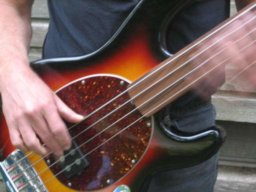
I play a fretless Stingray. My "home" volume setting is about 75%. During a soundcheck our levels are set. During the performance, some songs want a heavier "pluck" feel on the strings, some songs want a soft fingertip brush on the strings. I use my volume control to help balance out my volume with what the other band members are doing. Not huge volume shifts on my part… just a subtle tweak that probably only me and my mates can hear.
 
In a live situation, do you mess with your onboard volume knob at all?

Doesn't altering the output level of the bass itself throw off all the affects settings?

Should I just go full on (to 11) from the bass, match input/output levels on all affects and then just adjust level at amp and never touch onboard "volume" knob?

Same for front of house mix?

I'm sure the board op doesn't want the player messing with levels on the fly when they're trying to mix, right?

Or, am I wrong with this?

FWIW: Yes, I use the volume and tone controls on by basses and any soundman worth their wages won't care or have any problems with it either.
 
FWIW: Yes, I use the volume and tone controls on by basses and any soundman worth their wages won't care or have any problems with it either.

A soundman worth his wages would be concerned that you might not be as articulate with your volume changes as you think you are. As an example, last night I worked with two guys that were twiddling away all night. It only became an issue when they either forgot to turn back down/up, or wildly overshot their mark. It actually got to the point where the guy holding the mic that I have labeled as " $$ " made mention of it between songs and waited until he was sure it wouldn't happen again.

Granted, it's really a minor inconvenience to me if we're talking about a few db or so at front of house, but when other musicians take notice, and it begins to effect their performance, then it's a problem. (I spend 90% of my time at a monitor desk. The performers problem is MY problem)

So, if it's done well, it's fine. If it's done badly it's f-ing amateur hour.
 
A soundman worth his wages would be concerned that you might not be as articulate with your volume changes as you think you are. As an example, last night I worked with two guys that were twiddling away all night. It only became an issue when they either forgot to turn back down/up, or wildly overshot their mark. It actually got to the point where the guy holding the mic that I have labeled as " $$ " made mention of it between songs and waited until he was sure it wouldn't happen again.

Granted, it's really a minor inconvenience to me if we're talking about a few db or so at front of house, but when other musicians take notice, and it begins to effect their performance, then it's a problem. (I spend 90% of my time at a monitor desk. The performers problem is MY problem)

So, if it's done well, it's fine. If it's done badly it's f-ing amateur hour.

FWIW: I'd never hire you. ;)
 
99.9% of the time, I don't touch any of the knobs on the bass during a performance. I might be happy if I had a bass with no volume control, no blend control, no tone control, and maybe just a kill toggle to mute the thing in between songs or sets.

Seriously.

I want one of those. But without kill toggle.

I turn volume all the way up and leave it.

If I need more for ear I'll get it from my monitor.
If I need more for feel as in stage rumble I'll tweek my amp.

If I need less for ear on stage I'll have my monitor or whoever wants less of me in their monitor turned down.
If I need less in the middle of a song I'll touch my strings differently.

If I need a different tone during a song I'll touch my strings in a different place.

As long as my fingers don't get chopped off that's how I will always do it.

If I loose my fingers I will just sing with my nubs in my pockets.
 
I start at 3/4 during sound check and play a little softer for it. That way I have room to be a little sneaky and turn up,cause you know those guitarists are probably going to do so also,and of coarse the drummers gonna start banging 'em harder once He gets goin too. Overal,l I do more front/rear Pup blending to control how I cut through the mix though.
 
I use a volume pedal. Then, I set up for as loud as I ever will be during soundcheck, and back off with the pedal as needed.

I run my Fenders volume wide open, but my Gibson has two volume knobs. It ruins my blend if I start messing with them.
 
Jazz Bass player here, I keep both volumes around 8 or 9 as it sounds better that way.

I pluck the strings harder or softer to suit the song. Using a valve amp helps as it seems much more responsive to playing dynamics than s/s.
 
I soundcheck with my bass at about 3/4 of the volume and then when we start to ply i slowly bring it up to full. after that, no i do not touch my volume knob.

Go ahead and do this if you only use an amp. Please don't do this if you're DI only.

If you have both, turn up your amp instead.

Sound check is pointless if the band plays at a significantly higher level once the show starts.
 

Latest posts