Fodera makes extended b headstock.
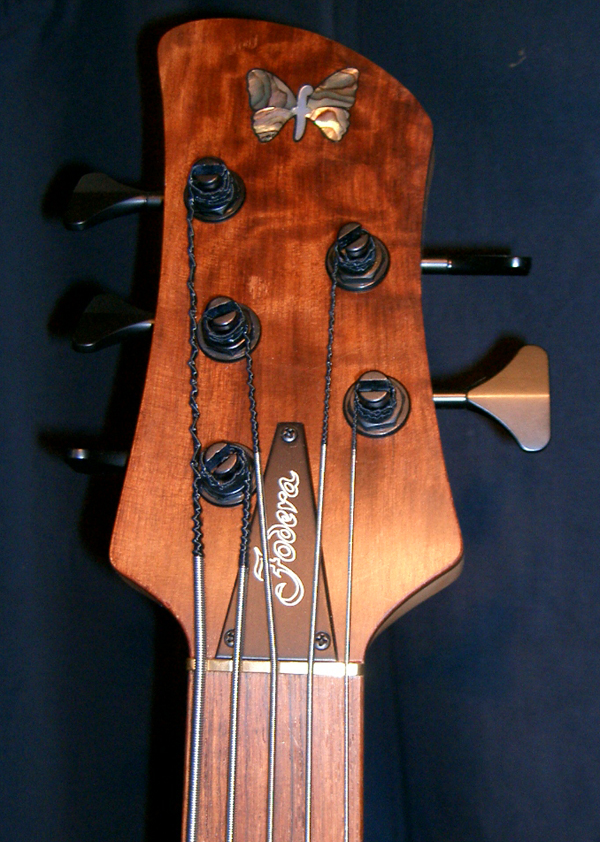
I can't help feeling that if the guys at Fodera really thought this was beneficial, they'd find a much more elegant way to do it.

TalkBass has been independent since 1998. Add your voice.
Create a free account to reply to discussions, view embedded media, and browse with fewer display ads.
Join free Log in
Want zero display ads or expanded classifieds tools? Compare plans.
Fodera makes extended b headstock.
In highschool I was a full-time guitard. I only played floyd rose guitars, my favorite one had the dang bridge disabled so that, in the playing area, it was like a non-trem headless guitar. It had stupid light .008" strings and still felt stiffer for all fretting, picking and especially bending compared to my buddies cheap non-locking kramer which was laced with .010"s- not by much on the lower strings, but d through highe e felt like overcooked spaghetti on his. Irritating as my strings were dumb-thin and they were a third as high off of the frets as his were. It is not a myth, it just is such a small difference on a long 34"scale (7"/25" vs 7"/34") that it almost doesn't matter. The effect can be mitigated with careful string selection if you have a reverse headstock.
I am less and less in love with my Warwick and one of the reasons is the pingy tight g string. That same feeling is there (to my hands and ears, ymmv) on most basses with the g tuner on its own side down closer to the nut. Were I having the energy to build a bass, among a bunch of other structural features, I would make an effort to eliminate as much unplayable length on the B as possible and put the g tuner way out in the wind for perfect-ish feeel on standard string sets.
There's no up charge for the extended B head stock. It's the same as any other headstock in their line up. So no, people don't pay thousands for that headstock.And people pay thousands for this? Each to his own and all that, but really? Those angles through the nut, different key lengths, mixed up tuning directions, inside/outside windings - IMO this is about as un-engineered as it is possible to get. And for what, a longer bit of the B string behind the nut which makes not a jot of difference to anything... Although I do like the inlay
If Fodera thought that the inverse of my experience were true, would they offer that funky B placement as a "uh, I guess, if you want it..." option or would they be patenting it, licensing it, pushing it in glossy ads and upcharging for it like the buzz feiten "system" years ago? if I had doubted the feel in my hands enough to get twelve packs of d'addario 9's, twelve hardtail strat bodies, four floyd-nut strat necks, four reverse strat necks, four standard strat necks, an accurate to four decimals digital fishing scale, and a center-crane apparatus with a cam lift to scientifically verify what my hands told me for the five years that I owned that guitar, we would have the cold data rather than my guitard story. Pm me if you would like to finance the research.I think you're full of baloney.
If Fodera thought that the inverse of my experience were true, would they offer that funky B placement as a "uh, I guess, if you want it..." option or would they be patenting it, licensing it, pushing it in glossy ads and upcharging for it like the buzz feiten "system" years ago? if I had doubted the feel in my hands enough to get twelve packs of d'addario 9's, twelve hardtail strat bodies, four floyd-nut strat necks, four reverse strat necks, four standard strat necks, an accurate to four decimals digital fishing scale, and a center-crane apparatus with a cam lift to scientifically verify what my hands told me for the five years that I owned that guitar, we would have the cold data rather than my guitard story. Pm me if you would like to finance the research.

Right; this is exactly what I'm talking about, so everyone is saying this doesn't do a thing to tighten up the B string. I don't understand why it wouldn't.

Yes there is, and it's the physics of bass reproduction...when all else is equal (and while these two cabs aren't 100% equal in tone, they're pretty close), bigger cabs with more drivers always sound better.@Happynoj I get what you're saying. Is there empirical data for why an 810e sounds better with an svt than a pair of 212av's?

Why would it?Right; this is exactly what I'm talking about, so everyone is saying this doesn't do a thing to tighten up the B string. I don't understand why it wouldn't.
Eh, they were just doing what a customer wanted. If it were me, I would explain to the customer why their logic was messed up...once. But if they insisted, I'd do it, too, and I'd enjoy getting the upchargeIn this topic I learned that the only scale of the neck (like 35") affects the tension of the strings not the tuning peg placement and my dislike for Fodera has grown a little bit more.


In highschool I was a full-time guitard. I only played floyd rose guitars, my favorite one had the dang bridge disabled so that, in the playing area, it was like a non-trem headless guitar. It had stupid light .008" strings and still felt stiffer for all fretting, picking and especially bending compared to my buddies cheap non-locking kramer which was laced with .010"s- not by much on the lower strings, but d through highe e felt like overcooked spaghetti on his. Irritating as my strings were dumb-thin and they were a third as high off of the frets as his were. It is not a myth, it just is such a small difference on a long 34"scale (7"/25" vs 7"/34") that it almost doesn't matter. The effect can be mitigated with careful string selection if you have a reverse headstock.

Lo Riders aren't low tension strings. If anything they're tighter than average.Slightly off topic and sorry to sound obtuse, but...
What is meant by "floppy B?" and is it really that common?
I've had 4 six stringed guitars (all 35" scale), and none of them had a B string that I would consider "floppy," and I use low tension strings DR Lo-Riders, medium gauge, with very low action. The B string doesn't feel as if it has as much tension on it as, say the D, but it feels fine and responds very well.
So who has a "floppy B" and how do you define a "B" as "floppy"?
Lo Riders aren't low tension strings. If anything they're tighter than average.