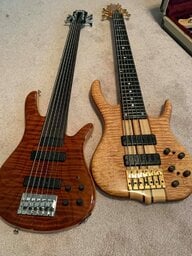
The stiffness - or lack of stiffness - in the structure of the bass is the main thing.OK - my bad. So my high tension Lo Riders haven't domnstrated any problems with B - so, what makes a "floppy B" string?
I think needed stiffness for a good 5 string bass is a fair bit higher than for a good 4. Just having a marginally wider neck, by itself, often doesn't add enough structural stiffness to allow a low B string to articulate well. That said, there certainly are good low Bs out there on plain maple necks, but they're most often on necks that are more carefully selected and seasoned than high quantity mass-produced instruments. And even with a cheap instrument you sometimes just get lucky with a hunk of maple that's a bit on the high side of typical stiffness range.
Also, I think that it's been assumed since the popularization of a low B string that the proper ballpark gauge should follow the traditional increment of about .02" between strings, i.e. since a typical string set is .100-.080-.060-.040, a B string should be around .120; I think that's just not the case. It depends on the specific brand and model of string, since there's so many flavors of core size versus wrap size, number of wraps, etc. but I tend to think that a better starting point is about .035 bigger than your E string.
Last edited: