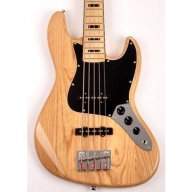
So, to the original question, "Does a reverse headstock tighten up the low end?" This is something that has been argued here before. My own experience of this is with guitars, and I would say that, in a way ... yes. It may not technically "tighten up" the low end, but it does give a difference in feel - the feel I'm describing involves more effort in bending a string with longer overall length to a particular pitch (as described below), and a general difference in feel which is quite recognizable (at least to me, and clearly to some others as well). As with so many things of this nature, people who are not particularly attuned to the feel I'm describing will be inclined to dismiss it as nonsense, and people are entitled to their own opinion. But there is an actual physical explanation for this difference in feel (which I imagine will apply to the bass as well). From Physics Forums:
-- --
...
what is important for the guitarist when he's bending the string is to reach the note he wants to play. It is important to remark this, because in my opinion if there is a lot of string behind the nut (and/or the bridge), it will be easier to bend the string if we think in terms of distance, but the string tension will not rise so easily as with a locking nut or a shorter length of string behind the nut. I believe the effort and the deflection (in terms of length) of the string will be less with a locking nut. Let's assume the string is attached (locked) at both ends.
In order to reach the desired note, the guitarist has to bend the string the distance d, so the string is deformed and tension is increased from T to T'. The force he exerts on the string is f. Now let's make the thought experiment proposed by sgb and think of a guitar with a distance between the tuners and the nut several times the scale length. If we pull the string sideways at the middle of the scale length we want the tension to increase accordingly, from initial tension T to the target tension T'. But as there is a lot of string length to stretch, we will have to deform it (increase its length) more and the string will travel a distance D, in order to reach the same tension T'.
As D>d, the angle between the two forces T' will be smaller,
so the force F that the guitarist has to exert on the string will be considerably higher. So in this case it will be more difficult to reach the note, the guitarist has to bend further the string and he will need more force. In my opinion bending should be easier with guitars with locking nuts or with short "free" lengths of string behind the nut and saddle. But as these distances are comparatively small against the scale length the difference will not be much (at least with common guitar designs).
This is a basic experiment you can do on a lock nut equipped guitar [shorter overall string length]. Bend with the lock nut
off, then again with it
locked down, I think the effect is definitely noticeable. I found the extra string length would require a greater bend distance to reach a certain pitch. I concluded it was because you are not only increasing the tension in the vibrating length but also the nut-tuner distance. Look at your (non locking) nut while bending, you can see the string sliding through the nut while bending - The string is elastic and the nut-tuner length is undergoing extension. This effect is even more pronounced on certain jazz guitars where the tail piece is some distance from the bridge - One of my guitars (Epiphone Joe Pass) has 23cm of non vibrating sting on the G & D strings that undergoes extension while bending.
-- --
So the longer (more "compliant") overall string length actually requires more effort to reach the same bent note than a shorter overall string length. This does fit with my experience. The difference in feel between a standard and reverse headstock is something I know about from my own experience, not theory. But I think these little physics forum excerpts do a decent job of accounting for it in physical terms. I myself prefer the reverse feel - I've already built a guitar with this configuration, and I'm planning on building a bass this way too. So my money is where my mouth is. The reverse headstock makes a difference, in my experience. You can bet that there are other folks who have not had this experience, but there it is.
Guitar string tension: effect of total length