

Enjoy the benefits of a premium membership!
Upgrade Account
-
TalkBass has been independent since 1998. Add your voice.
Create a free account to reply to discussions, view embedded media, and browse with fewer display ads.
Join free Log in
Want zero display ads or expanded classifieds tools? Compare plans.
You are using an out of date browser. It may not display this or other websites correctly.
You should upgrade or use an alternative browser.
You should upgrade or use an alternative browser.
Don't like PJ's?
- Thread starter JimmyM
- Start date
More options
Who Replied?


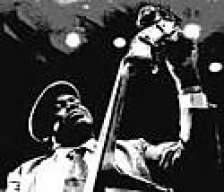
Intuitively, one might think that a PJ would be the ultimate combination. But in reality the short fat P and the high thin J just don't play well with each other. Add to this that to my ears something happens to the sound of a P pickup when a J pickup is in close proximity, it's just not as good. I suppose if I were to ever try this combination again I would go with a two coil J pickup to see if it played better with the P.

Yea, long hair don't care.One can still smell the Aqua Net in this photograph.

I played a MusicMan Caprice for a couple of years and enjoyed it. The bass played beautifully and it sounded pretty good too.
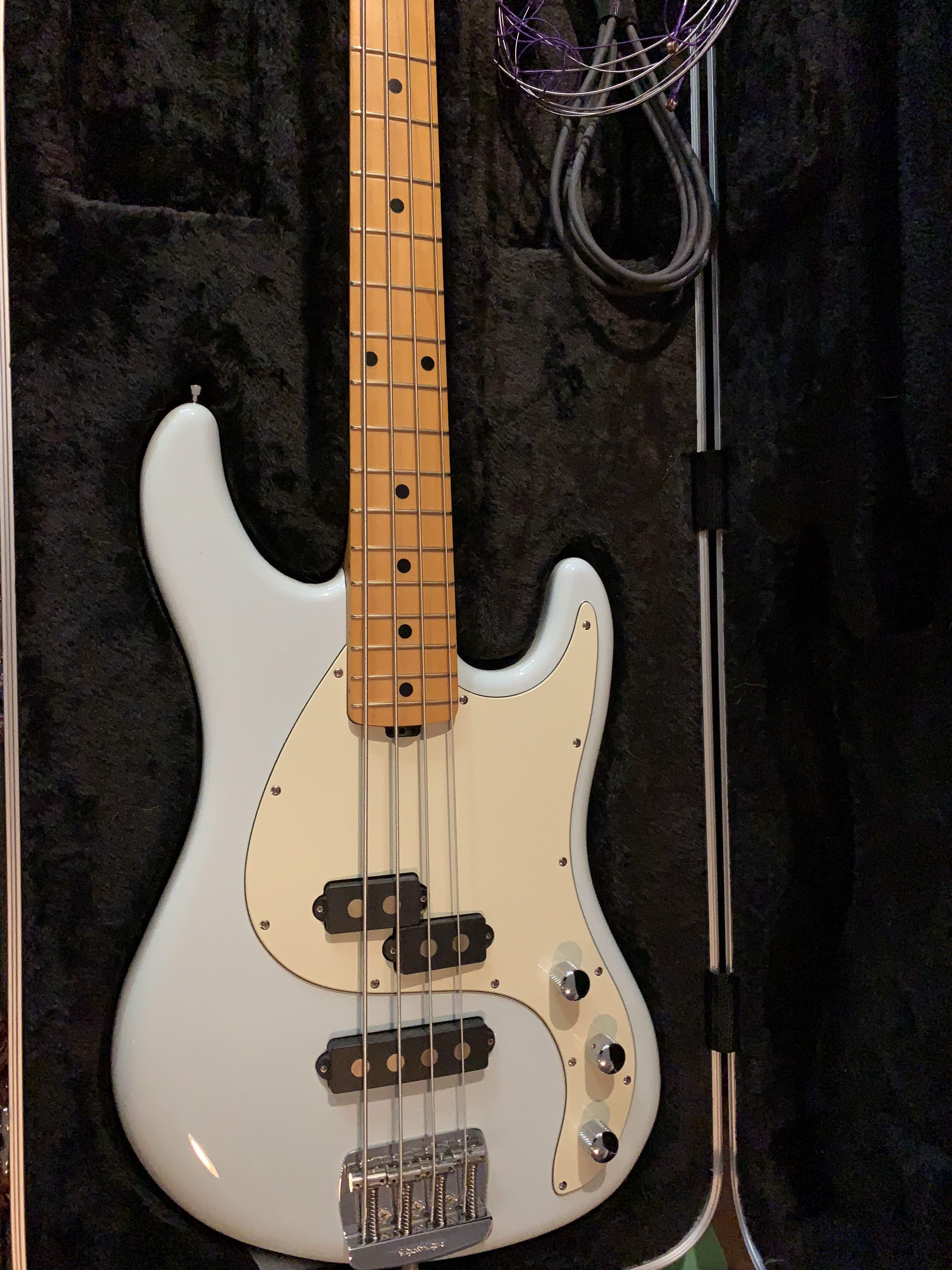


Nice collection you have there Jimmy!
I don't have a PJ, but I do have a JP. I converted a Jazz bass. I took a router and made a spot for the Precision pickup. The bridge pickup is a split coil 10% overwound to match the Precision pickup. I had to make a proper pickguard since the P pickup would go over the edge of the original jazz pickguard. Since this is now a parts bass and the colour is for a 1961 Chev Impala, that's the name of this bass. Sounds great with flats.
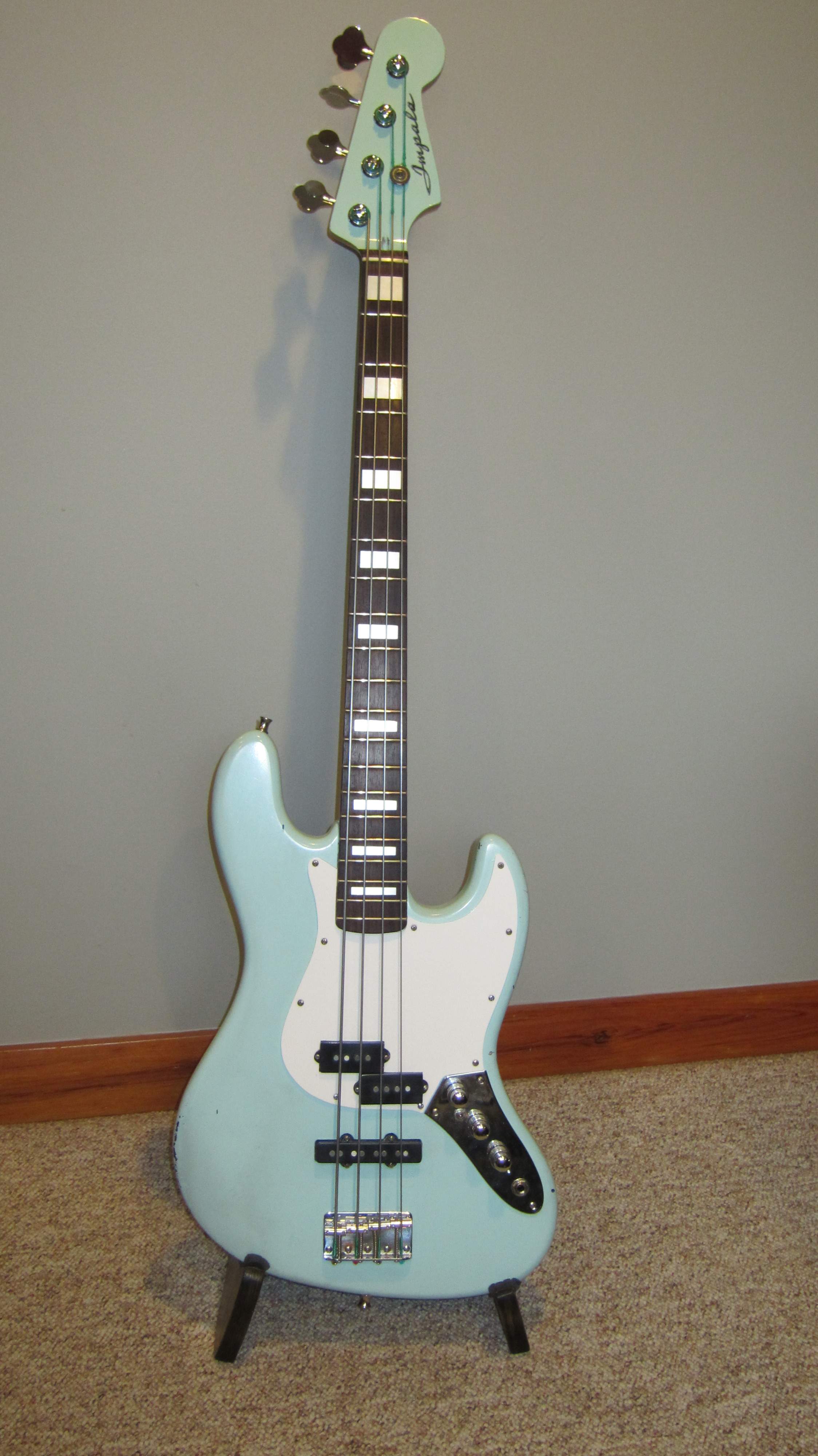
I don't have a PJ, but I do have a JP. I converted a Jazz bass. I took a router and made a spot for the Precision pickup. The bridge pickup is a split coil 10% overwound to match the Precision pickup. I had to make a proper pickguard since the P pickup would go over the edge of the original jazz pickguard. Since this is now a parts bass and the colour is for a 1961 Chev Impala, that's the name of this bass. Sounds great with flats.
Two of the newest addition to the hairspray corner.Yea, long hair don't care.




Back in the 70's the guitar player walked in with a 1968 Mustang Bass. That was entry level stuff back then. I laughed and plugged it in and played it.Almost talked myself into a Talman shorty like that, but bailed when I heard the JMJ Mustang was coming out in black. Then I bailed on that when Covid hit.
SHOCKED !!!!! WOW !! Amp was a 360`
Then the problem was not the PJ, the problem was the bass's tone itself combined with that P pickup.Had a PJ and it never sounded like a pure P bass even after adding a three way isolating switch. A pure P is well, just that a pure P.

I have a Am. Std. Jaguar that is PJ. It has actual on/off switches for the pickups (so no interplay with circuitry from the J 'changing the sound' of the P, like some say happens).
I think of PJ as P+. It's not a Jazz, unless you only ever use the bridge p'up. It does make all the right P sounds. Plus (+) it can have the additional tones by adding the J in the mix.
[I won't even get into the active mode, and series/parallel stuff. Cool sounds to be had.]
If I think of a PJ as an enhanced P it works just fine. Can it sound like a Jazz? No. Can it sound like a P? Yes.
Is it a Jazz? No. Is it a P? Yes. +.
That said, I do sometimes really love the simplicity of a Precision bass.
I think of PJ as P+. It's not a Jazz, unless you only ever use the bridge p'up. It does make all the right P sounds. Plus (+) it can have the additional tones by adding the J in the mix.
[I won't even get into the active mode, and series/parallel stuff. Cool sounds to be had.]
If I think of a PJ as an enhanced P it works just fine. Can it sound like a Jazz? No. Can it sound like a P? Yes.
Is it a Jazz? No. Is it a P? Yes. +.
That said, I do sometimes really love the simplicity of a Precision bass.

I wouldn't know. I don't worry about such things. My basses sound just fine with whatever pots are in them. And I hear absolutely no sound damping on a PJ with VVT or VTVT that isn't there with the regular VT P harness. And then if I wire the P pickup direct to the jack, all I hear is a little increase in the highs, which I don't want anyway.
This has got to stop, but it won't ever, will it? The difference between any of the different "pure" P pickups (Dimarzio, Duncan, EMG, etc.) is literally 1000x the difference between a solo P/J P and a "pure" p. Yet, all of the different sounding "pure" P pickups are "pure P"? Is the Steve Harris P pickup a "pure P", more than a solo'd Geezer on a P/J? So weird.

I’m very pleased with the sound and ergonomics of my Squier 34” scale VM P/J model, especially after changing the control panel and preamp to an Audere 4-band Jazz Plate.
- First, I prefer the narrower Jazz neck.
- Second, the Audere preamp completely separates the P and J pickups prior to mixing them - so soloing either pickup doesn’t load the other. The P sounds like a P, and the J sounds like a J bridge pickup. Blended sounds maintain the characteristics.
- Third, the offset body shape is comfortable to me, standing or sitting.
It’s become my most played bass.


I've never owned a PJ but I'm not above carving a hole in an old Allparts P-body and giving it a try. So, which J-pup position would be the most useful? The "70s closer-to-the-bridge position, or the standard position that is a bit closer to the neck. Or, will it really make any difference since it's only about 1/4" either way?
B.
my two cents: if you’re after soloing/favoring the J pickup, 60s sound would have some more body; but for blended tones (both pups on), I find it that 70s perhaps blends better. Whether the difference matters to you…well, you need to find out for yourself
What you'll prefer, I can't say (and I want to say that it's more like 3/8" between 60s and 70s bridge positions, but I'd have to look), but I do think that you'd notice a difference, both soloing the bridge pickup and blending, between the two positions. FWIW, I've tended to like the soloed bridge sound of 60s position better than 70s and found 70s to blend better with a P, but some of that will depend on your taste and the other factors in your setup (specific pickups, strings, etc.).
I've also seen P/J and reverse P/J setups with the J in 60s, 70s, closer-to-the-bridge-than-70s, and closer-to-the-neck-than-60s positions. Sometimes the P at the neck isn't centered in the usual location, either, which adds another variable (maybe not pertinent here, though).
I think that some of the thinness of a soloed bridge pickup in 70s position could be offset with a slightly warmer-voiced and/or hotter wound bridge pickup, if one wished.
Last edited:

I've never played a PJ before, never had the urge, if I'm being honest, but I am interested and should probably play one before I die. So, some questions. Are PJ's always on P style bodies, or do they come on J bodies ? What are the necks, P or J ? On a PJ, when soloing the J, aren't you going to sound like Jaco all the time ? How would you describe the sound when when you dial in less of one pickup vs. the other ?
Latest posts
-

-
-

-

-
Need Recommendation for Repair Shop In Western Connecticut
- Latest: averagejoe53
