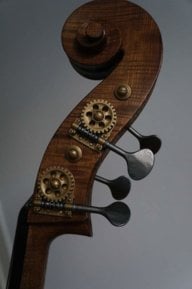
I just recorded this little clip today with the New Ischell C3 Contact Mic. Not only does it have great tone (in my opinion and on my bass) but is virtually Feedback and Bleed Free. Listen closely at the 19 second mark you can almost hear my voice.

TalkBass has been independent since 1998. Add your voice.
Create a free account to reply to discussions, view embedded media, and browse with fewer display ads.
Join free Log in
Want zero display ads or expanded classifieds tools? Compare plans.
My wife just asked the mods to remove your post. She also confiscated my credit card. Happy New Year!
Just got an Schoeps CMC MK 41 and I "have" to confirm this...I run a Schoeps CMC1 MK4 and have a Realist Life Line. I used to blend the Lifeline with an ATM mic. It was like 50/50. Now that I have the Schoeps I have yet to need piezo. That is playing mostly in piano bass drum trios. Frequently with a heavy handed drummer. I have a really old(1850) carved bass into an AI Clarus and either an MAS 28 or a Genzler 123SLT cab. Other bass players have told me that my tone was so natural they thought I had no amp and were wondering how I kept up with drums. The Schoeps is a little pricey and after you own it your search for “that sound” will be over. No feedback, no issue with bleed, and stupid simple to dial in your sound. Really good investment.


 Comparing it with a Felix to Line Audio CM4 and a Brauner Phantom the MK 41 is the "winner".... but as already said these are first short impressions...
Welcome to the Schoeps club!Just got an Schoeps CMC MK 41 and I "have" to confirm this...
View attachment 4927373 View attachment 4927374
The "voyage" and experimenting with the Schoeps has just begun, but already the first impressions are extremely convincing...

Not that I think that I ever get there with my heavily limited playing capabilities, but it might be interesting to others too:… I use a monitor wedge to my side, almost to the point of being ever so slightly behind me with a mic/pickup blend heavily favoring the mic. Both go to FOH.
…
Just get that wedge dialed.
Do you find that the position (almost) above the soundpost is a location that works very well for micing a nice DB sound?Welcome to the Schoeps club!
I remember Larry Grenadier talking about placing a mic uses a similar position...Do you find that the position (almost) above the soundpost is a location that works very well for micing a nice DB sound?
Your mic seems to be very close to the table, almost touching the top with the windshield.
It‘s one of the good locations for a contact mic, so that might make sense.
I just cannot remember to have it seen so clearly (if at all) before.
For me and my bass it does. There is some space between the end of the mic and the top of the bass, but only a centimeter or so. This, too, helps the mic being more effective in fighting bleed and maximising gain before feedback (although some bleed is unavoidable, if only because the top of the bass itself acts as an acoustic reflective area).Do you find that the position (almost) above the soundpost is a location that works very well for micing a nice DB sound?
Your mic seems to be very close to the table, almost touching the top with the windshield.
It‘s one of the good locations for a contact mic, so that might make sense.
I just cannot remember to have it seen so clearly (if at all) before.
I remember Larry Grenadier talking about placing a mic uses a similar position...
Not that I think that I ever get there with my heavily limited playing capabilities, but it might be interesting to others too:
Do you think that using an EQ directly in front of your bass monitor wedge can help to dial in a better bass sound for your personal needs?
Of course that only works if the monitor is not daisy-chained (then the technician could hopefully dial in your sound) or only the last in the chain. And only with active monitors.
Not only sound but the level before feedback can easily and quickly be controlled that way.
After years of looking for solutions, including expensive EQ units like the Grace Felix, I found that EQ leaves me cold. Every time myself or even very good monitor engineers start EQing my bass the sound suffers. It just never seems to help. I’ve spent more time getting my bass sound right, acoustically, and then sending that to the PA. That has worked best for me.

Hi Jason! While I don't play in as many large concert venues or large outdoor festivals as you, I've had very satisfactory results playing 350+ to 2000+ seat performing arts theaters and some smaller outdoor (300+ folks in small amphitheater) , plus small club venues plugging the Sennheiser MD -409 directly into the newer AI Clarus S4+. The largest ensemble is just rhythm and 7 horns, but there's enough headroom that I'm confident I could drive a full big band if necessary. I mean, I used to do big band rehearsals without an amp...I’ve tried them all in almost any situation. I’ve also watched Christian McBride trying to lead his big band while navigating the feedback from his amp. Microphones in amps do not work. Microphones in powered monitor/speakers are not much better. If I use an amp I use it for my stagemonitoring ONLY, David Gage Realist direct to the amp. I send my AMT mic to the board. I use a monitor wedge to my side, almost to the point of being ever so slightly behind me with a mic/pickup blend heavily favoring the mic. Both go to FOH. Microphone is the priority. I did try a Felix for a couple of tours but found it affected my sound even dialed in totally flat, and not for the better. If you can live without the amp, all the better. Just get that wedge dialed.
Audiosprockets is coming out with a new Tonedexter model in February. Just sayin…I’ve tried them all in almost any situation. I’ve also watched Christian McBride trying to lead his big band while navigating the feedback from his amp. Microphones in amps do not work. Microphones in powered monitor/speakers are not much better. If I use an amp I use it for my stagemonitoring ONLY, David Gage Realist direct to the amp. I send my AMT mic to the board. I use a monitor wedge to my side, almost to the point of being ever so slightly behind me with a mic/pickup blend heavily favoring the mic. Both go to FOH. Microphone is the priority. I did try a Felix for a couple of tours but found it affected my sound even dialed in totally flat, and not for the better. If you can live without the amp, all the better. Just get that wedge dialed.
Yeah, I've never gone the Clarus route. I wasn't a fan of the downfiring combos. That's something to consider maybe at some point. With this album cycle we are headed more electric with inears. For small things I have been just using a TH350 into a 1x12. Not really a great sound compared to a good mic and wedge but no one else notices but me.Hi Jason! While I don't play in as many large concert venues or large outdoor festivals as you, I've had very satisfactory results playing 350+ to 2000+ seat performing arts theaters and some smaller outdoor (300+ folks in small amphitheater) , plus small club venues plugging the Sennheiser MD -409 directly into the newer AI Clarus S4+. The largest ensemble is just rhythm and 7 horns, but there's enough headroom that I'm confident I could drive a full big band if necessary. I mean, I used to do big band rehearsals without an amp...
You found the Felix DI to color your sound? I am finding it very very clean. Was this with the realist or the mic or a blend of the two?I did try a Felix for a couple of tours but found it affected my sound even dialed in totally flat, and not for the better.
At some point the FOH did an A/B and noticed a definite change in the sound with everything at “0”. Seemed very odd to me as well. At some point I started reducing my signal down to the bare minimum and that’s where I’ve stayed for the time being. As long as my monitor is a good one and not too small I have no more issues. On bigger stages I’ll opt for an amp if it’s available, just to get a little more security on stage, such as this performance in Golden Gate Park for Hardly Strictly…You found the Felix DI to color your sound? I am finding it very very clean. Was this with the realist or the mic or a blend of the two?
I think we simply tried it with and without.Since almost every electronics and even the absence of certain electronics can color the sound, how are you sure that the coloration comes from the Felix and not from a non-optimal impedance that input at a DI or board?
I would check with a simple device for a large input impedance known to have no coloration like Francis Decks Quick‘n‘Dirty impedance buffer (HPFpre without the HPF part, using the PN4416 or 2N4416 JFET) or the HPFpre with a low frequency HPF setting as a reference.
I wouldn‘t take a valve based design, since valves can color the sound too. (They don‘t need to, depending on the design, but often do, even if in a desirable manner. )