• TalkBass has been independent since 1998. Add your voice.
    Create a free account to reply to discussions, view embedded media, and browse with fewer display ads.
    Join freeLog in
    Want zero display ads or expanded classifieds tools? Compare plans.

Double Bass Double Bass snapped at the heel

Feb 21, 2012
241
22
Good evening
I recently broke the neck on my double bass.
I've used evo stik 'serious stuff' to glue it back on,using the flight case as a jig.
Now I'm thinking of coutersinking 3 screws thru the fingerboard and into the heel and then fill the holes with dowling.
Is there something better I could do?
I ask because it held with 'weiss' strings,but couldn't handle some medium's I thought I'd try.Sure enough it caved in,so wont try that again with this instrument.
I didn't remove any thing,I stuck it down along and into the 'natural' split/break.
I'm not very clever with woodworking,by the way,and cant afford a 'pro' Luthier doing it .
Also,what would be a good sealant over something like
It's not a particularly expensive instrument,but all the same I would like to do a half decent job of a repair and get playing again.
I take it the heel is all one piece with the neck.

Cheers
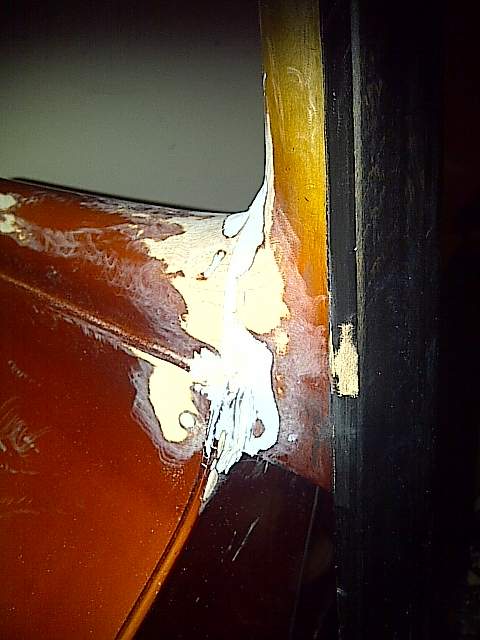
bass1.jpg
 
Yuck.

You could easily have looked on the internet (30 seconds) or called a luthier (30 minutes) and found out how to actually perform this repair, which could have been easy. You could have cleaned up the glue, which is also easy. Since you didn't do either, nothing you can do short of a refin will make that look OK again. Seal it with plasti-dip or car paint or herbicide if you want, it's pretty much valueless now.
 
  • Like
Reactions: ColdEye and jsf729
Yuck.

You could easily have looked on the internet (30 seconds) or called a luthier (30 minutes) and found out how to actually perform this repair, which could have been easy. You could have cleaned up the glue, which is also easy. Since you didn't do either, nothing you can do short of a refin will make that look OK again. Seal it with plasti-dip or car paint or herbicide if you want, it's pretty much valueless now.

I dont know what your on about cleaning up the glue....That is sanded smooth and will be sanded again [and again] after another couple of days..I dont want to rip the bonding out of the joint!
progressive sanding giving it more time to cure is best.
 
I dont know what your on about cleaning up the glue....That is sanded smooth and will be sanded again [and again] after another couple of days..I dont want to rip the bonding out of the joint!
progressive sanding giving it more time to cure is best.

And it's not for looking at,it is for PLAYING.
 
I disagree. The ideal is an artfully done and solid repair that does not detract from the value or serviceability of the instrument.

That's a bad spot for a heel break. My way is to pull the neck heel, neatly repair the break with urethane glue or T-88 epoxy, drill through the back of the heel and insert a countersunk steel bolt through the full length of the heel, and reset the neck.

Others use just glue or pins made from materials including tapered dowels and bamboo spears. Going through the fingerboard is bad work, period.
 
:rollno: Please, anyone with a broken neck who might be reading this thread in the future, don't be tempted to stick it back together this way. It wastes your time and any value left in that instrument. It won't play right, it won't hold together over time, it looks awful. The viol family of instruments has been evolving for centuries; if screws and construction adhesive were really where it's at, nine out of ten Chinese basses would be built that way today.


I see a lot of home-handyman fixes in the Kay world, and a lot of sad, unplayable basses as a result. Study up, get some tools, you may be able to learn how to fix it right. Otherwise bite the bullet and give it to a pro.
 
Yeah that was the prob,an impossible place for it to break,with no where to clamp it,that's why I used the case:All the supports in the right places and some weight on the ridge part supporting the neck.That was what I was thinking a bolt the lenght of the heel..
But I cant avoid fastening thru the board can I?
 
:rollno: Please, anyone with a broken neck who might be reading this thread in the future, don't be tempted to stick it back together this way. It wastes your time and any value left in that instrument. It won't play right, it won't hold together over time, it looks awful. The viol family of instruments has been evolving for centuries; if screws and construction adhesive were really where it's at, nine out of ten Chinese basses would be built that way today.

I see a lot of home-handyman fixes in the Kay world, and a lot of sad, unplayable basses as a result. Study up, get some tools, you may be able to learn how to fix it right. Otherwise bite the bullet and give it to a pro.

Of course you are right,but It cant hurt to try.If it don't work,then you haven't lost anything....It is really only ever a TEMPORARY fix anyway:Something until you can afford to get it professionally looked at,imo.Haven't the time to become a part time Luthier,so as long as it holds up,tunes up,holds tune,then it's worth it
 
If the gluing had stopped with the third follow-up pic, things might not be so bad. But the lead-off pic . . . WAY too much glue and glop. The break is in a bad place, but it's a pretty clean break. I think you are getting flak mostly because of your choice of glue (probably the consensus here would be either hide glue or epoxy), and the screws. KFS offers a pretty standard approach to the repair; the other option would be to remove the fingerboard and drill through the heel from front to back, then replace the fingerboard. I think the concern of a lot of us is that this repair *will not* hold up under playing conditions and may fail at the worst possible moment ( like when your three year-old is rushing up to hear Daddy play).

It's an easy repair to mess up. I've done so a couple of times.
 
  • Like
Reactions: EAME
EAME, in my opinion you used the wrong glue to allow playing the instrument. And yes, way too much. You don't need glue on the outside.

I don't know this glue personally, yet I learn that:
"
EVO-STIK Serious Glue is a high performance; single component, moisture curing, Modified Silane (MS) Polymer based adhesive. It will bond most surfaces even if both are impervious. The product will bond damp surfaces and may even be used underwater. It has very low odour, cures to form an elastic rubber, with almost no shrinkage and low hazard; it does not contain any water or solvent, making it ideal for bonding foam polystyrene.
EVO-STIK Serious Glue bonds to most surfaces including wood, concrete, brick, plaster, glass, ceramics, metals, rigid pvc, grp, fabrics and foam polystyrene . It is ideal for fixing and repair jobs inside and outside the home, in the garden, for cards and boats and for hobbies and crafts (EVO-STIK Serious Glue will not bond to polyethylene and polypropylene materials).

"
You don't want an 'elastic rubber' joint on a DB neck, and the quoted 300kg/m2 is very very weak. Even the quoted three 40 tonnes trucks is weak, if that is per m2. For comparison some typical shear strengths:
Seriously.jpg

HHG is commonly used in instruments, the number quoted above is under quite unfavourable circumstances for it. Most important is that is sets hard, in addition to other qualities.

For something like this I would use either HHG or a slow epoxy. Please note the word slow. Common quick epoxies (typically 15 min setting time) are also weak & unsuitable. It is up to you to decide if you want to break the joint, clean it to get rid of this polymer & re-glue it. If you decide to do that, by now it is probably best done with a slow epoxy (other choices: a 2 component PU or maybe even a 1 component PU, best not use PVA).

Now I'm thinking of coutersinking 3 screws thru the fingerboard and into the heel and then fill the holes with dowling.
Is there something better I could do?
Further reinforcement is required, certainly if you decide to stay with the polymer, but best not drill holes in your fingerboard. For internal reinforcement, either take out the entire heel, or take off the fingerboard. Try to maximise the arm of the internal reinforcements, to get maximal torque @ minimal load. External reinforcement will further reduce the resale value of your instrument, but might be a solution for you. If done well, an epoxy/glass or epoxy/CF external reinforcement would bring the instrument back to playing condition, and give the repair long-term stability at low visibility. All the polymer on the outside then has to go first: you do not want a rubbery layer between the wood & the reinforcement.

Good luck!
 
  • Like
Reactions: EAME
Been in a similar place considering picnic-table style repairs on an upright (see Best use for a CCB? ), but didn't make it far enough to actually trying it. At the advice of KFS and Condino as well as others, I went well beyond my comfort zone and removed the top of the bass and made repairs with hide glue. Definitely not pro-level work but 4 years later that bass is still being played by a friend. Conversely, one I tried to fix a free squareneck dobro by sinking three 3-inch screws into the neck block through the heel. Ha, my apologies to that guitar which I'd imagine by now is sitting in a landfill somewhere...

My advice is cut your losses, pretend that there is no glue in the joint (because it's not going to hold. For even 5 minutes.), and repair it by removing the fingerboard or entire neck heel. If you can get it out clean, maybe even put a new neck on the thing? It's going to seem daunting but folks here really can pretty much get you out of every sticky luthier situation if you just go slow, heed advice, and post pics of your progress.
 
  • Like
Reactions: EAME
Right.
Thank you.
I'm listening now.
It is in two pieces again.
I'm not sure even gluing is an option tho.The angle of the break offers no real support,and probably why it broke there in the first place.The weakest part of all is right there.
I was thinking,cut a whole new joint 'block' taking out half of the heel and the piece out of the neck so that all the faces would be flush again?
A Luthier would do,wouldn't he?
Maybe that's why I should probably leave it to him.Getting the angle right is a skill in itself.
 

Attachments

  • IMG-20160803-00414.jpg
    IMG-20160803-00414.jpg
    43.8 KB · Views: 463