
I just thought of a con...as we've been discussing, turning those tuners can be hard, so some maintenance is involved. However, not only does lubricating the threads of the tuners make them turn easier, it can save having to replace them. I had to replace one on my '88 XL2 because it had stripped out. That's when I learned lubrication is important there.

Enjoy the benefits of a premium membership!
Upgrade Account
-
TalkBass has been independent since 1998. Add your voice.
Create a free account to reply to discussions, view embedded media, and browse with fewer display ads.
Join free Log in
Want zero display ads or expanded classifieds tools? Compare plans.
You are using an out of date browser. It may not display this or other websites correctly.
You should upgrade or use an alternative browser.
You should upgrade or use an alternative browser.
Downsides/Cons of Headless Basses?
- Thread starter halcyo
- Start date
More options
Who Replied?
Actually, as I remember, those old headless Corts were good sounding basses. I had a friend who played one back before they were "old" Corts.I really didn't even think about doing that back then. That was 30 years ago...
But I do have an old cort that I took in on trade with a bunch of other gear... It's not in very good condition but I thought about fixing it up for a beater... It has tight knobs so I'll try that on it.
Thanks!

Actually, as I remember, those old headless Corts were good sounding basses. I had a friend who played one back before they were "old" Corts.
Yea I'm going to have to get into the electronics on this one, the tone knob isn't working. Just needs some soldering I'm sure... But the neck is excellent....


I have one, they came with DiMarzio pickups.I really didn't even think about doing that back then. That was 30 years ago...
But I do have an old cort that I took in on trade with a bunch of other gear... It's not in very good condition but I thought about fixing it up for a beater... It has tight knobs so I'll try that on it.
Thanks!
My wife bought it at a Sear's outlet store.
Still rock mine

Last edited:
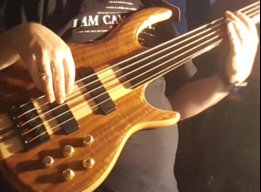
No downsides for me, although the no drop tuner on a 4 would suck if I played 4 still these days. I don't though, really.
I far prefer headless basses.
I far prefer headless basses.

I guess the only downside is that it's not a DOUBLE HEADSTOCK!
RockHewer Custom Arachnophilia 8 2017 Red Malleé Burl Gloss | Reverb
If you call that a downside.
Oh NOOOOO. Wow that is one ridiculous kind of a thing. Jeez, it's so ugly it's like it's cursed! haha
Not necessarily a headless feature, but the zero fret somehow aided in getting the action stupidly low so it was so easy to play.
oooh, thanks for reminding me of the zero fret concept. Another design feature I need to explore/research a bit more!
The epitome of ugly and totally void of grace.
haha it definitely seems like there's quite a subjective division between people who think they look cool/elegant, and those who find them repulsive!
I will say this, SOME manufacturers, who make otherwise nice looking instruments, have HIDEOUS headstock shapes, and I don't think I could take having any part of an expensive custom bass I might have built be less than attractive to me if I'm forking over big $$$!
Also, I think you need to make sure you get a headless bass that has its body going underneath the tuning knobs under the bridge. Some basses have the tuner knobs extending beneath the bottom when the bass is standing upright, and if the bass hits the floor, it can damage the knobs and bridge. Kiesel's headless models have one, the Vader, that has the exposed bridge, but the other models (Thanos, Osiris, Zeus) do not.
Excellent heads up on that potential issue. A very worthy design consideration!
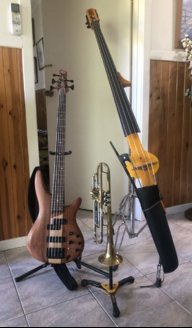
Regarding the Ibanez EHB style string clamp - could you neatly put a bit of heat-shrink on each string to stop it stabbing people or damaging your gig bag?

Yes.Regarding the Ibanez EHB style string clamp - could you neatly put a bit of heat-shrink on each string to stop it stabbing people or damaging your gig bag?
The heatshrink if applied in the correct spot and before the string was cut to final length would also likely stop the tape unwinding.

What's the technique when putting on new strings?
Depends on the particular instrument. My Steinberger L2, NS Radius CR and my now-departed Kramer Duke all have different ways to install single ball strings (only the L uses double balls, which is all that I use).

Jazzdogg
Less barking, more wagging!
Depends on the particular instrument. My Steinberger L2, NS Radius CR and my now-departed Kramer Duke all have different ways to install single ball strings (only the L uses double balls, which is all that I use).
I should have been more specific: is there a way to speed up the winding process when installing new strings with tuning machines that require so many turns? Is there a device you can use to speed things up? On the headless basses I've tried, the tuning knobs were very close to one another, which I imagine might cause me to say things you're not supposed to say in public, especially when installing a set of new strings.

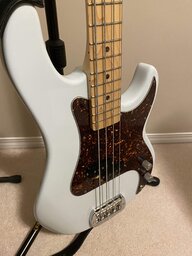
I have been pretty tempted to get a Strandberg original bass for a while. Would TI Jazz Flats work on it?
It's not really that bad. However, if you have arthritis in your fingers or carpal tunnel in your wrist, that could affect your ability when changing strings. Take the steps I mentioned in a post above to make it easier for both you and the bass.I should have been more specific: is there a way to speed up the winding process when installing new strings with tuning machines that require so many turns? Is there a device you can use to speed things up? On the headless basses I've tried, the tuning knobs were very close to one another, which I imagine might cause me to say things you're not supposed to say in public, especially when installing a set of new strings.

- Apr 18, 2008
- 16,007
- 1
- 31,705
- Disclosures
- I'm highly opinionated and extremely self-assured
I should have been more specific: is there a way to speed up the winding process when installing new strings with tuning machines that require so many turns? Is there a device you can use to speed things up? On the headless basses I've tried, the tuning knobs were very close to one another, which I imagine might cause me to say things you're not supposed to say in public, especially when installing a set of new strings.
I haven’t found that to be a problem. In fact, I can get a headless string up to pitch faster than a headed bass.
Me too. And my headless basses stay in tune better. No tuner paddles to accidentally get bumped when moving the bass around.I haven’t found that to be a problem. In fact, I can get a headless string up to pitch faster than a headed bass.

I've had a bunch of headless basses over the years: many Steinbergers and a Leduc UBass. On virtually all of them I've had issues with the tuners stretching/deforming and eventually needing to be rebuilt by a specialty shop like Peekamoose in midtown Manhattan.
One downside (for me) was that after playing conventional basses and guitars for so long, you develop 30+ years of muscle memory for fine-tuning the thing while playing. It's hard to get used to tuning at the bridge on the fly (for me).
One downside (for me) was that after playing conventional basses and guitars for so long, you develop 30+ years of muscle memory for fine-tuning the thing while playing. It's hard to get used to tuning at the bridge on the fly (for me).
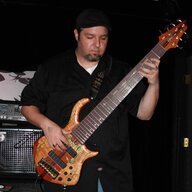
About cost of the double ball end strings: I have found Just Strings to be pretty reasonable.
But if you hunt around you can find better prices. I have never found the cost of strings to be a deterrent for a headless.
I could buy 3 sets for the price I pay for one 7 string set.
But if you hunt around you can find better prices. I have never found the cost of strings to be a deterrent for a headless.
I could buy 3 sets for the price I pay for one 7 string set.
The original Steinberger jaws are known to do this, but replacement high carbon steel sets are available from Headless USA and don't need anything special to install them. I got a SS set through Steinberger World 20ya but my originals are still fine.On virtually all of them I've had issues with the tuners stretching/deforming and eventually needing to be rebuilt by a specialty shop like Peekamoose in midtown Manhattan.
The string adaptors so you don't have to use double ball strings. What can you tell me about them, good bad or?
Thanks
Thanks


