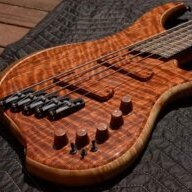
My experiences\observations:
Before doing anything, know your bass. Sounds stupid, but it isn't. You are messing with the physics behind the original design of your bass, so fully understanding its specs is helpful. What is your scale length, how do you adjust the bridge saddles, how do you adjust your truss rod, etc. Then ask yourself "Am I comfortable with adjusting these things, or making adjustments to my nut?" If you aren't, consult a professional luthier, or at the very least, some YouTube Videos.
It is your bass. What you do to it is on you.
There is a lot of math that goes into producing a certain frequency of sound. Over centuries, people have figured out how to get the right perceived note out from a certain tautness of string. For the last 70 years or so, a rough estimate of how to get a solid EADG out of an electric bass has been more or less settled. The benchmark, or standard, by general consensus is that a 34 inch scale instrument can use .105, .085, .065, and .045 strings to get the right pitches at the right plucking tension; give or take .005 inches for personal preference.
Great! All done, right?
Unless you want to do anything besides EADG on a 4 string. Then things get weird.
My personal opinion is that if a player wants to tune down one half step, or semitone, on all the strings, which is a common blues tuning, to Eb, Ab, Db, Gb, a .105 set of strings with a hexagon core will work just fine without any further adjustments. The shape of the core grips the steel or nickle winding material more, making the string stiffer, or "stable", enough for me.
When you tune a full step, or two semitones, to a DGCF tuning, most players find it preferable to go to a thicker gauge of string. A .110 .090 .070 .050 set of strings isn't impossible to find in stores, but not easy. There are many places all over TB that discuss places to buy strings that will carry them. The added winding increases the mass of the string, making it thicker, stiffer, and more taut if used at a standard tuning. However, at a hole step lower tuning, I find that a .110 set is perfect.
There are other options.
If you raise the height of your bridge saddles, sometimes called the action, it increases the tension on your strings. The strings on a guitar or bass are part of a sort of triangle composed of the nut, bridge saddle, where the string enters the bridge, and an imaginary plane going up the fret broad. If you raise the bridge saddle, it increases the steepness of the angle going to the nut, and creates a minor increase in length between the nut and the bridge saddle. This can help get more tension into a string at lower tuning, but it also increases the distance between the string and the frets, as well as the pickups. Some people hate this.
Another option is finding a 35" scale bass. That is the distance between the nut and the bridge saddle, and by increasing the length, you add tension to the string. Unfortunately, 35" scale four string basses aren't very common; and even 35" 5 string basses aren't as common as they could\should be. Some players find that they feel odd, but I've never had that problem. I have a 35" ESP\LTD bass that is great for downtuing because of the 35" scale. A .105 set is very tight at EADG but feels fine at DGCF.
Lets say you want to tune a step and a half or two steps down. Now you are entering a no-mans land that is often ignored and a lot of compromises have to be made.
For whatever reason bass manufactures and string makers have completely ignored the large (and growing) group of players that use C# and C tuning variants. These tunings have been around since the 70s, thanks to Black Sabbath, so this isn't new ground. Yet offerings are few and far between.
If .105 is good for E and .110 is good for D, then logic would suggest that a .115 is good for a C#\C tuning. However, to the best of my knowledge, only GHS Boomers produce a .115 set that is readily available to retail markets. There are rumors of .115 strings from DR produced custom for Geezer Butler, but I've never see one in person.
That means I am left using a .110 with a hex core, and higher action, or on a 35" scale bass, or using a .120 which is a little tight for C# and doesn't sit well on a lot of bridges or nuts.
Things are about to get ugly.
One of the facts of life of downtuning is the very real chance you will have to file out the nut of your bass to accommodate a thicker string. The precision way to do it is with a properly sized slotting file, or, since I'm cheap, to use a needle file and eye-ball the thickness. If the slot isn't big enough for the string, it will sit funny in the slot, mess up your intonation, and screw with the tone a little. If you aren't comfortable filing your nut, take it to a professional. You can reset your bridge saddle height, or your truss rod, but once you file your nut, it is a done deal; you can't un-file it.
I like a drop C tuning, which means I'm really hosed. CGCF is far from uncommon, but I have never found a worth while pre-packaged set that would work. D'Addario had a "balanced tension" set that should have worked, but the strings died very quickly. Generally, I have to order a .110 set online, with an additional .120. This is expensive and wasteful. But what can I do?
String problems go away with a 4 string bass tuned BEAD. Just buy a 5 string set and pitch the G. There are some companies offering 4 string BEAD sets, or "thick core" sets for this. That's nice.
The real trick becomes adjusting the bass. At this tuning, filing the nut is enviable. The lack of tension on a .105 or .110 with even extreme adjustments to the saddles and truss rod lead to a floppy mess that I can't work with. One of the only way out of this I'm aware of is to switch to a thicker flat wound string, usually around .109. The winding on a flatwound string makes it very stiff, and very stable at lower tunings. However, I personally despise flat wound strings, and don't care for them at any tuning. However, I know a lot of stoner and doom metal bass players tune low and use flats; my suspicion is because of the stability.
The bridge becomes a problem at this point too. The holes for stringing the instrument may not accommodate the thicker strings. The saddles may be too narrow for the thicker strings to sit in them properly , which messes with your tone. If the strings don't install properly on the bass, they will never sound right. Old Bad @$$ bridges work well because they often are rigorously notched, and the newer clones of this design can handle thicker strings. The last gotcha with the bridge is your intonation. Again, because there is a triangle involved, getting your open note pitch to match the pitches up and down the scale requires the angle the bridge saddle creates to be in exactly the right place. Sometimes that place isn't achievable when you monkey around with the tuning the instrument was designed for. I have a bass that I can't get the intonation right on because I can't move the saddle back far enough due to the length of the intonation screw and how far you can compress the bridge spring. To get the setup perfect, I may need to cut the screw and the spring.
One last complication of BEAD, or just BEADG, tuning, is that there isn't a lot of consensus over what gauge is right for a low B. The range is anywhere from .120 to .140! That is a lot of variation. Personally, I don't like the tone or feel of a string thicker than .130.
I don't personally have any experience with tuning below BEAD. Going to A#, A, or even as low as F just compounds the existing problems further. If I needed to get to those low notes, I would personally be inclined to get a 5 string with a 35" scale, or multi-scale neck, and work from there. The complications of A# or lower on a 4 string are too many for me to image.
One overlooked aspect of a bass when tuning lower is the pickups. People don't think about this much, but if a pickup was designed to work well with E being the lowest pitch it has to worry about, is it going to like C or B? It sounds stupid, but this is a real concern. That pickup with deep lows you love so much when tuned to E might sound like a muddy mess that is producing frequencies only whales can sense when trying handle lower tunings. Those nice crisp highs at E might turn into ear piercing rattle when the tension of the string changes. Don't forget that your guitar pals are probably tuning down too, which means they are totally invading your sonic space. Mids are your best friend at lower tunings. That goes for your amp too. The low mids will become your lows, and the attack of the highs changes completely because of the thicker strings. Scooped pickups and "dark" pickups often having trouble working right at lower tunings.