• TalkBass has been independent since 1998. Add your voice.
    Create a free account to reply to discussions, view embedded media, and browse with fewer display ads.
    Join freeLog in
    Want zero display ads or expanded classifieds tools? Compare plans.

Double Bass DPA 4099 vs AMT SP25B

Here are pics of Bob Bransetter's AMT mounts. This first is in a fabulous carved up maple.
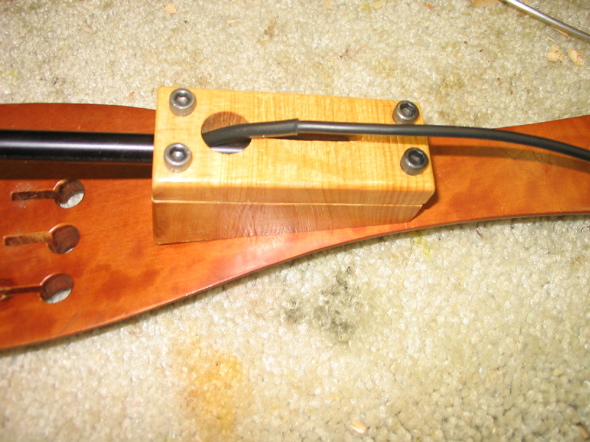
BransettersMicMountJig1.jpg


[Invalid or Expired Link Removed]

Here is the one in metal with the jackplate.

[Invalid or Expired Link Removed]

Invalid Link Removed

Invalid Link Removed

 
Sorry, quick side track. I read in Bass Gutar Magazine that John Patittuci uses the Neumann KM 184 live. A quick glance over the Neumann webpage would sugeest that 185 has better off-axis sound rejection...

Is the consensus that the KM185 is better than the 184 for live bass use?

During a masterclass in 2004, Patittuci mentioned that he uses a 185, which motivated me to buy one as well. The 185, being a supercardioid, has better of-axis rejection than a cardioid such as the 184, although it does have a "lobe" at the rear. I have been using this mic successfully for many years now, and it certainly works better for amplification than a 184, but I think the DPA will serve me even better. Next friday I will compare the Neumann to the DPA and will report here.

Best,
Vincent
 
Phil, perhaps you can help. I think I must be missing something really obvious about Bob's mounts.

Both assemblies look great. But, going from the tail piece out all the way out to (almost) under the finger board looks like a lot of moment arm hung off the tail piece. I seems like it would have been a simpler and more robust installation to simply tack the pickup under the finger board and run the wire back to the tail piece?

What am I missing? You can laugh at me if you like, I'm used to it ;)
 
Phil, perhaps you can help. I think I must be missing something really obvious about Bob's mounts.

Both assemblies look great. But, going from the tail piece out all the way out to (almost) under the finger board looks like a lot of moment arm hung off the tail piece. I seems like it would have been a simpler and more robust installation to simply tack the pickup under the finger board and run the wire back to the tail piece?

What am I missing? You can laugh at me if you like, I'm used to it ;)
Usually you don't want stuff that heavy hanging on your fingerboard. In fact I wouldn't hang anything on my fingerboard. Moreover running a wire from the fingerboard is problematic. You don't want it crossing the top and creating vibration. You want to keep it out of the way of the bow and the string excursion, but there is nothing to tie it to. It's just suspended under tension below the strings waiting to bang into something.

With his mike placement the bridge is holding the mic as it passes across the top and the cable is down below the TP so it avoids rattle on the top. The mic is stiff enough to not bang into the top or rattle on the bridge and it is well out of the way of the bow or string excursion.

I don't like bolting stuff to the fingerboard or the TP but if I have to bolt it to something I'd rather use the TP than the fingerboard.
 
i suspect it would be reasonably easy to bolt a stack of large washers into the top of the F hole, and clip the violin mount there (I'm thinking a large plastic automotive bolt and various rubber/fiber/plastic washers to create a bit of a lip to clip the thing to).

be that as it may, i do think you should score one of these mics just to play with. it is rather amazing how dramatically you can change/tweak the sound by moving things just a little bit ... whether in general location, or distance from top, playing with the proximity effect. they don't call these suckers shotguns for nothing ... the target sweet spot it's finding is *very* tight.

i think they should've given dpa the nobel prize for dreaming up this baby.

jeff.

Usually you don't want stuff that heavy hanging on your fingerboard. In fact I wouldn't hang anything on my fingerboard. Moreover running a wire from the fingerboard is problematic. You don't want it crossing the top and creating vibration. You want to keep it out of the way of the bow and the string excursion, but there is nothing to tie it to. It's just suspended under tension below the strings waiting to bang into something.

With his mike placement the bridge is holding the mic as it passes across the top and the cable is down below the TP so it avoids rattle on the top. The mic is stiff enough to not bang into the top or rattle on the bridge and it is well out of the way of the bow or string excursion.

I don't like bolting stuff to the fingerboard or the TP but if I have to bolt it to something I'd rather use the TP than the fingerboard.
 
which is why i'm content with mine sitting in the afterlength, just north of the tailpiece. my point, which obviously i made poorly, is that you can get lots of tonal options from places other than the holy grail of above the bridge ...

jeff.

+1 Although there are lots of places you can attach a mic to the bass it's probably better to try and avoid as many things as possible, like the bridge and top. The Tailpiece is one of the easier places to put the mount. Personally, I try avoid the f holes as well.

Ric
 
which is why i'm content with mine sitting in the afterlength, just north of the tailpiece. my point, which obviously i made poorly, is that you can get lots of tonal options from places other than the holy grail of above the bridge ...

jeff.

Jeff,
I've got some time today to speramint with placement. Since this mic is totally different than the AMT. I fool around with it a little, and see what shakes out.

Ric
 
And got me a DPA 4099! I had the chance to compare the km185 with the DPA, and almost immediately it became apparent that, for live double bass amplification, the DPA is so much more convenient. The sound had much more clarity, while at the same time sounding full, with more than enough lows (I used the xlr adapter without the low cut filter). Also, I was able to achieve far more volume before feedback. I even preferred the DPA when I compared recordings of the two mics. So, the conclusion was quickly drawn. Now I am the proud owner of a DPA!

BTW: I originally planned on getting the guitar version, but the shop dit not have it in stock. I was given a violin version to experiment with, and I was able to find the perfect spot with this clamp. Thus, I decided to keep the violin one, especially since I would like to have as small a clamp as possible.

Cheers,
Vincent
 
BTW: I originally planned on getting the guitar version, but the shop dit not have it in stock. I was given a violin version to experiment with, and I was able to find the perfect spot with this clamp. Thus, I decided to keep the violin one, especially since I would like to have as small a clamp as possible.

Cheers,
Vincent
Can you shoot a pic for us?
 
And got me a DPA 4099! I had the chance to compare the km185 with the DPA, and almost immediately it became apparent that, for live double bass amplification, the DPA is so much more convenient. The sound had much more clarity, while at the same time sounding full, with more than enough lows (I used the xlr adapter without the low cut filter). Also, I was able to achieve far more volume before feedback. I even preferred the DPA when I compared recordings of the two mics. So, the conclusion was quickly drawn. Now I am the proud owner of a DPA!

BTW: I originally planned on getting the guitar version, but the shop dit not have it in stock. I was given a violin version to experiment with, and I was able to find the perfect spot with this clamp. Thus, I decided to keep the violin one, especially since I would like to have as small a clamp as possible.

Cheers,
Vincent

This is starting to sound inevitable. Where/how did you end up mounting the violin version? i suspect that I'd be able to find a non-intrusive spot on my bridge or afterlength for this, but curious what you ended up doing.
 
And got me a DPA 4099! I had the chance to compare the km185 with the DPA, and almost immediately it became apparent that, for live double bass amplification, the DPA is so much more convenient. The sound had much more clarity, while at the same time sounding full, with more than enough lows (I used the xlr adapter without the low cut filter). Also, I was able to achieve far more volume before feedback. I even preferred the DPA when I compared recordings of the two mics. So, the conclusion was quickly drawn. Now I am the proud owner of a DPA!


Cheers,
Vincent

+1

Working with both the DPA and the AMT today through a set of headphones into a Headway EDB-1 the difference between the two is very striking. While the tone quality of the AMT is good the DPA is outstanding, even at fairly long distances from the top of the bass.
Using a bow with this mic is an absolute joy and I have Spirocore Weich Strings on my bass. I'll be in a recording studio next weekend, perhaps they will let me use it for the session.

Ric
 
Hey all, for those who posted recordings, they sound really nice. Only one had a band in it though. How is either the DPA or AMT in regards to sound isolation?

Will people with either mic could do the following recipe? (goofy writing will follow)

ingredients:
1 double bass
1 DPA or AMT going to recorder
1 vacuum cleaner, or other loud noisy sound. (Could be another musician! or a stereo system playing a CD)
1 room recorder (omni mic into another channel of above recorder, or those pocket digital stereo recorders working separately)

Directions:
Place noise machine drummer distance away from bass
start recorders
start noise machines
play bass
stop

Separate the tracks into separate files, normalize volume and post.


Essentially, I'd like to hear the room sound of the bass plus noise machine, to hear the 'live sound', and then compare it to the DPA/AMT recording, to hear how well the mic and mic placement isolated the double bass away from the noise.

I'm sure other people would like to hear this too.

Whenever you have time. Using a noise machine means not having to involve other musicians in the experiment. Just don't put the room control mic next to the noise machine, keep it in the middle.

thank you very much for this service.
 
here's the deal ... you can virtually snap your fingers next to the mic and not pick it up ... the beauty of it is that it is *that* directional. it gives you the true luxury of setting the mic further from the top of the bass, so you really are getting the sound of "your bass, only louder" ... take a look at the other mics that dpa makes, not to mention the prices. these guys know their stuff. frankly, from a marketing standpoint it's brilliant: make *the* killer acoustic instrument mic, price it at an affordable (for them) pricepoint, then ... cash out.

i got the flat module the other day and, yeah, that's the way to do it, score one of fdeck's boxes or whatever and use your own HPF to control the low end and then just enjoy. It really is worth every penny. think of it as a few bad string experiments.

jeff.

Hey all, for those who posted recordings, they sound really nice. Only one had a band in it though. How is either the DPA or AMT in regards to sound isolation?

Will people with either mic could do the following recipe? (goofy writing will follow)

ingredients:
1 double bass
1 DPA or AMT going to recorder
1 vacuum cleaner, or other loud noisy sound. (Could be another musician! or a stereo system playing a CD)
1 room recorder (omni mic into another channel of above recorder, or those pocket digital stereo recorders working separately)

Directions:
Place noise machine drummer distance away from bass
start recorders
start noise machines
play bass
stop

Separate the tracks into separate files, normalize volume and post.


Essentially, I'd like to hear the room sound of the bass plus noise machine, to hear the 'live sound', and then compare it to the DPA/AMT recording, to hear how well the mic and mic placement isolated the double bass away from the noise.

I'm sure other people would like to hear this too.

Whenever you have time. Using a noise machine means not having to involve other musicians in the experiment. Just don't put the room control mic next to the noise machine, keep it in the middle.

thank you very much for this service.
 
Wow.. it's already 10+ pages of DPA 4099.

An engineer recommended this mic to me when Dianne Reeves came into town and the bassist used my bass for the concert.
I showed the engineer my Yamahiko pickup and told him the high fidelity i could get out of it. He then showed me the 4099 but using a trumpet/saxophone mount, he clamp it on one side of the f-hole with it. It seems to work much better than most of the pics i see in this thread. I'm getting mine soon and will post a pic of it with the sax trumpet mount. There isn't much marring of the finish, but i can't give a 100% guarantee on all basses.
 
This is starting to sound inevitable. Where/how did you end up mounting the violin version? i suspect that I'd be able to find a non-intrusive spot on my bridge or afterlength for this, but curious what you ended up doing.

Invalid Link Removed is the way I mount the mic. It has no audible effects on the sound of the bass.

Cheers,
Vincent