• TalkBass has been independent since 1998. Add your voice.
    Create a free account to reply to discussions, view embedded media, and browse with fewer display ads.
    Join freeLog in
    Want zero display ads or expanded classifieds tools? Compare plans.

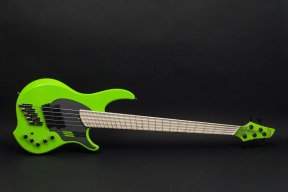
Dual density body ala Dingwall

Its amazing to me how often tones are described in visual language that more or less corresponds to how the wood looks. Dark, light, bright.

Ebony is awfully bright. Or shiny when sanded and polished. Maple is light. Rosewood has a dark tone. Purpleheart has a dark earthy tone, a bit ruddy,which make a good rock tone, but still is pretty good for blues.

Builders may or may not recognize a difference in "tonewoods" but since their customers do, you can bet that anyone who wants to cash a check will certainly recognize it too. Emperors new clothes and all of that. I don't mean to imply judgement in this case. Any time you engage in customer service, your own opinions shouldn't compromise your professionalism.

I respect everyone's opinions in the tone debate because I don't think anyone has put together a really scientific study about the matter that makes any sense.

The science does say, however, that you hear what you see. I am tonewood agnostic. When I build, and when I plan future builds, I only consider the aesthetics of the thing.
 
Blue Blood, without reading on the topic at length and becoming familiar with the salient points of the argument, you're starting to sound a little like a religious fundamentalist here with the amount of suspension of disbelief. Remember we are not all a bunch of "dudes" talking on the internets - many of us are well-versed in the scientific method. I typically encourage those who take one solid position so staunchly over the other to read up on cognitive bias - as it's the factor in the tonewood debate that has the greatest amount of gold standard peer reviewed research behind it...
 
Xaxxat, I feel a little bad that you've asked about the A string and glue line over and over. I can't really tell if you're truly interested or just poking fun but I'll assume the best.

With regard to a dual density or dual species body the A sounds and responds unremarkably. It just fits. You'd also asked about the b being affected more than the e. I'd have to say yes because the tone progresses evenly across the strings, not abruptly at the glue line.

If your question is more along the lines of how does the glue line affect the string above it in general. Then I'd say as long as the glue is good quality and it's a nice, tight joint, the effect on the string would be too small to be meaningful.
 
  • Like
Reactions: 5StringPocket
If Leland Sklar, who's recorded on over 2500 records (I would believe that he's probably recorded more than the combined total of most of TalkBass) digs it, then what the f***else really matters?

Sheldon builds some amazing instruments. I don't believe tonewood hype, but Sheldon does what he does and puts out some high quality bass guitars.

How many of you have played a Dingwall?
 
Ok. Several things: wood changes tone. Any material changes the frequency response of a flat signal sent through it. This process is described by a materials damping factor, which is determined by the speed of sound in the material, which is a product of stiffness and, to a lesser degree, grain structure.
In the electric instrument the tonal change caused by the wood is brought to the fore in to ways: synthesising new or reducing the harmonic content of the actual string, abd by vibrating the pickup coils around the magnet, creating what is in effect a dynamic microphone. Note that all these parameters can be QUANTIFIED. The myth of wood not shaping tone stems from two things: pickup potting, and most bass players lack of interest in the field of engineering acoustics.

and to the guy who noted that spruce was visually unexciting, it is heard again and again how many more beautifully sounding guitars that could be made if people were willing to look past wide grain and 4piece tops. Also some manufacturers have (finally) decided to grade spruce on stiffness and not on grain. Aesthetics rule the acoustic communoty too.
on that note there is a certain marketing going on in the "tonewood with nice looks department". Some builders would have you believe maple is the lowest damping neck wood available. Bubinga, douglas fir, ovangkol, silver birch, australian blackwood, mountain ash etc. are all lower damping. Which of course helps confuse players ob the subject.
still no excuse for unscientifically claiming that "wood has no effect" in the name of science, based on arguments falsifiable by science
 
The reason why nobody has put research into this is that the mechanics of it are on a pretty low level, it's the psychoacoustic response end result that's interesting. Which is why people tap the wood, figure out where in the guitar it qould fit nicely, and think about how the combination worked, rather then sit and calculate the amount of vibration transfer to the pickups this wood combination will theoretically output, how it will be damped, and so forth.
 
Ok. Several things: wood changes tone. Any material changes the frequency response of a flat signal sent through it. This process is described by a materials damping factor, which is determined by the speed of sound in the material, which is a product of stiffness and, to a lesser degree, grain structure.
In the electric instrument the tonal change caused by the wood is brought to the fore in to ways: synthesising new or reducing the harmonic content of the actual string, abd by vibrating the pickup coils around the magnet, creating what is in effect a dynamic microphone. Note that all these parameters can be QUANTIFIED. The myth of wood not shaping tone stems from two things: pickup potting, and most bass players lack of interest in the field of engineering acoustics.

and to the guy who noted that spruce was visually unexciting, it is heard again and again how many more beautifully sounding guitars that could be made if people were willing to look past wide grain and 4piece tops. Also some manufacturers have (finally) decided to grade spruce on stiffness and not on grain. Aesthetics rule the acoustic communoty too.
on that note there is a certain marketing going on in the "tonewood with nice looks department". Some builders would have you believe maple is the lowest damping neck wood available. Bubinga, douglas fir, ovangkol, silver birch, australian blackwood, mountain ash etc. are all lower damping. Which of course helps confuse players ob the subject.
still no excuse for unscientifically claiming that "wood has no effect" in the name of science, based on arguments falsifiable by science

Of course everything on a bass makes a difference. The wood vibrates with the strings and the strings are affected as such. The question is, how much does it actually affect your tone? Would two identical basses, except wood, sound drastically different from eachother?

Personally I think that tone wood has an effect, but that strings and pups change tone much more than wood. Do you happen to know of any studies on this?
 
For proper scientific evidence look up gerald marleaux's columns in baagearmag 9 and 10. It's mostly a study on construction types, but in it are included many explanations of what actually happens in an electrical instrument.
 
It would be an interesting experiment to build say 10 identical basses (a feat in itself) using different woods and fretboard material, with all the same strings, hardware and electronics, and feed the output to a TEF analyzer (http://www.gold-line.com/tef/t-rta.htm) with a waterfall graph showing the result.

In the 45 years I've been playing bass, I've come to prefer specific woods for my instrument bodies and fretboards, simply because of the resulting sound and feel of those basses that feature those woods. On the other hand, I've enjoyed playing and hearing some basses that do not conform to my preferences. I personally would not claim that the species of wood has no effect on the resulting sound, based on my personal experience. However, I also understand that my opinion on the matter is purely subjective, and very much non-scientific.

Only a test like I've described above would convince me that certain woods do, or do not, have an impact on the resulting sound, as a scientific fact. Perhaps a top luthier would take this as a challenge, to once and for all, provide a scientific method and pear reviewed study (with the members of this forum as the peer reviewers :P ) to prove whether or not body and fretboard wood effect resulting sound, and exactly how the resulting sound is (or is not) effected.

 
Northern Ash on the bass side adds great sustain, clarity and punch to the B and E strings. Alder on the treble side keeps the G and D strings nice and warm sounding.

I don't buy it. The body is not going to resonate differently on each side, in any significant way. Rather, the different woods are going to combine into one material of particular resonant qualities.

I know that if you tap on a block of wood, you will get a different tone from the tangential grain than the radial grain, but that sort of stuff aside, this dual density concept seems no different than capping a body with a thick laminate top, to impart a certain tonal flavor.
 
I'm not sure why some of you feel that just because there is no scientific proof backing the argument that wood has a major impact on tone that it somehow proves your theory that wood has no effect.
 
Wow, you guys are a tough crowd;)

I don't know how you'd prove or disprove this claim scientifically except through experience with as large a sample group as possible.

Within this particular model family we've built a hundred or so with northern ash bodies, several hundred swamp ash, a hundred or so northern ash/alder. I feel pretty comfortable with my understanding of which variables make what changes - again, within this model family. Dual density and dual species bodies do what we say they do. No more, no less, no BS.

I love your basses also and most build touches make sense in a scientific way: fanned fret for tension on lower strings, nifty bridge saddles that look cool and adjust well. And I don't doubt that body wood makes a tiny difference to the tone (although I doubt many will hear the difference amplified) but not to the extreme that your marketing guys on the website are claiming ;)
 
It would be an interesting experiment to build say 10 identical basses (a feat in itself) using different woods and fretboard material, with all the same strings, hardware and electronics, and feed the output to a TEF analyzer (http://www.gold-line.com/tef/t-rta.htm) with a waterfall graph showing the result.

In the 45 years I've been playing bass, I've come to prefer specific woods for my instrument bodies and fretboards, simply because of the resulting sound and feel of those basses that feature those woods. On the other hand, I've enjoyed playing and hearing some basses that do not conform to my preferences. I personally would not claim that the species of wood has no effect on the resulting sound, based on my personal experience. However, I also understand that my opinion on the matter is purely subjective, and very much non-scientific.

Only a test like I've described above would convince me that certain woods do, or do not, have an impact on the resulting sound, as a scientific fact. Perhaps a top luthier would take this as a challenge, to once and for all, provide a scientific method and pear reviewed study (with the members of this forum as the peer reviewers :P ) to prove whether or not body and fretboard wood effect resulting sound, and exactly how the resulting sound is (or is not) effected.


I think we have all always wanted to see such a test but I would bet if you built ten basses exactly the same they would sound different. Especially if done by hand. I also imagine if you did ten soundclips from the same bass, posted them on TB and asked for opinions at least some people would insist they heard a difference.

I remember an old interview with Dimebag Darrel and he owned 3 Dean's right off the line next to each other. He was convinced each one had a completely different sound so each was worth owning. They were line guitars so they were all built to identical specs.
 
Well, since it looks like nobody is going to offer up any scientific proof that wood doesn't matter, let's go in a slightly different direction.

For those who say wood doesn't matter but believe the fingerboard makes a big difference in tone, which I believe it does as well, why do you think it makes a difference? I've often wondered if the wood isn't so much resonating the tone back into the strings as it is reflecting it back into them, sort of like a mirror. Maybe as the string is vibrating, the frequencies reflect off the fingerboard (and maybe the body) which is also resonating, causing certain frequencies to cancel out others, giving off a specific tone. With that idea in mind, perhaps the tone of the different fingerboard materials, which all "reflect" differently based on density and compositional make-up, is the reason for tonal difference. It seems like an out there theory but might be worth discussing and expanding upon.
 
So if someone claims wood doesn't make a difference for the tone of an electric instrument it is fact until someone disproves it? I don't think so. It's two opposing claims, neither of which has evidence to prove which is correct.
 
Your strawman is that woods have NO effect on tone.

I don't see anyone saying that but you.

You've made specific claims about specific woods having specific effects on tone.

It's up to you to prove those claims.

Antedotes are not scientific evidence...
 
Building off of the looks standpoint, maple is a lighter color than rosewood. People also say maple is brighter sounding. I see a correlation. Mahogany is mellow sounding and dark colored. Ash and alder are brighter colored and therefore must be brighter sounding! duh! And because a famous player or luthier (not saying those people aren't amazing at what they do, because they ARE, but that doesn't mean what they say is 100% fact) says so, it must be a fact!

Now lets put it this way

My red car also goes faster than a brown car of the same model, now I just need a famous Nascar driver to repeat what I said and 70% of the racecar enthusiasts will believe it to be true!

For the record I don't believe in tonewoods, but until someone can prove me wrong with 100% fact I don't think anyone has the "right" to say they are right on either side.