
I currently have the Ernie balls on a bass but was wondering if anyone has tried both and what the differences in tone and string tension is with the Dunlop's of the same gauge 45-105?

TalkBass has been independent since 1998. Add your voice.
Create a free account to reply to discussions, view embedded media, and browse with fewer display ads.
Join free Log in
Want zero display ads or expanded classifieds tools? Compare plans.



Just curious... What was it about the Dunlop that didn't work for you?Deposited the Dunlops in the D'Addario recycle bin at my shop after a year's trial...
Just curious... What was it about the Dunlop that didn't work for you?

Interesting... Dunlop Flats were on my shopping list for a few years, until I started reading about the intonation issues. Meanwhile, their prices kept going up and up... I don't think I want to be spending $65 USD on a set at this point.The chief problem — installed medium scale Dunlops on this short scale bass —
View attachment 6988572
where it is easy to see the floating bridge makes it impossible to intonate the bass correctly because the speaking length of the G needs to be much longer than normal. Certainly do-able with a fixed bridge. Not this one! And the bridge wound up even more cockeyed than in this early record. Still off. Never fixed.
Forget next month... Why wait to do the right thing? Just reinstalled the same set that was on this bass for 9 mths previously.EB Group IV will be going back on my P bass next month.
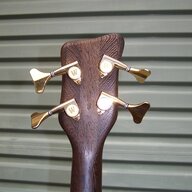



This is exactly my experience with the EB Group IV. No thuddy E and no twangy G... Nice and even all across four strings both in tone and feel. Going from the GHS Pressurewound 40-54-76-96 to the Group IV (40-60-70-95), hardly any setup tweaks needed, except for very slight intonation adjustments.I've had a set of EB Group IVs on my Ibanez RKB900 for about 6 months.... The light gauge feels great, all 4 strings sounded exactly the same right out of the package, easy to intonate, good balance of clarity, detail & warmth...
Yes! And as I mentioned, the B string in that long-scale product line is very well-matched to the set for 5-stringers.This is exactly my experience with the EB Group IV. No thuddy E and no twangy G... Nice and even all across four strings both in tone and feel. Going from the GHS Pressurewound 40-54-76-96 to the Group IV (40-60-70-95), hardly any setup tweaks needed, except for very slight intonation adjustments.
I used live and die by tension figures, going on the wrong notion that a set of strings must be balanced in tension to FEEL balanced or SOUND balanced. Then I learned through trials and errors that a set of strings didn't necessarily have to be perfectly balanced in tension (as in pulling weight) to FEEL or SOUND balanced.In the knowledge of EB Group IV's pulling tension figures posted by @michael_t , I'm unable to feel a significant difference between plucking the "looser" A string and plucking the other three. That 10 pounds (or so) fewer pounds of pulling tension isn't enough to trogger any technique alarms... ...Pulling tension figures don't tell me how a set feels to play. They do tell me what to expect doing set up...


