• TalkBass has been independent since 1998. Add your voice.
    Create a free account to reply to discussions, view embedded media, and browse with fewer display ads.
    Join freeLog in
    Want zero display ads or expanded classifieds tools? Compare plans.

Dunwich Amplification General Discussion

I'd think twice about it. Selling Dunwich is easy money, but you'll likely regret it later. Just sayin'
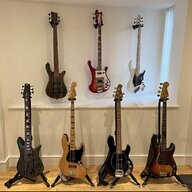
I know… I’ve done this before and regretted it. But, they have been sitting on my shelf for more than a year and I’m not using them. I’m a player, not a collector and I want a new bass guitar. So, I’m selling to fund the purchase of a 70’s Rickenbacker, something I’ve been wanting for a while. Oh, and all my extra money goes to my ex wife.

 
I know… I’ve done this before and regretted it. But, they have been sitting on my shelf for more than a year and I’m not using them. I’m a player, not a collector and I want a new bass guitar. So, I’m selling to fund the purchase of a 70’s Rickenbacker, something I’ve been wanting for a while. Oh, and all my extra money goes to my ex wife.
It feels wrong liking the whole comment so please consider this a like in respect of everything up to “Oh”.

I hope you get that Rick!
 
Well, that sale didn’t go well. I decided to cancel the sale due to the feeding frenzy over the VT and my incompetence in managing the feeding frenzy.

I guess I missed it...disregard my PM asking what's for sale...I'm slow to these things (but still jump before reading the rest of the thread :) )

I get it. I have been purging some stuff that isn't getting much love in favor of bringing in other things that catch my eye and it's a very worthwhile endeavor to turn things you don't care about into things that pique your interest.
 
I gotta say the Parabellum v2 is fantastic. I said initially I liked but didn't love it, and I guess that's still true because the only pedal I love is the one my wife built for me, but it's just got the most pleasing, musical breakup. You have to crank the lows to keep them there but there's enough reach to do it. The way it transitions from the warmer clipping in the lows to the more cutting in the highs isn't something I'd probably design myself and I didn't know I was looking for it, but when I briefly had it off my board, I missed it.
 
Spending a bit more time exploring the Witchfinder and finding settings I like. I decided to work on sounds with lots of clean blend and the “no” clipping diode setting. Turns out you really need to start turning up the output to keep the ratio in balance, but the results sounded pretty good with my 18” scale bass. I’ll play some other basses through it this weekend, but the pedal has really started to grow on me.
 
It’s NPD today! It’s not the best picture but it gives a decent idea of the finish. I’ve got a full day of work and family visiting this weekend so I’m not sure when I’ll get a chance to really dig into this but I played it for about ten minutes earlier and everything rattled, so that’s a good sign. Any suggested settings welcome!
A4A009A0-A0FF-4B79-9244-C67186715A1B.jpeg
 
It’s NPD today! It’s not the best picture but it gives a decent idea of the finish. I’ve got a full day of work and family visiting this weekend so I’m not sure when I’ll get a chance to really dig into this but I played it for about ten minutes earlier and everything rattled, so that’s a good sign. Any suggested settings welcome!
View attachment 4828947


From Dunwich: Info From the Dunwich Amps Website –
“The Dunwich DA-120 Overdrive is a MOSFET Emulation of a boosted/overdriven amp with the overall block diagram of the design taken from my DA120 amp (which in turn was based on the 70s GT120). The idea with this pedal was to get the low-medium gain tones and texture of the amp and also achieve higher gain sounds of the amp being boosted.
The total amount of gain can be controlled using Boost, Drive, and Gain controls. Although each controls gain, they function differently and affect the gain at different locations in the circuit. The pedal shines best when a little bit of amp gain is combined with the gain from the pedal.
Frequency shaping is achieved using the Depth, Bass and Treble controls. These controls mirror those found on the DA120 amp where the Bass and Treble are a passive EQ (bax/james) and the Depth controls the RC low end cutoff early in the pedal.
The pedal can be run off a 9V center negative supply but if desired it can run up to 18V (center negative) for additional headroom and output swing.”
More Info from Nick At Dunwich
“It’s not exactly the preamp of a GT120; it’s more like an emulation of a pedal hitting a GT120 and it does have a phase invertor and power amp emulation section inside it as well. It’s got a lot more gain on tap than what you would get out of just a GT120.
In general, the pedal is designed to sound like Sleep’s Dopesmoker, or like the guys from Windhand, or any band who drives the front end of a GT120 with another pedal to achieve a really saturated sound.
It’s not really designed to stack with other pedals
but that would depend upon how much gain you are using on it. You can dial it very clean if you want and it might be better with other pedals. I only use it into my super low gain amp with 150W on tap.
I would hazard to guess that none of the Matamp based pedals are made to go into a loop. To my understanding the loop is really only for time based effects (verb, delay, modulation), since you want to get all your clipping in before you add those effects (in some people’s ideal world).”
Circuit & Controls
The DA120 Overdrive circuit design follows the basic block diagram of a 70’s Matamp GT120, with the addition of a Post Phase-Invertor Master Volume followed by a midrange Boost:
Gain Stage – Depth – Drive – Gain (called Volume on a GT120) – Gain Stage – EQ – PI Driver – PI – Master – Boost (~700Hz)
Depth is similar to the original Depth control on the GT120 but it has different capacitor values. The control basically selects from among 6 different cap values that are connected to the output of first gain stage and those caps from a high pass filter with the circuitry they are connected to. Small cap value, higher cutoff frequency, less bass; large cap value, lower cutoff frequency, more bass.
Gain and Drive control the actual gain levels at two different points in the circuit in two different ways:
Gain is basically equivalent to the Volume control on the original GT-120, it is controlling the amplitude of the signal from the output of the first gain stage into the input of the second gain stage.
Drive sets the gain or amplification factor of the first gain stage from ~3dB to 30dB in total range.
Bass and Treble are identical to the original EQ on the GT120; it’s a passive James/Baxandall EQ which are ~shelf filters.
Master occurs after the Phase Invertor / Power Amp
 
Not entirely Dunwich, but I recently got a Frost Giant Bass Mountain pedal. According to an old IG (maybe FB?) post, Nick helped with the blend circuit on it. I'm really digging it so far, and it only makes me want a Volt Thrower or Super Volt Thrower even more...

True, I helped Eric with that blend idea. I’ve worked with Eric on a few designs.