

Enjoy the benefits of a premium membership!
Upgrade Account
-
TalkBass has been independent since 1998. Add your voice.
Create a free account to reply to discussions, view embedded media, and browse with fewer display ads.
Join free Log in
Want zero display ads or expanded classifieds tools? Compare plans.
You are using an out of date browser. It may not display this or other websites correctly.
You should upgrade or use an alternative browser.
You should upgrade or use an alternative browser.
Eastwood "The Sandman" 2-String Bass
- Thread starter who
- Start date
More options
Who Replied?
Just stumbled on this post: I made this last summer, from a Westone Spectrum LX fretless neck.
The "YF23" 3-string Fretless Bass!!!
This is the prototype, made using MDF body.....but I'm gonna make the "real" one with a nice piece of timber!!
Plan is to shave about 3mm off each side of the neck and reduce the string spacing a bit, too.

The "YF23" 3-string Fretless Bass!!!
This is the prototype, made using MDF body.....but I'm gonna make the "real" one with a nice piece of timber!!
Plan is to shave about 3mm off each side of the neck and reduce the string spacing a bit, too.
Last edited:


Here's are a couple of old threads regarding strings on a Sandman style slide bass:
and
tl;dr: Flatwound GUITAR strings turned out to be the best solution for me; rounds rattle too much with a slide, flats sound wrong, All Wrong. I ended up using D'Addario flat wound guitar strings, CG075 and CG056, tuned D and A respectively, on my diy two string slide bass.
I'm almost embarrassed to ask this, but here goes...
So I play 2-string bass with a slide on more than a songs. (Super-simple rudimentary basslines in a sloppy noisy rock band.) I recently upgraded my bass and want to switch out the cheap roundwound strings that came on it to something else. (The "neck noise" of the slide is just too much, plus I just don't like the metallic highs.) I had flats on my old Squier p-bass and they sounded good with the slide, but I can't for the life of me remember what brand they are.
I'm leaning towards flats, but also thinking of trying out tape-wound...
So I play 2-string bass with a slide on more than a songs. (Super-simple rudimentary basslines in a sloppy noisy rock band.) I recently upgraded my bass and want to switch out the cheap roundwound strings that came on it to something else. (The "neck noise" of the slide is just too much, plus I just don't like the metallic highs.) I had flats on my old Squier p-bass and they sounded good with the slide, but I can't for the life of me remember what brand they are.
I'm leaning towards flats, but also thinking of trying out tape-wound...
- H-S
- flat wound short scale strings tape wound
- Replies: 18
- Forum: Strings [BG]

Hello all, I am having someone make me a two string bass for a Mark Sandman type of bass.
I was wondering what gauge of string should I use? I head he used the A and D sting.
Since I will be playing with a slide primarily I was wondering also what type of string anyone would recomend
Thanks!
C.
I was wondering what gauge of string should I use? I head he used the A and D sting.
Since I will be playing with a slide primarily I was wondering also what type of string anyone would recomend
Thanks!
C.
- aliveinvain
- 2 strings mark sandman morphine slide bass
- Replies: 53
- Forum: Strings [BG]
tl;dr: Flatwound GUITAR strings turned out to be the best solution for me; rounds rattle too much with a slide, flats sound wrong, All Wrong. I ended up using D'Addario flat wound guitar strings, CG075 and CG056, tuned D and A respectively, on my diy two string slide bass.

I made my own sandman bass out of a squier modified jag and a slip on steel nut for sliding. It was awesome for my short-lived morphine tribute band. The tuning is D A. Gonna be really hard not to grab one of these!!!!
Last edited:

And went through with it:Somewhat related I have long been planning to raise the nut of my 4 string 28.6" scale Mikro Bass, and turn it into a slide bass.
And I think I am going to go through with it next week.
Equipping it with Elixir guitar stings of the gauges .062 - .032 - .042 - .036 and tune it C# (as a baritone tuning) - C# (as an octave higher) - G# - B, for an open Minor tuning.
And just looked it up, seems like Sandman most of the time used an open D tuning, that is like the high D string of a 4 string bass in regular E standard tuning, and then the fifth above that A, like the low A on a guitar (though he did use other tunings as well): Mobiusbandwidth.com Morphine tablature transcriptions
So as I questioned earlier, the standard E - A tuning and appropriate strings for that tuning that the Eastwood comes with, according to the specs they provided, is not authentic to what Sandmand actually played.
Strung with Elxir Nanoweb guitar strings of the gauges .068 - .046 - .036 - .028, and tuned B - F# - A# - D#.
As I also pointed out.Should be tuned in a 5th, not E and A as specified. Playing 4ths with a slide won't sound very good. Might need to get a different size string for the B.
It says it's just a mock-up but they'll have stock in a few days.
Also the tuning Sandman utilized most was with a D, as in same as the high D string on a 4 string bass in E standard tuning, as the lowest note, that is tuned D - A, A as the same as the low A string on a guitar tuned in E standard tuning.
I also somehow doubt Eastwood actually raised the nut.
This very much seems like a standard bass, just with just 2 strings, that looks somewhat like the one he played, rather than actually also functioning as it did.

And went through with it:
View attachment 7290881
View attachment 7290882
View attachment 7290883
View attachment 7290884View attachment 7290885
Strung with Elxir Nanoweb guitar strings of the gauges .068 - .046 - .036 - .028, and tuned B - F# - A# - D#.
Seems interesting. I've thought about doing that a few times. I will say that if I've practiced, which I haven't lately, and use a light glass slide I can play slide on guitar without having to raise the string or nut height. Unless you want to play lap style with a heavy bar you can probably lower the action down and play slide and finger style.
Well, there's a few aspects that makes it much easier to do slide on this bass with nut action raised, for one with thicker, lower tuned, strings you need to put a bit more weight into the slide (it is much harder to get a great slide tone out of a .068 gauge low B string, than it is a gauge .046 low E string), and that does become an issue at the frets closest to the nut, if cut properly for regular fretted play (no matter how high you raise the action at the bridge), then there is the aspect of tension on this particular instrument, it's a 28.6" scale instrument, which means tension is lower than on a 34" or even 30" scale relatively to string gauge, and simply going up in gauge is not a viable solution as that affects tone negatively, especially using a slide on the lower tuned strings, and again referring to the issue with sliding near the nut and at the first couple of frets.Seems interesting. I've thought about doing that a few times. I will say that if I've practiced, which I haven't lately, and use a light glass slide I can play slide on guitar without having to raise the string or nut height. Unless you want to play lap style with a heavy bar you can probably lower the action down and play slide and finger style.
And yes, I'd like to be able to dig in with the slide and get a fat slide tone, and utilize the slide to bend the strings, like if I had a wammy bar/vibrato arm installed.
If you are able to do without raising the nut that is great, but I prefer being able to play freely without not constantly having to be weary of hitting the first couple of frets and induce unwanted clank.
I think how much you are going to use it probably has a say too weather you want to really dedicate a whole instrument to it or not.
If you are just going to play 5 min slide noodles every once in a blue moon for the giggles when practicing alone it is properly not worth it, but if you actually plan to use it for compositions, recordings and/or live performances it might be worth considering.
Finally, even if I know many people denies this, higher string action does actually affect the tone.
It might just be due to the higher break angle at nut and bridge, but the result is that same non the less, you get a bigger clearer tone from it, which, for me at least, is particularly desirable for slide.
Last edited:
Raised to about 6mm (~0.24") over the first fret, with a piece of wood cut to size under the nut, and then going ever so slightly upwards, towards the bridge at a quite low angle.And went through with it:
View attachment 7290881
View attachment 7290882
View attachment 7290883
View attachment 7290884View attachment 7290885
Strung with Elxir Nanoweb guitar strings of the gauges .068 - .046 - .036 - .028, and tuned B - F# - A# - D#.
Equipped with a single bridge EMG Geezer Butler J pickup, from the P/J set.
And just got a proper ceramic slide tube, and it sounds awesome!
Just as awesome as I imagined.
Will require some practice though, with 4 strings and this tuning.
Main problem actually not being so much the tuning, which offers some great opportunities and options both for melodies and 2 or 3 note harmonies, but rattling noises from strings that is not supposed to be played, so will have to learn to mute and to be more precise with the slide.
In that aspect I understand the appeal of just having 2 strings.
Last edited:
Just recorded a bit on my "new" converted slide bass, mind I need serious practice, as it's totally different instrument in a totally different tuning, it's more the sound than what I play here:Raised to about 6mm (~0.24") over the first fret, with a piece of wood cut to size under the nut, and then going ever so slightly upwards, towards the bridge at a quite low angle.
Equipped with a single bridge EMG Geezer Butler J pickup, from the P/J set.
And just got a proper ceramic slide tube, and it sounds awesome!
Just as awesome as I imagined.
Will require some practice though, with 4 strings and this tuning.
Main problem actually not being so much the tuning, which offers some great opportunities and options both for melodies and 2 or 3 note harmonies, but rattling noises from strings that is not supposed to be played, so will have to learn to mute and to be more precise with the slide.
In that aspect I understand the appeal of just having 2 strings.
Last edited:
Apologize for spam, but this take got better:Just recorded a bit on my "new" converted slide bass, mind I need serious practice, as it's totally different instrument in a totally different tuning, it's more the sound than what I play here:
View attachment 7294382
Last edited:


See this link below, prepared by Eastwood. It explains their reasoning, and provides guides on how to customize the sandman bass to spec or otherwise.As I also pointed out.
Also the tuning Sandman utilized most was with a D, as in same as the high D string on a 4 string bass in E standard tuning, as the lowest note, that is tuned D - A, A as the same as the low A string on a guitar tuned in E standard tuning.
I also somehow doubt Eastwood actually raised the nut.
This very much seems like a standard bass, just with just 2 strings, that looks somewhat like the one he played, rather than actually also functioning as it did.

Low Strings and High Art: the Mark Sandman Approach to Bass
Mark Sandman’s radical approach to bass (two strings, alternate tunings, and slide playing) helped define Morphine’s singular sound. Eastwood’s “The Sandman” 2-String Bass captures that spirit of innovation and invites players to explore bold, unconventional tones.
 eastwoodguitars.com

Makes sense. It's a very DIY kind of thing anyway, and it probably keeps the cost down by not having to specify that all this be done by the factory.See this link below, prepared by Eastwood. It explains their reasoning, and provides guides on how to customize the sandman bass to spec or otherwise.
Low Strings and High Art: the Mark Sandman Approach to Bass
Mark Sandman’s radical approach to bass (two strings, alternate tunings, and slide playing) helped define Morphine’s singular sound. Eastwood’s “The Sandman” 2-String Bass captures that spirit of innovation and invites players to explore bold, unconventional tones.
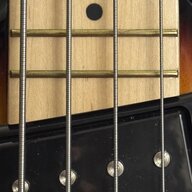
Got it! It's beautiful and plays great. I'm not after the Sandman sound. I just wanted a two-string bass since I play mostly on the E/A strings anyway. I will replace the round wounds with flats, but otherwise I love it. It came in a nice gig bag too.
Attachments



Dang. These were 499 when they first got announced. Already bumped up to 699.
For that money, I could easily pick up an old Framus (they have a neck that's about the size of a broomstick, and a really tight squeeze as a four-stringer), and convert it to two strings - would look cooler too.

My Sandman arrived on Friday and I was hard pressed to put it down all weekend. In the previous decades I've been through at least 3 basses I've stripped down to 2 string as well as 2 more I purchased from Krappyguitars.com. Most recently prior to this Eastwood I purchased the Waterstone Sandman bass and thought it was a keeper. I am thrilled to say that this Eastwood Sandman 2 string is without a doubt the best instrument I've rubbed a slide across.
When I ordered from Eastwood I made contact with one of their sales reps to request a couple simple customizations. For a modest $35 fee they replaced the nut with a 2mm taller piece and sanded the 2 center slots for D and G strings. They also strung the bass with a pair of flatwounds, specifically the D&G string as requested. They did not proactively adjust the neck relief or intonation for the increased tension of tuning the G up to A. No worries, I let the neck get settled with the tuning and made the necessary adjustments yesterday. This thing f'n rips.
The physical build is great. I didn't expect a gig bag to come with it as it wasn't listed in the sale, so this was a pleasant surprise. Though the gigbag is rather light on padding and I doubt I'll trust it to be all that protective.
For these last couple of days I've been running the bass through a MarkBass TTE500 with the gain up and master down. All of my tonal boxes are checked. The only things I have yet to test with this bass are how my effects sound and what my normal gigging amp sounds like with it. I generally don't play slide bass on most gigs - these are mostly for my own joy and entertainment, but i'll likely be taking this out to play at least 1 number on it this coming weekend.
I'll get some video of the bass when time allows (and when I get my studio cleaned up enough to be seen online). Anyone on the fence about these can be assured - they are fabulous basses. BUT no royalties were shared with Mark Sandman's estate. Maybe all of us buying these could donate a little to make up for that.
When I ordered from Eastwood I made contact with one of their sales reps to request a couple simple customizations. For a modest $35 fee they replaced the nut with a 2mm taller piece and sanded the 2 center slots for D and G strings. They also strung the bass with a pair of flatwounds, specifically the D&G string as requested. They did not proactively adjust the neck relief or intonation for the increased tension of tuning the G up to A. No worries, I let the neck get settled with the tuning and made the necessary adjustments yesterday. This thing f'n rips.
The physical build is great. I didn't expect a gig bag to come with it as it wasn't listed in the sale, so this was a pleasant surprise. Though the gigbag is rather light on padding and I doubt I'll trust it to be all that protective.
For these last couple of days I've been running the bass through a MarkBass TTE500 with the gain up and master down. All of my tonal boxes are checked. The only things I have yet to test with this bass are how my effects sound and what my normal gigging amp sounds like with it. I generally don't play slide bass on most gigs - these are mostly for my own joy and entertainment, but i'll likely be taking this out to play at least 1 number on it this coming weekend.
I'll get some video of the bass when time allows (and when I get my studio cleaned up enough to be seen online). Anyone on the fence about these can be assured - they are fabulous basses. BUT no royalties were shared with Mark Sandman's estate. Maybe all of us buying these could donate a little to make up for that.

I don't think I'd ever purchase anything like this, as some others said, I'd probably rather take Sandman's own approach and DIY something for that purpose. I do love that this simply exists as a production instrument though, as a tribute to the legacy and impact of Sandman and his playing in Morphine, and also as just something very different from the norm.


