
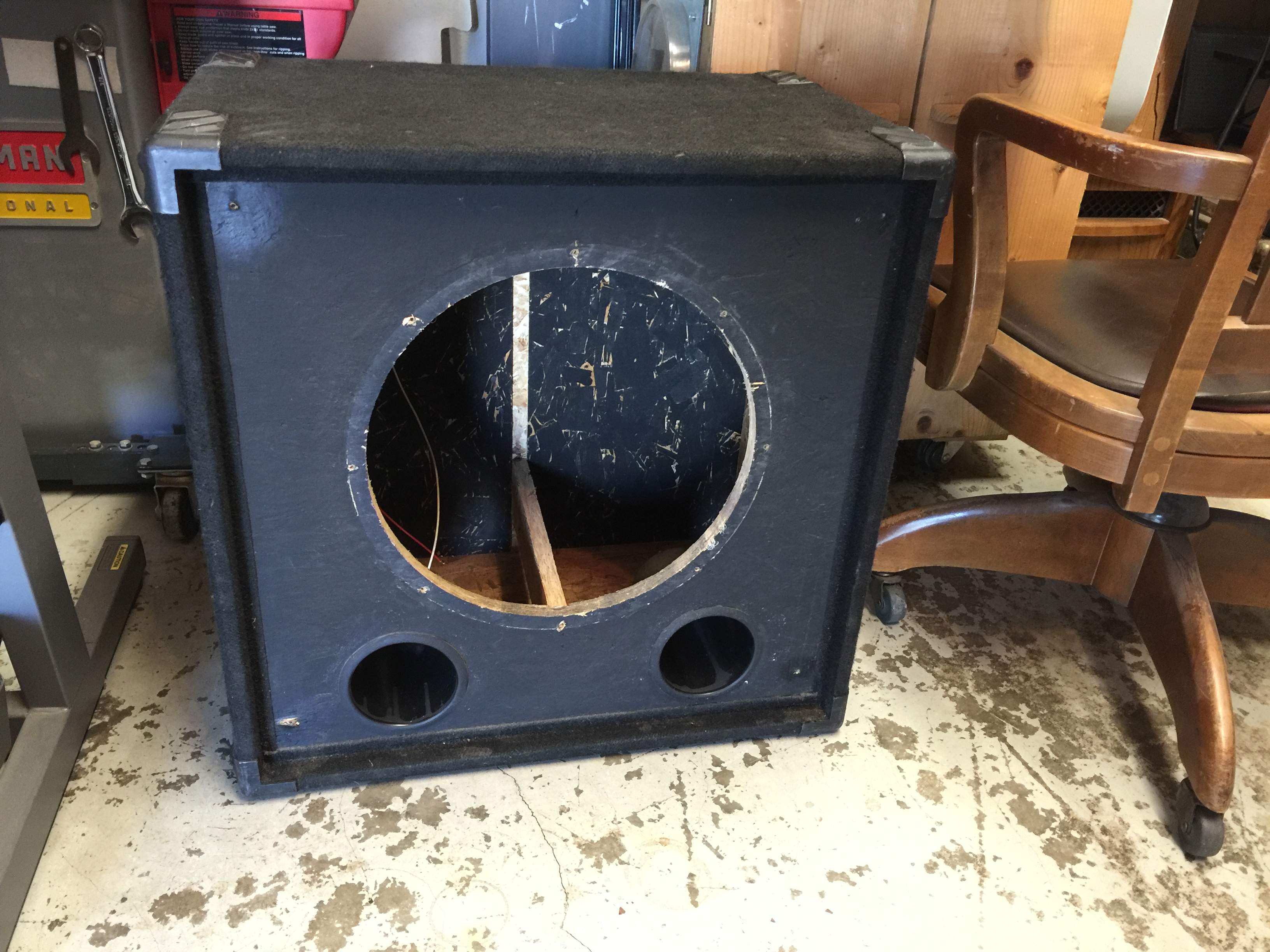
I have recently acquired a pair if EV 15B speakers and would like to try them out in a couple of empty hartke transporter cabs that I have but the existing hole is too small for the EVs. Looks like they require a 13 7/8 cut out and the existing hole is ~13 3/4. What is the best way to enlarge the cutout? Just sanding? Any recommendations from someone who has done this? Thanks


Enjoy the benefits of a premium membership!
Upgrade Account
-
TalkBass has been independent since 1998. Add your voice.
Create a free account to reply to discussions, view embedded media, and browse with fewer display ads.
Join free Log in
Want zero display ads or expanded classifieds tools? Compare plans.
You are using an out of date browser. It may not display this or other websites correctly.
You should upgrade or use an alternative browser.
You should upgrade or use an alternative browser.
Enlarging Speaker Hole
- Thread starter gregmari
- Start date
More options
Who Replied?
Before you going into irreversible modifications have you verified that the EVs will actually work well with the enclosure size and existing porting? Slapping good drivers into a poorly matching box is a good way to damage them - permanently!


I have had good luck by simply taking a bit out of the front edge of the hole with some coarse sandpaper to get an EVMB to fit flush. In my experience, you don't need to take the whole hole out to the larger diameter. Hope that helps

I have done this a time or two... with somewhat qualified success. If the baffle board is plywood, it's next to impossible to do it with sanding. I used a rotary rasp, about 3 or 4 inches in diameter, chucked into a variable speed drill. I got it done eventually, but in retrospect I decided it was more work than it was worth. If I had to do it again, I'd probably try to figure out a way to use the same template-and-router technique that I use to make speaker cut-outs in new work. I'm imagining that sanding or using a rotary rasp would be a more reasonable approach if the baffle board is MDF.
In another thread, a poster mentioned that he had had success just rounding over or chamfering the front edge of the opening all the way around. I haven't tried that yet, but my memory is that might well have worked in my case as well. In his instance, as well as my previous encounters, we were trying to enlarge the cut-outs to accommodate EV drivers.
Somewhere on-line (sorry, I don't know where) I ran across a speaker parts supplier that sold some "speaker adaptor ring" thingies that might offer an easy solution if you can handle the extra 3/4" it adds to the height of the speaker above the baffle board.
Good luck with your project.
Edit: I see BasturdBlaster weighed in with the same solution of just rounding off the edge. I bet that might work.
In another thread, a poster mentioned that he had had success just rounding over or chamfering the front edge of the opening all the way around. I haven't tried that yet, but my memory is that might well have worked in my case as well. In his instance, as well as my previous encounters, we were trying to enlarge the cut-outs to accommodate EV drivers.
Somewhere on-line (sorry, I don't know where) I ran across a speaker parts supplier that sold some "speaker adaptor ring" thingies that might offer an easy solution if you can handle the extra 3/4" it adds to the height of the speaker above the baffle board.
Good luck with your project.
Edit: I see BasturdBlaster weighed in with the same solution of just rounding off the edge. I bet that might work.


First find out if the EV's will work to your satisfaction in those cabs. Just go ahead and mount them. Most likely they will seal (but stand out a little), but add a little caulking, and then try one out. Don't bypass this step just because these are legendary drivers. Their tone is not legendary in just any cab. Like any driver, a cab is required that is more or less optimized for the driver (and the tone you want).
If you are pleased with the result, use a big sharpie and make a line around the existing cutout. Then use a rasp file (or drum sanding attachment with 60 grit paper) to bevel the cutout edge at (more or less) 45 degrees. Remove enough material to remove the sharpie line. The driver should fit or come close. Keep at it, a little at a time, until the driver slips right in.
If you are pleased with the result, use a big sharpie and make a line around the existing cutout. Then use a rasp file (or drum sanding attachment with 60 grit paper) to bevel the cutout edge at (more or less) 45 degrees. Remove enough material to remove the sharpie line. The driver should fit or come close. Keep at it, a little at a time, until the driver slips right in.
One can also get a rough idea of how the replacement driver will perform by mounting it on the outside of the box pointing inward. The only difference is the volume the driver displaces is not in the box, but that's a relatively small variable. I tend to agree that swapping drivers randomly in bass reflex enclosures is not a path to success, but this box looks like a blank slate...plenty of internal volume and two round ducts. It would be easy to tune this box to whatever new response curve is desired.

A router with the correct bit would be the easiest.

Hi gregmari, ….
I can tell you how to get a bigger hole with a router but...
ask an expert!
Sometimes I love Paul!
may the bass be with you
Wise(b)ass
….I can tell you how to get a bigger hole with a router but...
would like to try them out
sanding?
ask an expert!
Slapping good drivers into a poorly matching box is a good way to damage them - permanently!
Sometimes I love Paul!
may the bass be with you
Wise(b)ass

- Feb 12, 2006
- 61,019
- 5
- 220,879
- Disclosures
- Development Engineer-Mesa Boogie, Development Engineer-Genzler (pedals), Product Support-Genz Benz
A router with the correct bit would be the easiest.
Except that most routers won't fit the baffle setback into the cabinet.
Rotary rasp (or drum sander with 50-60 grit) and chamfer the top edge all the way around at about a 30 degree angle from vertical.
Be sure the drivers will work well BEFORE doing this modification, it's rather irreversible and the math is a lot easier to do than finding out that it's not a great match with the cabinet.
- Feb 12, 2006
- 61,019
- 5
- 220,879
- Disclosures
- Development Engineer-Mesa Boogie, Development Engineer-Genzler (pedals), Product Support-Genz Benz
Dimensions of ports...? They are not only for looks.
Ive done this more than once, it doesnt need nearly as much clearence as you think.
Drop the driver in the hole as is and you will see that the distance to make it flush is much less than the thickness of the baffle.
A rasp would likely be the best tool but I've easily done it with coarse sandpaper on a sanding block, it literally only took a few minutes.
Drop the driver in the hole as is and you will see that the distance to make it flush is much less than the thickness of the baffle.
A rasp would likely be the best tool but I've easily done it with coarse sandpaper on a sanding block, it literally only took a few minutes.

A router with the correct bit would be the easiest.
And cut a circle template out of mdf. Lay this on top of the existing hole and use a bearing guided bit to follow the template. If the MDF isn't thick enough to extend pass the baffle set back, make a template of the template and stack them up.
I'd also add that sure just shoving a "speaker in a box" isn't the best way to go. It won't hurt to try to get it right. You may not be getting the "most" out of the drivers but it may be worth a try.

Sometimes I love Paul!
Especially when he's behaving, usually that's when he's asleep!Only sometimes???

Common for EV speakers, or the ones I've owned. A rasp works fairly well.I have recently acquired a pair if EV 15B speakers and would like to try them out in a couple of empty hartke transporter cabs that I have but the existing hole is too small for the EVs. Looks like they require a 13 7/8 cut out and the existing hole is ~13 3/4. What is the best way to enlarge the cutout? Just sanding? Any recommendations from someone who has done this? Thanks
View attachment 3244341 View attachment 3244349
I've loved every EV speaker I've owned once they were in a properly tuned cabinet. I think it's the natural midrange that seems to be inherent in the EV 15's I've messed with. If you can get each of those installed in their own properly ported cab where they can be stacked, and apply plenty of clean power, you will probably like them a lot.
Last edited:
- Feb 12, 2006
- 61,019
- 5
- 220,879
- Disclosures
- Development Engineer-Mesa Boogie, Development Engineer-Genzler (pedals), Product Support-Genz Benz
A half-round rasp will work, in all cases a shop vac cleanup is needed.
Dimensions of ports...? They are not only for looks.
The port tubes are 4" diameter and 5" long.

I had to do this once. Drill with a drum sander bit, round and round against the rotation in the hole.
Done.
Done.


