

Enjoy the benefits of a premium membership!
Upgrade Account
-
TalkBass has been independent since 1998. Add your voice.
Create a free account to reply to discussions, view embedded media, and browse with fewer display ads.
Join free Log in
Want zero display ads or expanded classifieds tools? Compare plans.
You are using an out of date browser. It may not display this or other websites correctly.
You should upgrade or use an alternative browser.
You should upgrade or use an alternative browser.
Estate Auction Basses
- Thread starter lucyfur
- Start date
More options
Who Replied?
that fender looks like a good idea, i doubt you'll get a total steal since it's a fender, pretty well known valuable item. who knows though. goood luck.



These 2 basses are coming up at an estate auction near me. I have no idea what brand the semi-hollow is. As for the Jazz bass, does it look like it could be ‘65 or ‘66? It appears it has the bound fretboard with dots, and lollipop tuners. It’s not available to inspect until the day of the auction. The photos aren’t the best but any comments would be appreciated.
Judging by the preponderance of the evidence we can see here, the Jazz Bass is very likely a '66 considering the combination of dot markers, neck binding, lollipop tuning machines, and the style of the Fender decal.
More about the clues: The dot makers suggest that the likely date when the neck was produced leans more toward '65/early to mid '66, but the lollipop tuners came in '66. The decal design would suggest as late as early '67 but not a '68.
[Invalid or Expired Link Removed] very much like that one.
I'm at least 90% sure it's a '66, if it's a legitimate Fender, which it very much looks to be to me.
Last edited:

I'm now rusty on my 1966 J Bass history so please don't quote me on this...........................
There were mulitple variations of the J Bass in 1966.
One was made pretty much like the pre-CBS, Kluson reverse tuners, dot fretboard, no binding.
Then there was binding with dots.
Binding with square markers.
Lollipop tuners
Fender in house made tuners.
1966 was a strange year for the Jazz Bass.
There were mulitple variations of the J Bass in 1966.
One was made pretty much like the pre-CBS, Kluson reverse tuners, dot fretboard, no binding.
Then there was binding with dots.
Binding with square markers.
Lollipop tuners
Fender in house made tuners.
1966 was a strange year for the Jazz Bass.


I didn’t notice this amp the first time I looked at the pictures. I’m not an Ampeg guy so don’t know if this is desirable or not. At least maybe I can plug the basses into it to see if they work.
Attachments
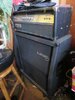



Desirable. The SVT is Ampeg's flagship. The V-4B would be their #2.I didn’t notice this amp the first time I looked at the pictures. I’m not an Ampeg guy so don’t know if this is desirable or not. At least maybe I can plug the basses into it to see if they work.

I'm now rusty on my 1966 J Bass history so please don't quote me on this...........................
There were mulitple variations of the J Bass in 1966.
One was made pretty much like the pre-CBS, Kluson reverse tuners, dot fretboard, no binding.
Then there was binding with dots.
Binding with square markers.
Lollipop tuners
Fender in house made tuners.
1966 was a strange year for the Jazz Bass.
Accurate though I've only seen lollipops on '66s (that were not changed). I have seen multiple late '65s with them. Have seen '66s in 3 versions:
dots without binding (with lollipops - not many without binding as I've see JAN 66 stamped necks both bound and unbound - even saw one oddball that was unbound but had the binding channel routed at the butt end only).
Dots, binding, lollipops with neck stamps running from January through approximately July. While they didn't make them in this combo long it seems like they made a lot of them (reportedly CBS was pushing Fender to target making 10,000 instruments overall PER MONTH). Conversely, '67 Js are scarce - I've assumed due to possible overproduction in '66 but that's just a guess.
Blocks, binding and lollipops in the second half of the year. I'd note that having worked in a repair shop that on a number of the early block markers ones with thinner profile the necks tended to crook up - much like the infamous upper register ski jump - around the first or second fret.
I've not seen the inhouse elephant ear/cloverleaf tuners in '66, but not impossible.
Judging by the preponderance of the evidence we can see here, the Jazz Bass is very likely a '66 considering the combination of dot markers, neck binding, lollipop tuning machines, and the style of the Fender decal.
More about the clues: The dot makers suggest that the likely date when the neck was produced leans more toward '65/early to mid '66, but the lollipop tuners came in '66. The decal design would suggest as late as early '67 but not a '68.
[Invalid or Expired Link Removed] very much like that one.
I'm at least 90% sure it's a '66, if it's a legitimate Fender, which it very much looks to be to me.
Lollipops were definitely being used on Js by late '65. Agree with all else. Pretty much certainly an early/first half of '66 (assuming not recombined parts, etc).
I have seen unbound '66s (all with January stamps) but never a bound '65 (though test examples could be possible).


Looks good. Good luck on it!
Everything looks right to me. Of course, can't know if pickups or pots have been changed, etc - but not seeing any red flags. I'd bid pretty strong on it if I was there and it felt and played right.
Everything looks right to me. Of course, can't know if pickups or pots have been changed, etc - but not seeing any red flags. I'd bid pretty strong on it if I was there and it felt and played right.
Last edited:


I’ll dissent on the hollowbody. The headstock looks like a Musima from East Germany however that appears to be a Guild bridge and possibly some version of Darkstar pickups which, if correct, makes the pickups worth something.
Musima Hollow Body Bass | Reverb
My exact thoughts on the pickups and bridge. The pickups are worth some $$ as parts.

My exact thoughts on the pickups and bridge. The pickups are worth some $$ as parts.
Yeah, a couple more people have said Starfire and, while I’m sure there is, I can’t think of a good reason to alter a Guild headstock like that. However, if you got a hold of a “good ‘un” I can think of good reason to install some great pickups on a decent German bass.
The Jazz ended up selling for $6160. It included an original case that was barely in one piece, definitely not something that is usable. I checked inside for the missing covers but they weren’t there. The “Guild” ended up going for $200. I didn’t hang around to see what the Ampeg amp went for, as it was probably going to be at least another hour before they got to it, and I wanted to get to my grandsons baseball game.
The Jazz ended up selling for $6160. It included an original case that was barely in one piece, definitely not something that is usable. I checked inside for the missing covers but they weren’t there. The “Guild” ended up going for $200. I didn’t hang around to see what the Ampeg amp went for, as it was probably going to be at least another hour before they got to it, and I wanted to get to my grandsons baseball game.
I was thinking $6-6.5K on the Jazz. Low enough to still be ok if discovering non original pickups or similar. Good deal if straight.
I was thinking $6-6.5K on the Jazz. Low enough to still be ok if discovering non original pickups or similar. Good deal if straight.
Perhaps still a good deal, but unfortunately outside of my budget.


