
I'd be afraid of checkered binding. Probably lay awake at night waiting for John Hall and his minions of legal beagles to line up and extract their pound of flesh.

TalkBass has been independent since 1998. Add your voice.
Create a free account to reply to discussions, view embedded media, and browse with fewer display ads.
Join free Log in
Want zero display ads or expanded classifieds tools? Compare plans.

I'd be afraid of checkered binding. Probably lay awake at night waiting for John Hall and his minions of legal beagles to line up and extract their pound of flesh.
 ...that too!
This forum has turned me from painting switches white with a brush, to full on clean mods, repairs, and setups. Just another facet of playing an instrument that makes it impossible to give up.I love the checkered binding on Rics - it's not on all of them but is part of its iconic look. As the maple character on my UEB thing is so outstanding, I feel a simple (black or creme) would better harmonize with it visually. (as in, wouldn't compete with more visual 'chatter') Works great in your posted pic because the wood is pretty subdued/neutral in character. Thanks as always for your interest and input - you are part of what makes our little corner special!
I'm voting for simple black binding against that top. If you wanted to get fancy because you're a glutton for punishment, maybe a dark dyed flame maple binding? But it's gonna be hard to look better than black.
Another vote here for black binding, better to tie in with the hardware and the grain.

Your EUB is looking fantastic!A very cool EUB from 1939 (! - a Ric maybe judging by the pu) posted ion a concurrent tread by @swarfrat - I like the simplicity of the angled P-like pu's. Food for thought.

Your EUB is looking fantastic!
As for the Rickenbacker: Cool indeed! I looked it up and from this Wiki:
Rickenbacker electric upright bass (1935), Amplifier (mid 1930s), Console piano, Museum of Making Music
“The Rickenbacker Bass, 1935. Rickenbacker's George Beauchamp thought acoustic sound chambers were unnecessary. This upright magnetic horseshoe up is split into two section to accommodate the curvature of the fingerboard. In order for the pickup to function properly, the gut strings are wrapped with a fine ferrous or steel wire, that can be magnetized when strings pass between the magnet and the coils.”
Also, from this Invalid Link Removed on George Beauchamp:
He was born in Coleman County, Texas on March 18, 1899. Beauchamp performed in Vaudeville, playing the violin and the lap steel guitar, before he settled in Los Angeles, California. During the 1920s, he experimented with the creation of electric lap steel guitars, electric guitars, electric bass guitars, electric violins, and instrument amplifiers. In 1931 he joined with Paul Barth and Adolph Rickenbacker to form the Ro-Pat-In Corporation to produce and sell electrified string instruments. In 1937 Beauchamp secured a United States patent for the electric guitar.
He died of a heart attack in 1941 while deep-sea fishing near Los Angeles. He was survived by his wife, Myrtle, and two children, Frances and Nolan.
Nice touch inlaying the jack plate - I've always wanted to inlay the bridge (for a hardtail) or trem cover (for a tremolo model) guitar.
Oh yeah, that would be sweet...The same design comes in carbon fiber ($$)
Oh yeah, that would be sweet...
While I'm spending your money, what are you going to do about a case?

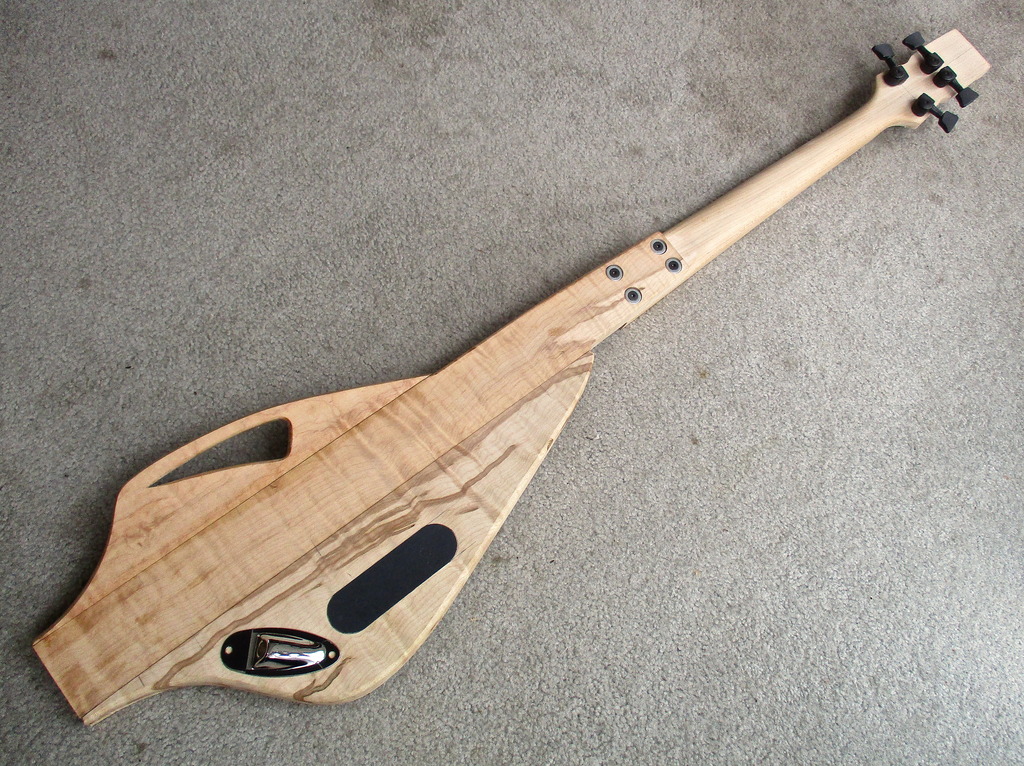
I'm glad I didn't attach the other wing as I will first need to do some routing on the back of that loose piece for controls and jack. I will use a (black) Strat-jack boat inverted which will put the plug at a shallow angle below the top. I'll need to open the hole up for a barrel-jack, but I've determined it's do-able.

A very cool EUB from 1939 (! - a Ric maybe judging by the pu) posted ion a concurrent tread by @swarfrat - I like the simplicity of the angled P-like pu's. Food for thought.


